


























Views
Downloads

Essential Helping Verbs Worksheet | Grade 3 Printable
Paste this activity's link or code into your existing LMS (Google Classroom, Canvas, Teams, Schoology, Moodle, etc.).
Students can open and work on the activity right away, with no student login required.
You'll still be able to track student progress and results from your teacher account.
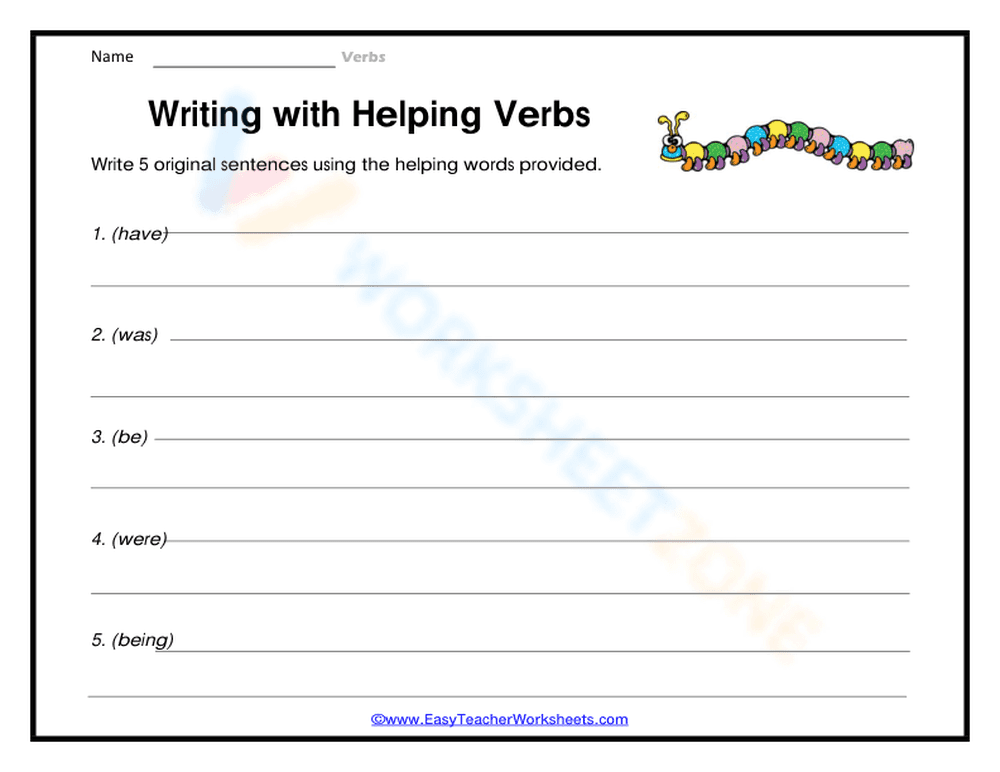
This essential Grade 3 helping verbs worksheet provides students with targeted practice in constructing original sentences using specific auxiliary verbs. By focusing on five core helping words, students learn to extend the meaning of main verbs and demonstrate mastery of complex sentence structures. This resource ensures students can apply grammatical rules in their own creative writing.
At a Glance
- Grade: 3 · Subject: English Language Arts
- Standard:
CCSS.ELA-LITERACY.L.3.1.e— Form and use the simple verb tenses including helping verbs- Skill Focus: Helping Verb Sentence Construction
- Format: 1 page · 5 problems · Answer key included · PDF
- Best For: Grammar reinforcement and sentence writing practice
- Time: 10–15 minutes
What's Inside
This single-page PDF features five structured tasks designed to build confidence in using auxiliary verbs correctly. Students are prompted to write one original sentence for each of the following words: have, was, be, were, and being. The clean layout provides ample writing space for Grade 3 handwriting, and a sample answer key is provided to guide evaluation.
Zero-Prep Workflow
- Print: Generate the single-page document in under 30 seconds.
- Distribute: Hand out the worksheets during your grammar block or as a quick transition activity.
- Review: Evaluate student sentences using the provided sample key or through a peer-review session. Total teacher preparation time is under two minutes.
Standards Alignment
This worksheet aligns with `CCSS.ELA-LITERACY.L.3.1.e`, which requires students to form and use the simple verb tenses in their writing. Specifically, it targets the use of helping verbs to indicate time and condition. This standard code can be copied directly into lesson plans, IEP goals, or district curriculum mapping tools to document evidence of student learning.
How to Use It
Use this worksheet as a formative assessment immediately following a direct instruction lesson on helping verbs. As students work, circulate through the room to observe if they are including both the helping verb and a main verb in their sentences. It also serves as an excellent bell-ringer activity or a reliable addition to an emergency sub-plan folder.
Who It's For
This activity is ideal for third-grade students mastering basic sentence mechanics and second-grade students ready for extension work. It provides necessary scaffolding for English Language Learners by isolating specific vocabulary words within a familiar sentence-writing framework. Pair this with a helping verb anchor chart or a short reading passage to reinforce the concept.
According to the Fisher & Frey (2014) model of gradual release of responsibility, structured practice in sentence construction is a critical bridge between guided instruction and independent application. This worksheet targets CCSS.ELA-LITERACY.L.3.1.e by requiring students to synthesize their understanding of helping verbs within their own original prose. Research suggests that when students generate their own sentences using specific linguistic constraints, they develop deeper syntactical awareness and better retention of grammatical rules. This resource provides the necessary structure for students to demonstrate mastery of the helping verb skill in a classroom-ready format. By focusing on five high-frequency auxiliary words, the worksheet ensures that students build a strong foundation for more complex verb tense usage. It is a proven tool for reinforcing essential ELA standards through active production.


