


























Views
Downloads
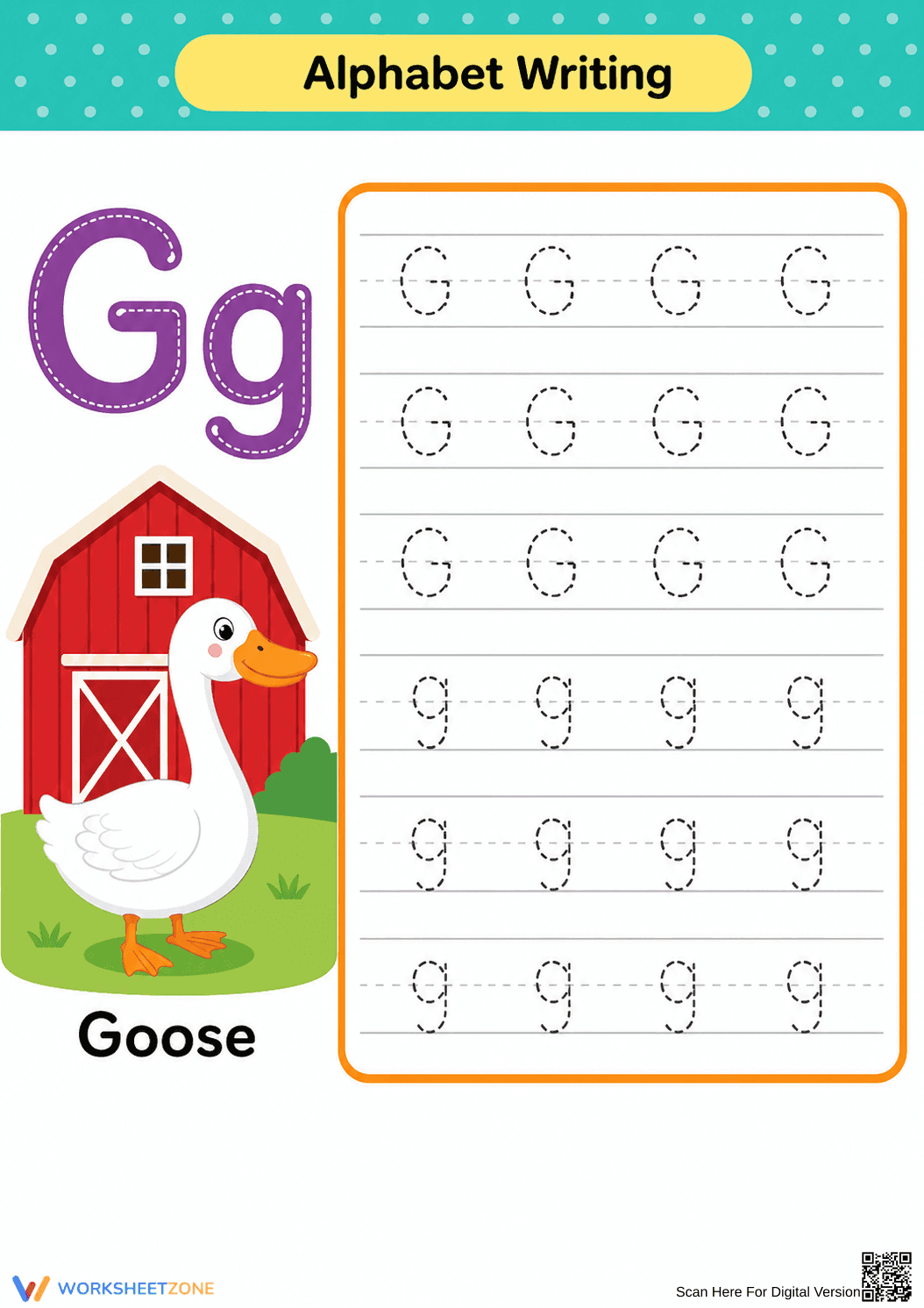

Essential Letter G Writing Worksheet | Kindergarten Phonics
Paste this activity's link or code into your existing LMS (Google Classroom, Canvas, Teams, Schoology, Moodle, etc.).
Students can open and work on the activity right away, with no student login required.
You'll still be able to track student progress and results from your teacher account.
This Kindergarten Letter G writing worksheet provides students with 24 structured tracing opportunities to master uppercase and lowercase letter formation. By combining tactile handwriting practice with visual phonics cues, learners develop the fine motor control and letter-sound correspondence necessary for early literacy success. Students will trace the letter G while associating it with the goose beginning sound.
At a Glance
- Grade: Kindergarten · Subject: ELA Phonics
- Standard:
CCSS.ELA-LITERACY.L.K.1.A— Print many upper- and lowercase letters accurately on primary lines- Skill Focus: Letter G formation
- Format: 1 page · 24 problems · Answer key included · PDF
- Best For: Independent morning work or literacy centers
- Time: 10–15 minutes
What's Inside: This single-page PDF features 12 uppercase G tracing guides and 12 lowercase g tracing guides. Each letter is placed on standard primary dotted lines to ensure proper height and placement. A large, colorful illustration of a goose serves as a phonemic anchor, helping students connect the grapheme to its phoneme while they practice their handwriting skills.
Zero-Prep Workflow
- Print: Select the single-page PDF and print enough copies for your class in under 30 seconds.
- Distribute: Hand out the sheets during morning work or literacy rotations to get students started immediately.
- Review: Walk around to check for proper pencil grip and stroke order as students complete the 24 tasks.
Total teacher prep time is under 2 minutes, making this an ideal resource for sub plans or busy classroom mornings.
Standards Alignment
This worksheet aligns with CCSS.ELA-LITERACY.L.K.1.A: "Print many upper- and lowercase letters." This resource specifically targets the letter G, ensuring students can distinguish between the circular stroke of the uppercase version and the hooked tail of the lowercase version. Both standard codes can be copied directly into lesson plans, IEP goals, or district curriculum mapping tools.
How to Use It
Use this worksheet during the independent practice phase of a gradual release lesson on the letter G. It is ideal for literacy centers where students can work quietly while the teacher conducts small-group reading. For a formative assessment, observe if students start their strokes at the top of the line or if they struggle with the lowercase descender. Expected completion time is 10 to 15 minutes.
Who It's For
This resource is designed for Kindergarten students, Grade 1 learners needing remediation, and English Language Learners building foundational vocabulary. It pairs perfectly with an alphabet anchor chart or a beginning sounds picture sort activity to reinforce phonemic awareness alongside handwriting. The clear visual cues support students with varying fine motor abilities.
According to Fisher & Frey (2014), the integration of handwriting and phonics is a critical component of the gradual release of responsibility model in early childhood education. This worksheet aligns with CCSS.ELA-LITERACY.L.K.1.A by providing explicit, repetitive practice for the letter G, which is essential for developing automaticity in writing. Research indicates that students who master letter formation early are better equipped to focus on higher-order composition tasks later in their academic careers. By utilizing 24 specific tracing tasks, this resource ensures that students receive the high-frequency exposure required to move from guided tracing to independent production. The inclusion of a visual anchor like the goose supports phonological processing, a key predictor of reading fluency. This evidence-based approach to literacy instruction provides a reliable tool for educators seeking to meet foundational standards through structured, no-prep practice.


