


























Views
Downloads

Essential Bossy R Words Worksheet | Grade 1-2 Aligned
Paste this activity's link or code into your existing LMS (Google Classroom, Canvas, Teams, Schoology, Moodle, etc.).
Students can open and work on the activity right away, with no student login required.
You'll still be able to track student progress and results from your teacher account.
Mastering r-controlled vowels, often called "Bossy R," is a pivotal milestone in early literacy. This phonics worksheet provides Grade 1 and Grade 2 students with focused practice identifying and writing words containing "ar," "er," "ir," "or," and "ur" patterns. By connecting visual cues to written language, learners solidify their decoding and spelling accuracy.
At a Glance
- Grade: 1-2 · Subject: ELA Phonics
- Standard:
CCSS.ELA-LITERACY.RF.1.3— Decode words with r-controlled vowels and identify common spelling-sound correspondences- Skill Focus: R-controlled Vowels (Bossy R)
- Format: 2 pages · 8 problems · Answer key included · PDF
- Best For: Phonics centers and independent practice
- Time: 10–15 minutes
What's Inside
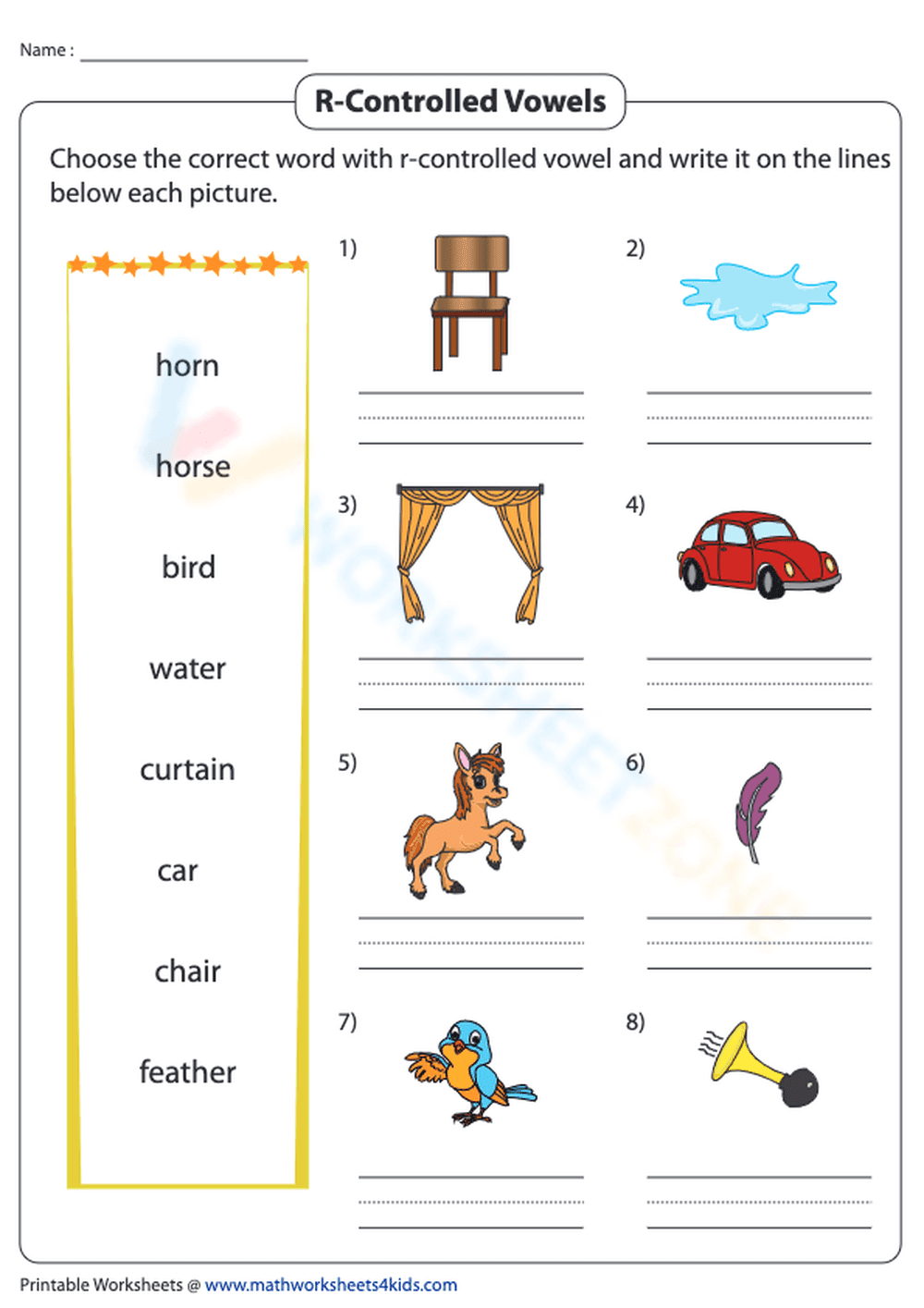
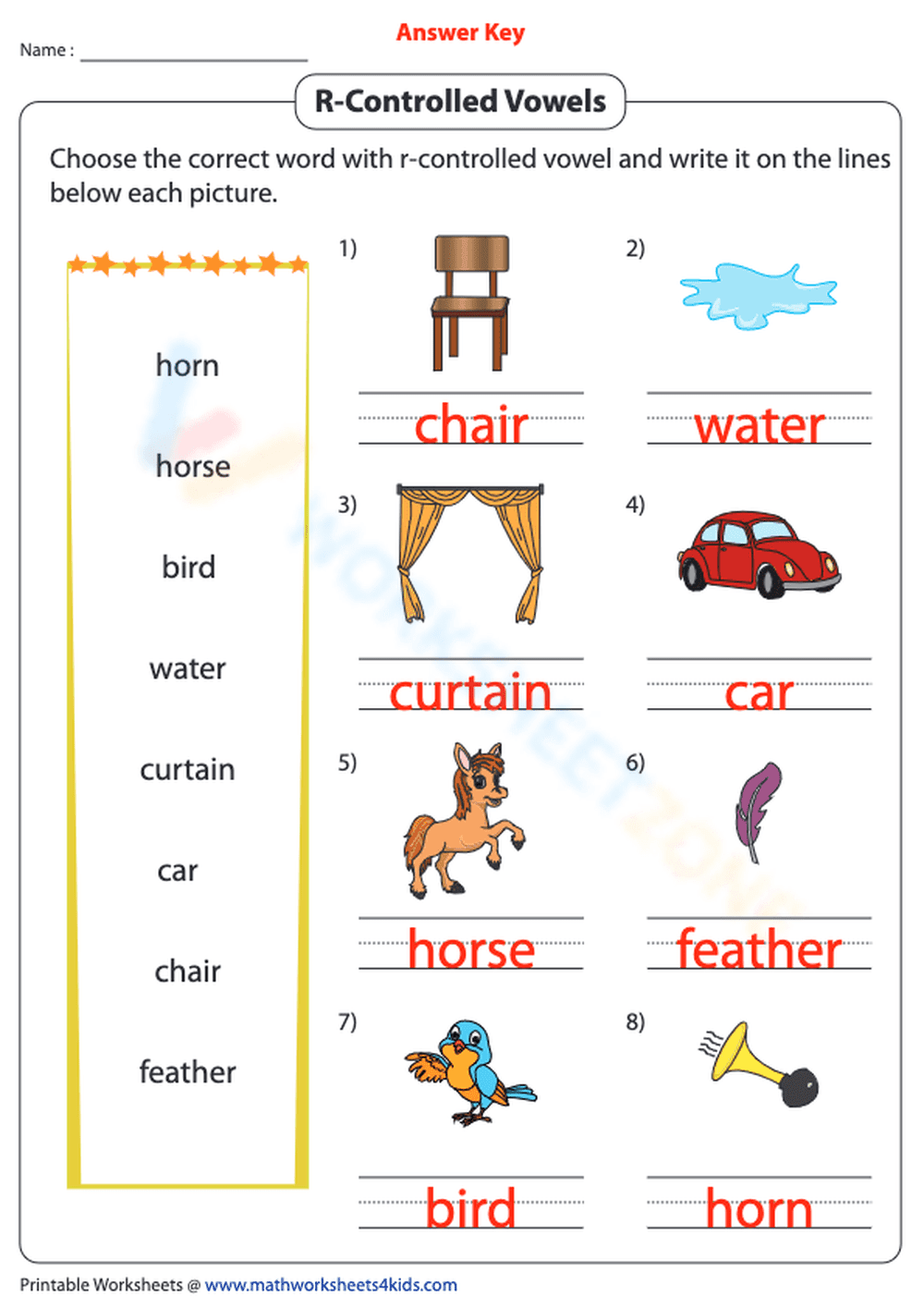
This two-page PDF resource includes a primary worksheet and a corresponding answer key. The activity features eight high-quality illustrations representing common r-controlled vowel words such as "horn," "horse," "bird," and "water." A convenient word bank at the left margin provides structural support, helping students select the correct term to label each picture on primary-ruled lines.
Zero-Prep Workflow
This resource is designed for immediate classroom implementation with a total teacher prep time of under 60 seconds. Simply print the single-page activity and distribute it to your students. Because the word bank and visual cues make the instructions self-explanatory, it serves as an ideal emergency sub-plan or a transition activity between literacy blocks. No additional teacher setup or materials are required.
Standards Alignment
This worksheet is aligned to CCSS.ELA-LITERACY.RF.1.3, which requires students to know and apply grade-level phonics and word analysis skills in decoding words. Specifically, it targets the ability to recognize vowel-r combinations as a single phonemic unit. This standard code can be copied directly into lesson plans, IEP goals, or district curriculum mapping tools for easy reporting.
How to Use It
Incorporate this worksheet during the "Independent Practice" phase of a phonics lesson after introducing the Bossy R concept. For a formative assessment, observe students as they navigate the word bank; those who struggle to distinguish between "horse" and "horn" may need additional support with ending sounds. Completion typically takes 12 minutes during a literacy center rotation.
Who It's For
This resource is tailored for first and second-grade students, as well as ELL learners who require visual scaffolding to build vocabulary. It pairs naturally with a r-controlled vowel anchor chart or a decodable text focused on nature, providing a cohesive reinforcing loop for struggling readers who need to bridge the gap between sounds and letters.
The systematic instruction of r-controlled vowels, or "Bossy R," is essential for developing orthographic mapping skills in young readers. Research from Fisher & Frey (2014) emphasizes the importance of gradual release models where visual scaffolds, such as the picture-word association found in this worksheet, bridge the gap between phonemic awareness and independent writing. By requiring students to select terms from a word bank and transcribe them onto ruled lines, this activity reinforces the CCSS.ELA-LITERACY.RF.1.3 standard through multisensory engagement. Identifying words like "curtain" and "feather" requires learners to process the r-controlled vowel as a stable unit rather than separate letters. This direct application of phonics rules has been shown in NAEP data to significantly improve fluency and spelling accuracy in the primary grades, ensuring that Grade 1 and Grade 2 students build the necessary foundational strength for reading complex multisyllabic texts.


