


























Views
Downloads

Printable Rhyming Words Worksheet | Grades 1-3 ELA
Paste this activity's link or code into your existing LMS (Google Classroom, Canvas, Teams, Schoology, Moodle, etc.).
Students can open and work on the activity right away, with no student login required.
You'll still be able to track student progress and results from your teacher account.
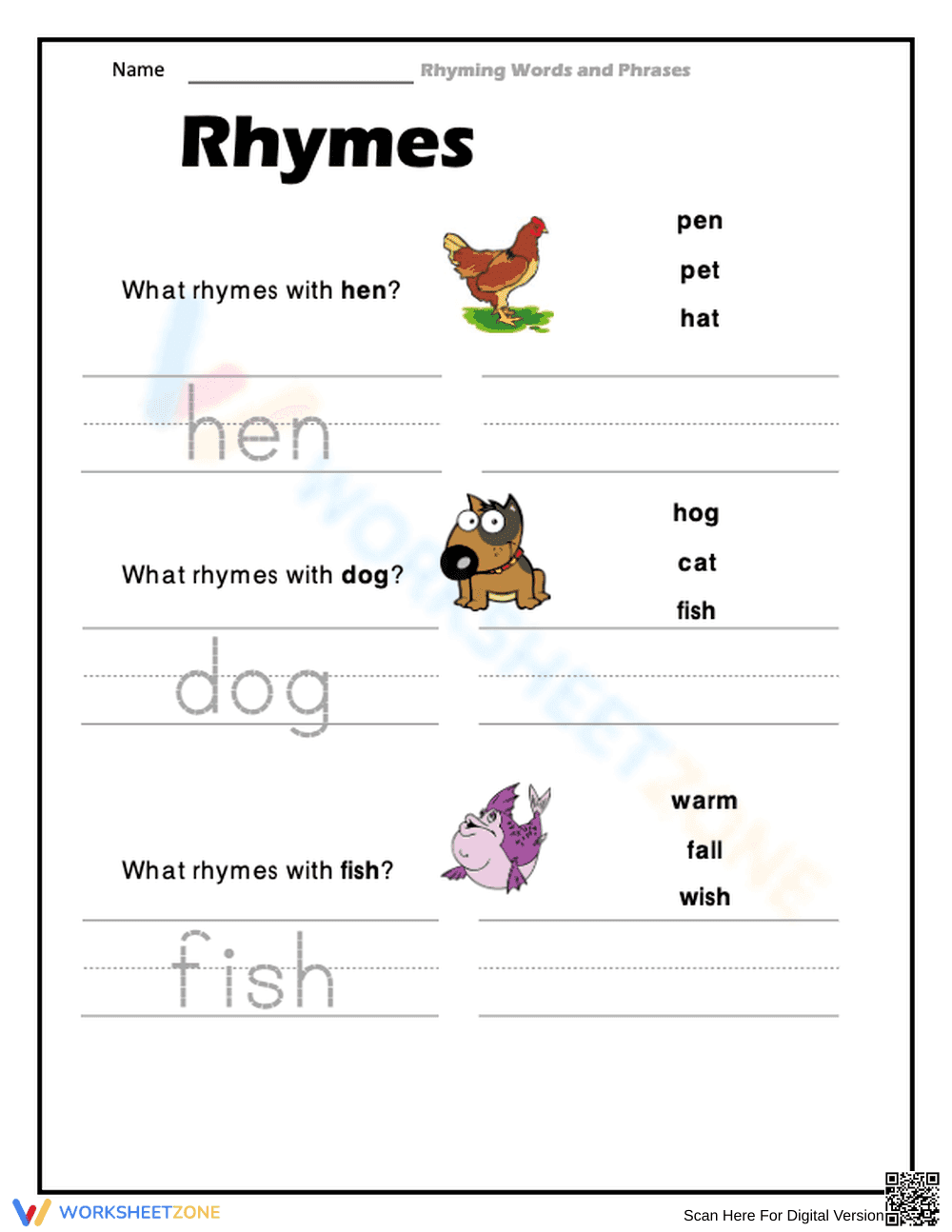
This essential Grade 1-3 rhyming words worksheet helps early learners master phonemic awareness through targeted visual and auditory association. By identifying rhymes for common words like "hen" and "dog," students strengthen foundational literacy skills required for fluent reading. This printable resource bridges the gap between recognizing sounds and producing language.
At a Glance
- Grade: 1–3 · Subject: English Language Arts
- Standard:
CCSS.ELA-LITERACY.RF.K.2.A— Recognize and produce rhyming words to build foundational phonemic awareness- Skill Focus: Rhyme identification and word tracing
- Format: 1 page · 3 tasks · Answer key included · PDF
- Best For: Literacy centers and independent phonics practice
- Time: 10–15 minutes
This single-page PDF includes three phonics modules featuring clear illustrations. Students choose the correct rhyme from a multiple-choice list, discerning which word shares a rime with the stimulus. The worksheet incorporates primary-ruled tracing lines for letter formation practice. A complete answer key is provided to facilitate rapid teacher grading or student self-correction.
This resource is designed for immediate implementation with preparation time under 2 minutes. First, print copies for your group. Second, distribute the worksheets; the intuitive layout ensures students begin with minimal instruction. Third, review responses using the included key for instant formative feedback. Its self-contained nature makes it ideal for emergency sub plans or quick transitions.
The primary alignment is CCSS.ELA-LITERACY.RF.K.2.A, requiring students to recognize and produce rhyming words. This skill is critical for understanding word families. The tracing component supports fine motor development and letter-sound correspondence. These standard codes can be copied directly into lesson plans, IEP goals, or district curriculum mapping tools to ensure benchmark compliance.
Deploy this worksheet during independent practice after introducing word families. It serves as an excellent warm-up for literacy rotations or intervention for students struggling with phonological processing. As a formative tip, observe students as they say words aloud; if they struggle, provide an anchor chart of common word families to scaffold their success.
This resource is tailored for Grade 1-2 students, though it serves as a valuable review for Grade 3 RTI support. It is effective for English Language Learners who benefit from visual cues. Pair this worksheet with a rhyming picture book or digital phonics game to create a comprehensive multi-sensory learning experience.
The CCSS.ELA-LITERACY.RF.K.2.A standard emphasizes phonological awareness as a precursor to reading proficiency. Research from NAEP highlights that students who master rhyming early are more likely to achieve reading fluency by third grade. This worksheet facilitates the recognition and production of rhyming words by leveraging visual stimuli and auditory repetition, which are proven methods for cementing phonetic patterns. By integrating tracing with identification, the resource addresses multiple cognitive pathways, ensuring students hear rhymes and physically engage with word structures. Educators can use this aligned tool to track progress toward literacy milestones and provide data-driven instruction. According to NAEP, systematic phonics instruction combined with structured practice is the most effective way to close achievement gaps. This resource provides the precise, repeatable practice necessary for students to internalize the rhythmic and phonemic structures of the English language.


