




























Views
Downloads

Write and Draw Prompt | Grade 1 Printable

Paste this activity's link or code into your existing LMS (Google Classroom, Canvas, Teams, Schoology, Moodle, etc.).
Students can open and work on the activity right away, with no student login required.
You'll still be able to track student progress and results from your teacher account.
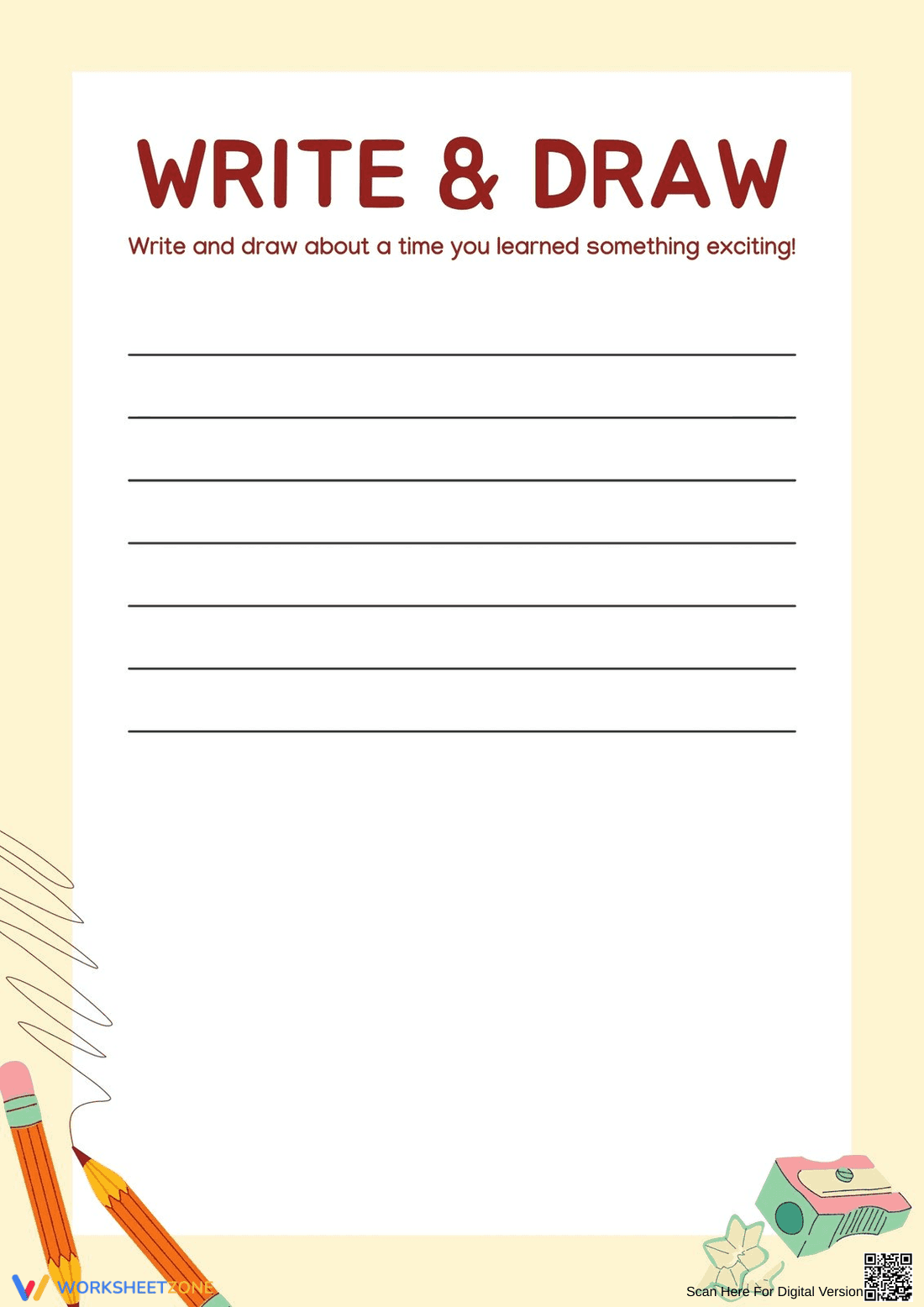
This Grade 1 write and draw worksheet prompts students to recount a personal experience about learning something exciting. By combining illustration with written expression, young learners can organize their thoughts visually before drafting sentences, building foundational narrative writing skills in an engaging, accessible format.
At a Glance
- Grade: 1 · Subject: ELA
- Standard:
CCSS.ELA-LITERACY.W.1.3— Write narratives recounting an event with details- Skill Focus: Narrative Writing & Illustration
- Format: 1 page · 1 prompt · No answer key · PDF
- Best For: Independent practice or morning work
- Time: 15–20 minutes
This single-page resource features a clear writing prompt asking children to describe a time they learned something exciting. The top half provides seven lines for drafting, while the bottom offers a large space for a corresponding illustration. The open-ended design encourages creativity while maintaining structured boundaries, making it ideal for early elementary students.
Zero-Prep Workflow
- Print (1 min): Download the PDF and print a class set.
- Distribute (1 min): Hand out during your writing block. No additional materials required.
- Review (2 mins): Read the prompt aloud and brainstorm examples to activate prior knowledge.
With total prep time under two minutes, this activity is perfect for sub plans or fast finisher bins.
Standards Alignment
This activity aligns with CCSS.ELA-LITERACY.W.1.3, requiring students to write narratives recounting appropriately sequenced events and including details regarding what happened. The drawing component supports early literacy by allowing students to add visual details to their text. Both standard codes can be copied directly into lesson plans, IEP goals, or district curriculum mapping tools.
How to Use It
Deploy this worksheet during independent writing time after a brief mini-lesson on personal narratives. It works exceptionally well as a Monday morning reflection activity where students can write about a weekend experience. As a formative assessment observation tip, watch how students transition between drawing and writing; note whether they use their illustration to generate vocabulary for their sentences. Expected completion time ranges from 15 to 20 minutes, depending on the student's writing fluency.
Who It's For
This resource is designed primarily for Grade 1 students, though it can easily serve as a review for Grade 2 learners or an extension for advanced Kindergarteners. For differentiation, teachers can encourage emerging writers to dictate their story after drawing, while advanced students can be challenged to fill all seven lines with descriptive adjectives. It pairs naturally with a read-aloud of a picture book focused on trying new things or discovering a new hobby.
Integrating drawing into the writing process is a critical scaffold for early elementary students. According to Fisher & Frey (2014), multimodal composition strategies, such as combining illustrations with text, significantly lower the affective filter for young writers and increase overall text production. When students are asked to write narratives recounting an event with details, as outlined in CCSS.ELA-LITERACY.W.1.3, the act of drawing first allows them to visually organize their sequence of events and retrieve specific vocabulary from their working memory. This write and draw prompt leverages that cognitive connection, ensuring that students who may struggle with immediate text generation have a concrete entry point into the assignment. By providing a structured space for both modalities, educators can foster greater independence and confidence in early literacy development, ultimately leading to richer, more detailed personal narratives.


