


























Views
Downloads
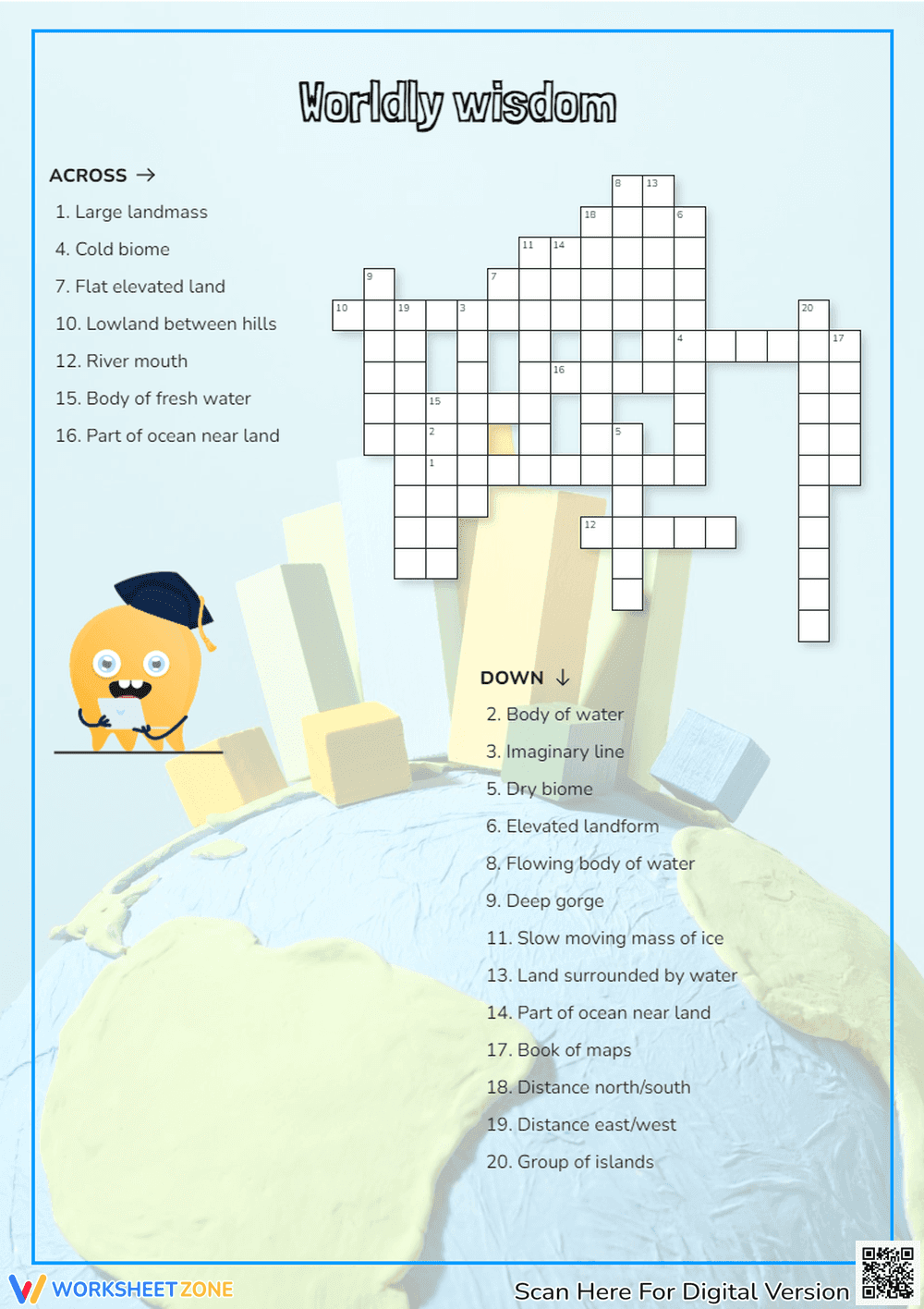

Geography Crossword Worksheet | Grade 3 Printable
Paste this activity's link or code into your existing LMS (Google Classroom, Canvas, Teams, Schoology, Moodle, etc.).
Students can open and work on the activity right away, with no student login required.
You'll still be able to track student progress and results from your teacher account.
This ready-to-use geography crossword puzzle helps students master essential earth science vocabulary. By solving clues related to landforms, biomes, and bodies of water, learners reinforce their understanding of physical geography concepts. The engaging format keeps students focused while building critical academic language skills.
At a Glance
- Grade: 3 · Subject: Earth Science
- Standard:
2-ESS2-2— Identify shapes and kinds of land and water- Skill Focus: Geography vocabulary
- Format: 1 page · 20 problems · Answer key included · PDF
- Best For: Independent practice and review
- Time: 15–20 minutes
This single-page printable features a comprehensive crossword grid with 20 distinct clues divided into across and down sections. Students will read descriptive hints to identify specific geographical features such as a large landmass, a cold biome, and a flowing body of water. The clear layout includes numbered boxes that correspond directly to the provided clues, ensuring a smooth user experience. A complete answer key is provided to facilitate quick grading.
This resource is designed for immediate classroom implementation with a zero-prep workflow:
- Print (1 minute): Simply download the PDF and print the required number of copies. No special formatting is needed.
- Distribute (1 minute): Hand out the puzzle during morning work, science centers, or as an early finisher activity.
- Review (3 minutes): Use the included answer key to quickly check student responses or display it for self-correction.
Total teacher preparation time is under two minutes, making this an ideal, self-explanatory activity for substitute teacher plans.
This activity aligns with 2-ESS2-2, requiring students to develop a model to represent the shapes and kinds of land and bodies of water in an area. By identifying these features through descriptive text, students build the foundational knowledge necessary for mapping and modeling. It also supports general science vocabulary acquisition. Both standard codes can be copied directly into lesson plans, IEP goals, or district curriculum mapping tools.
Deploy this crossword puzzle as a formative assessment after direct instruction on earth's physical features. It serves perfectly as an independent practice station during science centers. As students work, observe which clues cause hesitation; this provides immediate formative feedback on which vocabulary terms require reteaching. Expect most students to complete the puzzle within a 15 to 20-minute timeframe.
This resource is primarily designed for second through fourth-grade students studying physical geography and earth science. It provides excellent vocabulary reinforcement for English Language Learners who benefit from the structured context clues. Pair this worksheet with a visual anchor chart displaying various landforms and biomes to support students who need additional scaffolding.
Mastering academic vocabulary is a critical component of science comprehension. This worksheet targets 2-ESS2-2, helping students identify shapes and kinds of land and water through targeted context clues. According to Fisher & Frey (2014), explicit vocabulary instruction combined with multiple exposures to terms in varied contexts significantly improves reading comprehension and content retention. By engaging with 20 distinct geographical terms in a puzzle format, students actively retrieve information, strengthening their cognitive pathways. This active recall process is essential for moving terminology from short-term memory into long-term retention. The crossword structure provides immediate self-correction, as incorrect words will not fit the intersecting grid, promoting independent problem-solving. Utilizing this evidence-based approach ensures that foundational earth science concepts are firmly established, preparing students for more complex geographical modeling and environmental studies in subsequent grade levels.


