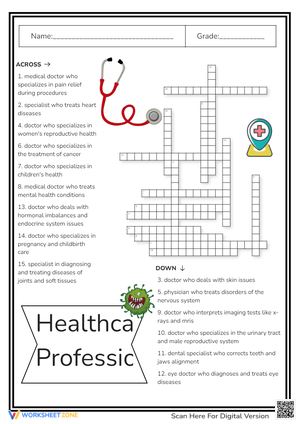
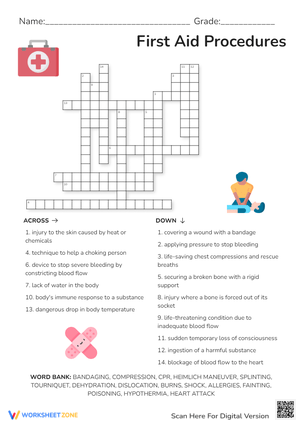
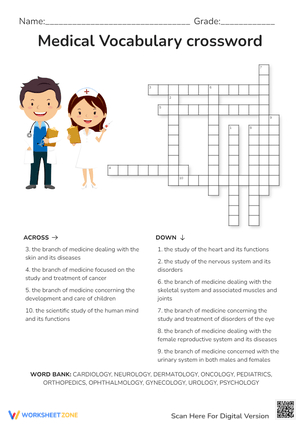
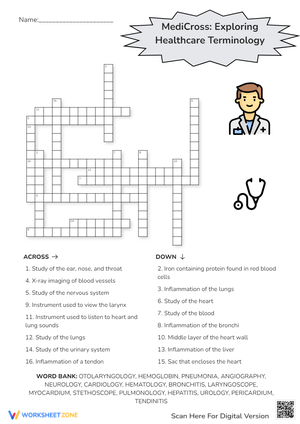
Attention future healthcare professionals: a stack of patient charts has just landed on your desk, and every line is filled with unfamiliar Latin roots and clinical abbreviations. Your mission, should you choose to accept it, is to decode that language one term at a time. A medical terminology word search turns that intimidating wall of jargon into a playful investigation, inviting you to hunt for hidden anatomy, physiology, and pharmacology terms tucked among rows of letters. Each puzzle becomes a small case file where curiosity is the only tool you need to crack it open.
Think of every grid as a set of clues planted by a clever instructor. The words you are searching for represent body systems, common diagnoses, surgical procedures, and diagnostic tools that any nursing or pre-med student must recognize on sight. As your eyes scan diagonally for cardiology terms or sweep across rows looking for orthopedic vocabulary, you are training the same observational muscles you will later use to spot critical details in a patient note. Sharp observation is not a bonus skill in healthcare; it is the foundation of safe practice.
The thrill of this medical terminology word search collection lies in the quiet build of tension as the grid slowly empties. You circle pulmonary, then dermatology, then phlebotomy, and suddenly a cluster of related terms reveals an entire body system you have been studying. That moment of pattern recognition is exactly what your future board exams will reward. To deepen the connection between vocabulary and visuals, pair these printable puzzles with a focused anatomy resource such as the heart anatomy worksheet, so the words you find on the page map directly onto the structures you will examine in lab.
For instructors and clinical educators, framing terminology practice as an active mission changes the energy of the classroom. Students who might glaze over during a flashcard drill will lean forward when the same vocabulary appears inside a puzzle, because the format rewards persistence with the small dopamine hit of discovery. Teachers can scaffold lessons by assigning beginner grids early in the unit, then graduating to advanced puzzles packed with prefixes, suffixes, and combining forms once learners are ready. If you want to build custom grids tailored to your syllabus, the Worksheetzone guide on how to make a word search worksheet walks you through the process step by step.
Parents supporting a student in a health science pathway can use these printable activities as a low-pressure study companion during evenings and weekends. There is no glowing screen demanding attention and no test score on the line, just a pencil, a quiet table, and a steady stream of medical terms moving from short-term memory into long-term recall. The lesson plan can be as simple as ten minutes of puzzle time followed by a quick verbal review of the discovered words, which strengthens spelling, pronunciation, and definition recall all at once.
So sharpen your pencil, settle into your seat, and treat each medical terminology word search as your next clinical case. Every term you uncover is a small victory that brings you closer to fluent communication with physicians, nurses, and patients. Open the next puzzle, scan the grid, and let the language of medicine reveal itself one hidden word at a time.
Frequently Asked Questions
Question 1: Who benefits most from a medical terminology word search?
Nursing students, pre-med learners, medical assistants, and high school health science classes all gain real value from these puzzles. The format reinforces vocabulary related to anatomy, physiology, diseases, and procedures while keeping the practice engaging. Teachers also find them useful as warm-up activities, exit tickets, or homework supplements that reinforce textbook readings without feeling like another rote memorization task for students.
Question 2: How does word search practice improve clinical vocabulary retention?
Active retrieval is the engine behind long-term memory, and a word search forces learners to scan, identify, and lock onto target terms. Each successful find strengthens the neural pathway tied to that word, its spelling, and its medical context. When students repeat this process across multiple puzzles, terminology shifts from passive recognition into active recall, which is exactly the level of mastery clinical environments demand.
Question 3: Can I use these puzzles alongside a textbook or curriculum?
Absolutely. The medical terminology word search puzzles on Worksheetzone align with common health science units such as cardiology, respiratory care, the musculoskeletal system, and pharmacology basics. Pair each puzzle with the matching textbook chapter so students encounter the same terms in reading, lecture, and puzzle form. This triple exposure mirrors proven spaced repetition techniques and helps anchor difficult terminology firmly in memory.
Question 4: What is the best way to use these printables in a classroom setting?
Start with a brief vocabulary preview so students recognize the target terms, distribute the printable worksheet, and set a focused timer for the search. After the round, lead a short discussion where students share definitions and pronounce each term aloud. This routine combines visual scanning, peer learning, and verbal practice, turning a simple word search into a multi-modal lesson plan that supports diverse learners across the classroom.












 Interactive Worksheet Maker
 Quiz Maker
 Word Search Maker
 Crossword Puzzle Maker
 Word Scramble Generator
 Sentence Scramble Generator
 Handwriting Worksheet Generator
 Name Tracing Generator
 Fill In The Blank Generator