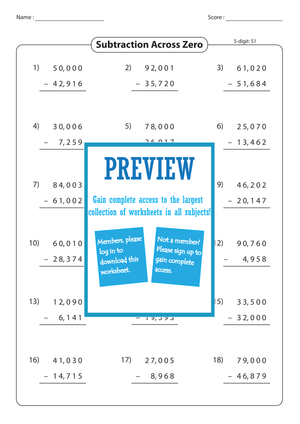
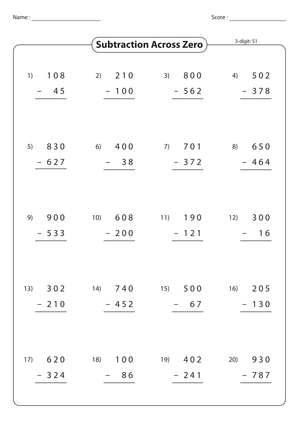
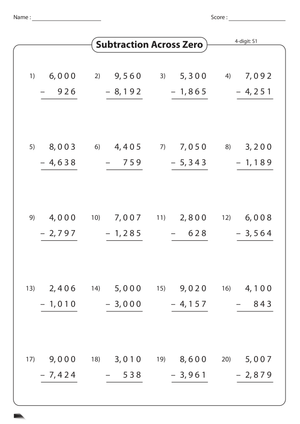
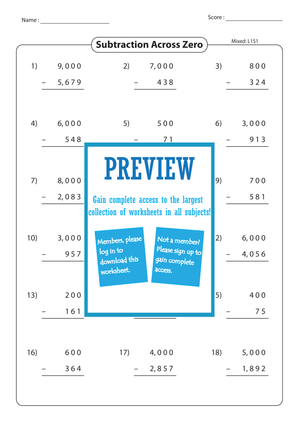
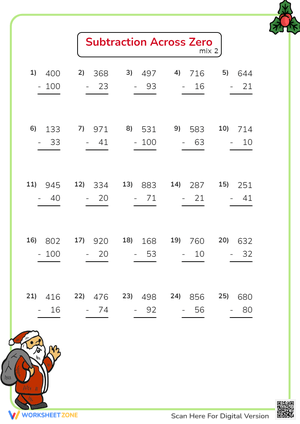
Why Subtraction Across Zeros Trips Up So Many Students
Regular regrouping is hard enough, but subtraction across zeros adds a second layer of thinking that catches even confident students. When a minuend like 600 or 3,004 has zeros stacked in the tens or hundreds place, there is nothing to borrow from in the neighboring column. Students have to reach past the empty place value to the next digit that actually holds something, then work their way back. That extra step is where the errors pile up.
The most common failure point is not the arithmetic itself. It is the moment a student stalls at a zero, decides there is "nothing there," and either skips the column or writes the bottom digit straight down. If you have watched a class work through a problem set, you have seen the same wrong answer appear again and again on problems like 500 - 234. Sequencing your instruction to head off that stall is the whole game.
Model 500 - 234 Step by Step on the Board
Start every unit with one worked example students can copy into their notebooks. Take 500 - 234. Point to the ones place: you need to subtract 4 from 0, so you have to regroup. But the tens place is also a zero, so there is nothing to borrow from there either.
Say it out loud in place-value language: "I don't have any tens, so I go to the hundreds. I break one hundred into ten tens." Now the hundreds digit drops from 5 to 4, and you have 10 tens. Then break one of those tens into ten ones, leaving 9 tens and 10 ones. From there the subtraction is ordinary: 10 - 4 is 6, 9 - 3 is 6, 4 - 2 is 2, giving 266. Modeling the two-stage break with place value blocks makes the abstract "borrow across the zero" move something students can physically see.
Here is the detail that changes results: teach students to rename the whole chunk at once. Instead of borrowing digit by digit, have them read 500 as "50 tens" and cross it out to write 49 tens and 10 ones in one move. This single reframing collapses the two-step regrouping into one, and it eliminates the most frequent error, where a student correctly reduces the hundreds but forgets to leave 9 (not 10) in the tens column.
Standard Algorithm vs. the Count-Up Strategy
Not every student thinks in borrowing. The count-up strategy gives you a second valid method for the same worksheet. Instead of decomposing the minuend, students count up from the subtrahend to the minuend. For 500 - 234, they jump from 234 to 240 (6), from 240 to 300 (60), and from 300 to 500 (200), then add 6 + 60 + 200 to get 266.
Count-up shines with the tidy zero problems that appear constantly in real life, like making change from a $5.00 bill or figuring elapsed time to a round hour. Keep both methods visible. Some students will always prefer the algorithm; others avoid the zero trap entirely by counting up. Offering both on the same practice set lets you differentiate without printing two versions.
Classroom Implementation
Move through a predictable arc so the worksheets do the work you need at each stage. Open with a five-minute guided model, then release students to a short set of scaffolded problems before anything independent.
- Guided practice: Work the first three problems together, thinking aloud at every zero. Have students narrate the regrouping back to you before they touch their pencils.
- Small-group intervention: Pull students who stalled during the model. Use place value blocks or base-ten drawings alongside the worksheet so the regrouping stays concrete.
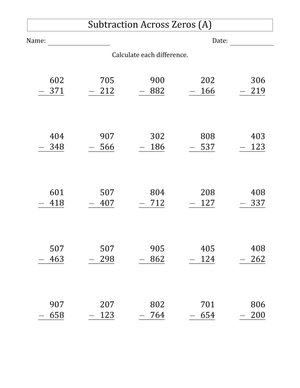
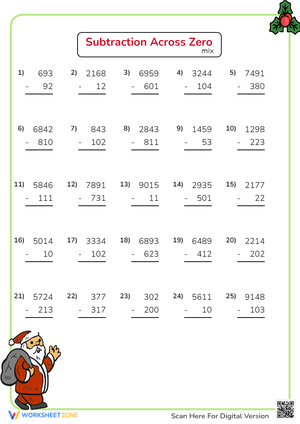
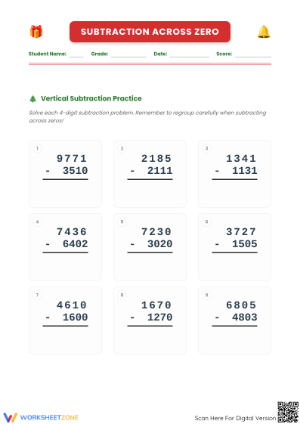
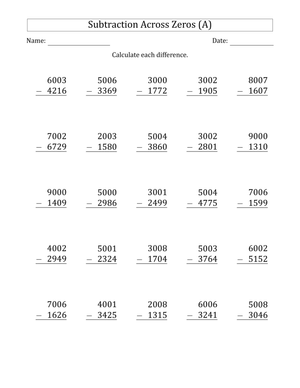
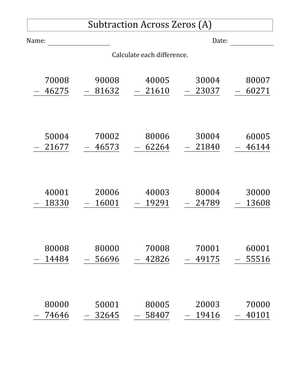
- Formative check: Reserve the last four or five problems as an exit ticket. Problems with two zeros in a row, such as 4,003 - 1,568, tell you quickly who has generalized the skill and who memorized one case.
A workable benchmark is roughly eight to ten guided and paired problems before independent work. If a student misses more than two of those, they are practicing the error, and it is time to step back to blocks or the count-up method rather than push forward.
Common Misconceptions to Watch For
Three predictable mistakes show up on nearly every class set, and naming them in advance shortens your grading time.
- "Zero means nothing to borrow." Students stop at the zero instead of continuing to the next place value. Counter it by rehearsing the phrase "keep going until you find something to break."
- Forgetting the leftover 9. After breaking a hundred, students write 10 in the tens column instead of 9, because they forget the ten they just passed to the ones.
- Flipping the digits. When the top digit is 0 and the bottom is 4, some students subtract 0 from 4 and write 4, reversing the order. This is where the count-up strategy quietly prevents the error.
Reteaching lands better when you show the wrong answer next to the right one and ask students to find the broken step, rather than just marking it incorrect.
How These Worksheets Align to Standards
Subtraction across zeros is not an enrichment topic; it sits inside the grade-level fluency expectations, which makes it easy to justify the practice in a lesson plan.
According to CCSS 4.NBT.B.4, fourth graders must fluently add and subtract multi-digit whole numbers using the standard algorithm, and that expectation covers minuends with zeros. Building on CCSS 3.NBT.2, where students add and subtract within 1000 using strategies based on place value and the relationship between operations, the standards treat regrouping across zero as a fluency benchmark rather than an optional stretch skill.
Because the skill is introduced in third grade and cemented in fourth, the same worksheet set can serve spring review in one grade and fall diagnostics in the next. Tie the practice to real contexts your students already meet, such as calculating change, measuring distances, and solving elapsed-time problems, so the round numbers feel purposeful instead of arbitrary.
Frequently Asked Questions
1. What grade level typically learns subtraction across zeros?
It is usually introduced in third grade under place-value subtraction within 1000 and reinforced in fourth grade as numbers grow into the thousands. Many teachers revisit it early in fourth grade because the summer gap tends to erase the two-step regrouping move.
2. What is the best strategy when there are multiple zeros in a row?
Rename the whole chunk at once. For 4,003 - 1,568, read the top number as 400 tens and 3 ones, then decompose to 399 tens and 13 ones. Naming the entire block prevents the digit-by-digit confusion that multiple zeros create.
3. How can teachers tell if a student is ready for these worksheets?
Confirm the student can already regroup once with confidence on problems without zeros, such as 62 - 28. If single regrouping is still shaky, start there first, since subtraction across zeros stacks a second decision on top of a skill that must already be automatic.
4. How do these worksheets align with Common Core standards?
They target CCSS 3.NBT.2 in third grade and CCSS 4.NBT.B.4 in fourth grade, both of which require fluent multi-digit subtraction using place-value strategies and the standard algorithm, including problems with zeros in the minuend.
5. How many practice problems should students complete before independent work?
Plan on about eight to ten guided or paired problems first. If a student misses more than two, pause and reteach with base-ten blocks or the count-up strategy before assigning an independent set, so they are not rehearsing a broken procedure.













 Interactive Worksheet Maker
 Quiz Maker
 Word Search Maker
 Crossword Puzzle Maker
 Word Scramble Generator
 Sentence Scramble Generator
 Handwriting Worksheet Generator
 Name Tracing Generator
 Fill In The Blank Generator