


























0
Views
0
Downloads

0.0
0
Save
0 Likes
Share
Best Bargains Math: Unit Price Worksheet (Grades 6-7)
0 Views
0 Downloads
Paste this activity's link or code into your existing LMS (Google Classroom, Canvas, Teams, Schoology, Moodle, etc.).
Students can open and work on the activity right away, with no student login required.
You'll still be able to track student progress and results from your teacher account.
Information
Description
What It Is:
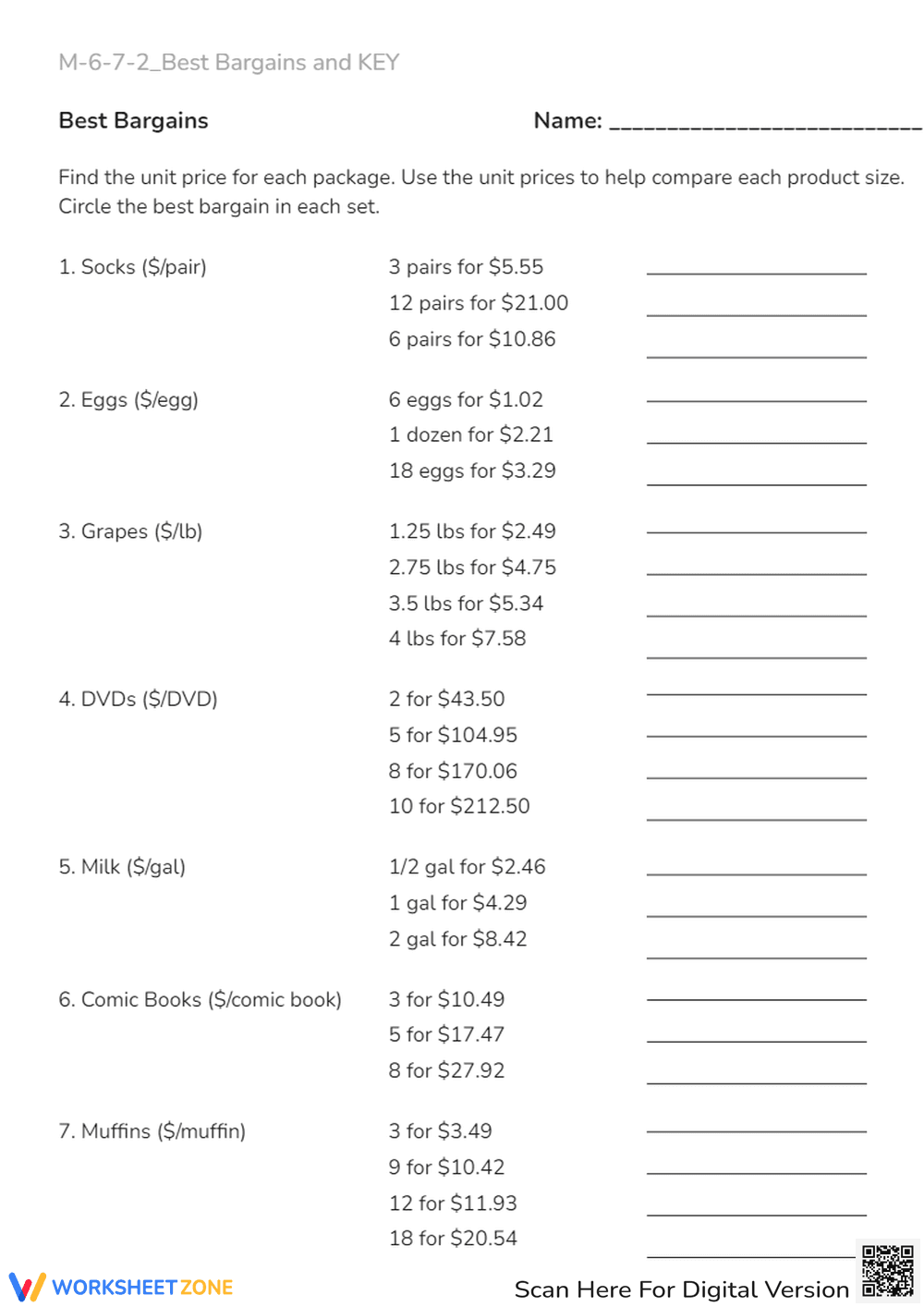
This is a math worksheet titled 'Best Bargains'. Students are instructed to find the unit price for different items such as socks, eggs, grapes, DVDs, milk, comic books, and muffins. For each item, multiple package sizes and prices are given, and the student must determine which package offers the best bargain by calculating and comparing unit prices.
Grade Level Suitability:
This worksheet is suitable for grades 6-7. It requires students to divide decimals, compare prices, and understand the concept of unit price, which are typically taught in these grades.
Why Use It:
This worksheet reinforces division skills and helps students develop critical thinking and problem-solving skills in a real-world context. It teaches them how to compare prices and make informed purchasing decisions based on unit cost, which is a valuable life skill.
How to Use It:
Students should first calculate the unit price for each package size by dividing the total price by the number of units (e.g., price per pair of socks, price per egg). Then, they should compare the unit prices and circle the package that offers the lowest price per unit.
Target Users:
This worksheet is designed for middle school students (grades 6-7) who are learning about unit prices, ratios, and proportional reasoning. It can also be used for students who need additional practice with decimal division and problem-solving.
This is a math worksheet titled 'Best Bargains'. Students are instructed to find the unit price for different items such as socks, eggs, grapes, DVDs, milk, comic books, and muffins. For each item, multiple package sizes and prices are given, and the student must determine which package offers the best bargain by calculating and comparing unit prices.
Grade Level Suitability:
This worksheet is suitable for grades 6-7. It requires students to divide decimals, compare prices, and understand the concept of unit price, which are typically taught in these grades.
Why Use It:
This worksheet reinforces division skills and helps students develop critical thinking and problem-solving skills in a real-world context. It teaches them how to compare prices and make informed purchasing decisions based on unit cost, which is a valuable life skill.
How to Use It:
Students should first calculate the unit price for each package size by dividing the total price by the number of units (e.g., price per pair of socks, price per egg). Then, they should compare the unit prices and circle the package that offers the lowest price per unit.
Target Users:
This worksheet is designed for middle school students (grades 6-7) who are learning about unit prices, ratios, and proportional reasoning. It can also be used for students who need additional practice with decimal division and problem-solving.


