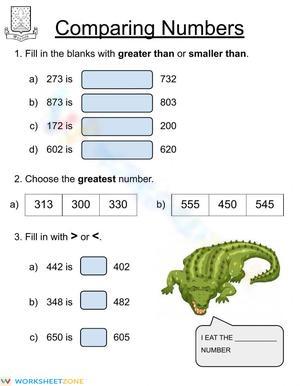
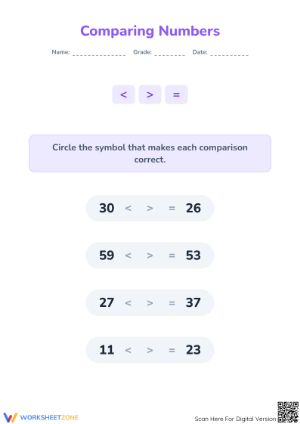
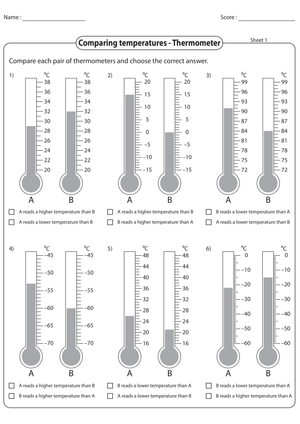
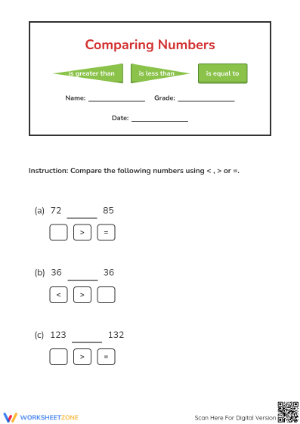
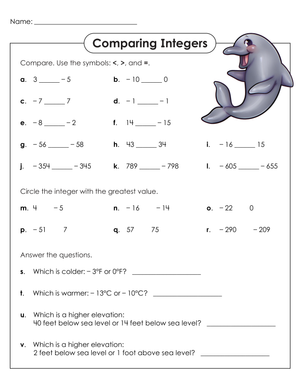
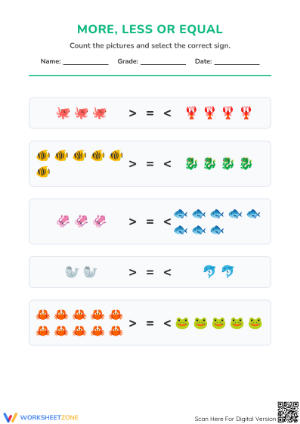
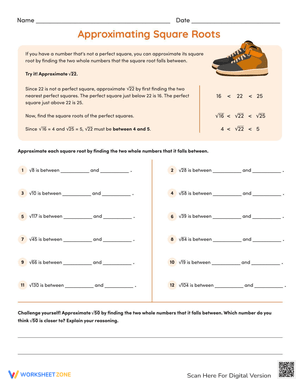
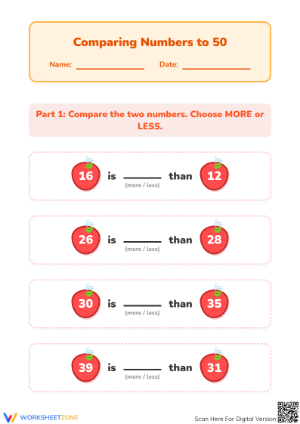
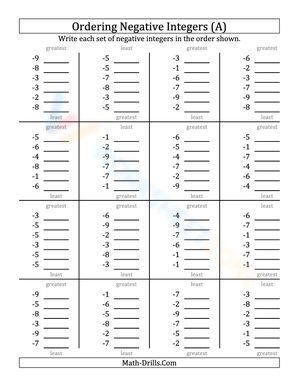
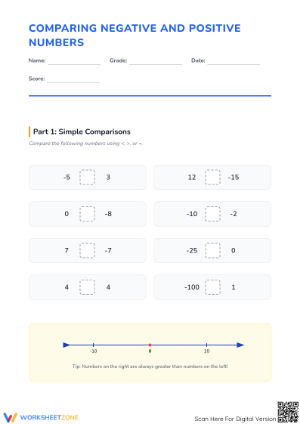
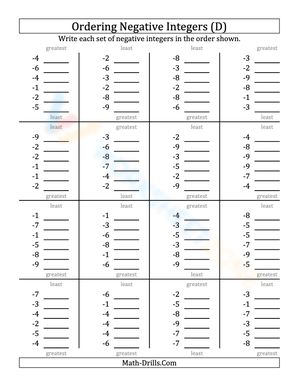
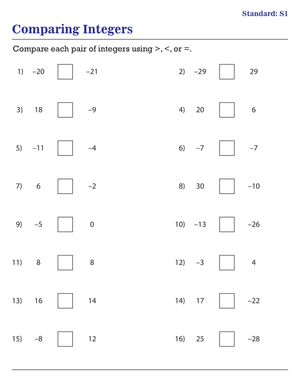
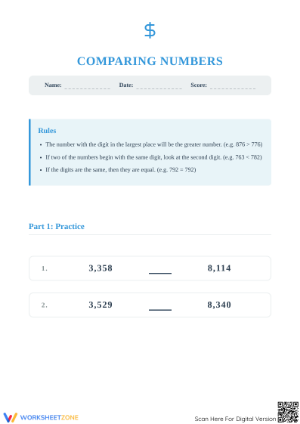
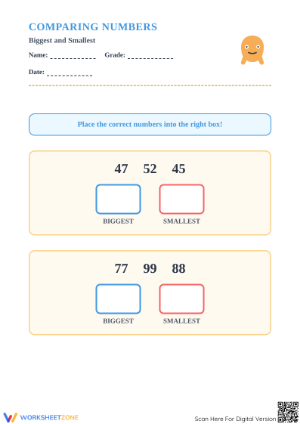
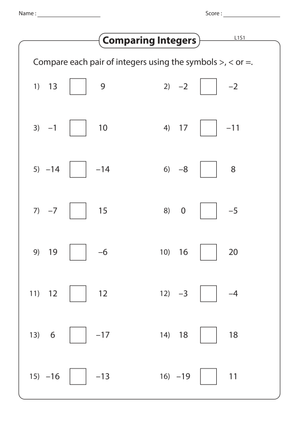
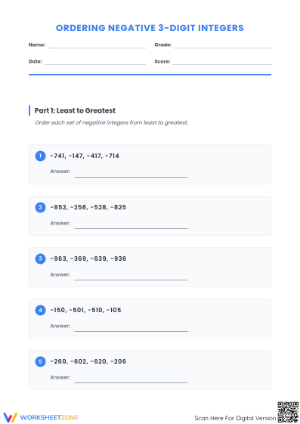
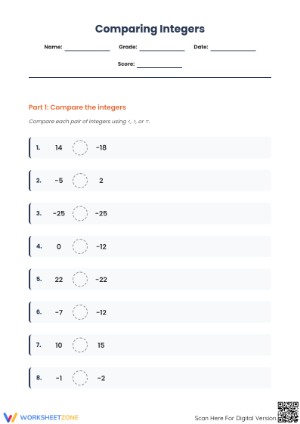
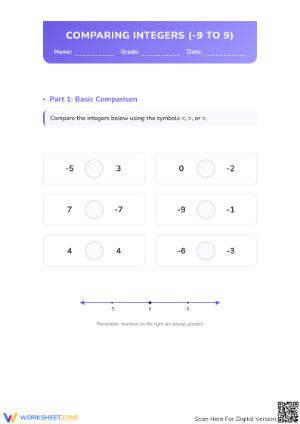
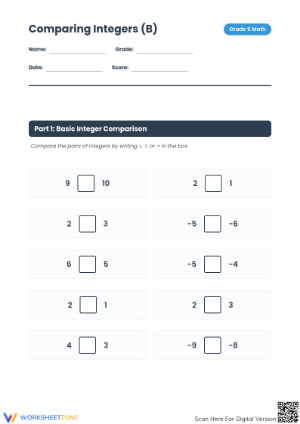
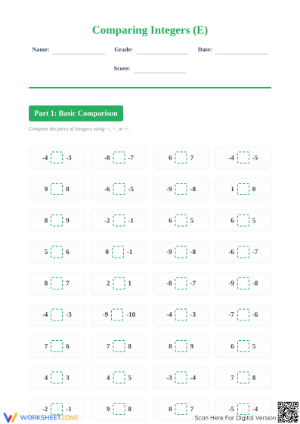
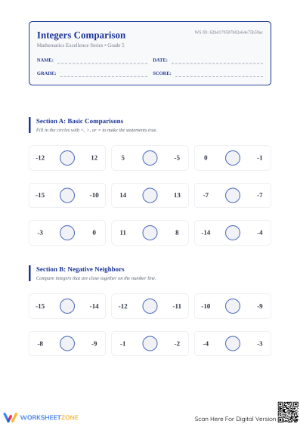
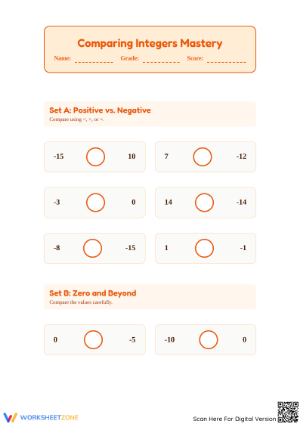
When students move from whole number comparisons to the negative side of the number line, the logic they relied on in elementary grades stops working cleanly. Comparing integers worksheets give grade 6 teachers a focused way to rebuild that logic, one inequality statement at a time, before students are asked to reason about absolute value or real-world debt and temperature contexts. This skill sits squarely inside CCSS.Math.Content.6.NS.C.7, the grade 6 number system standard that covers ordering and interpreting rational numbers.
For most classrooms, this unit is where students first encounter the idea that -7 is less than -3, even though 7 looks like the bigger number. Worksheets built around number lines let students see that relationship instead of memorizing a rule they cannot yet justify.
Building Number Line Fluency Before Symbol Work
Under 6.NS.C.7.a, students must interpret statements like -3 greater than -7 as statements about relative position on a number line, not just as symbol manipulation. Comparing integers worksheets that lead with visual number lines, asking students to plot pairs of integers and then write the inequality, build this connection directly. Only after students can consistently place integers correctly should worksheets shift toward abstract symbol-only comparisons.
A useful sequencing move is to keep every early practice set anchored to a visible number line, even when the comparison itself looks trivial, because premature symbol-only practice is where the greater-magnitude misconception takes hold and becomes difficult to unteach later in the unit.
Order Versus Absolute Value: Where Students Get Stuck
6.NS.C.7.c introduces absolute value as distance from zero on the number line, and 6.NS.C.7.d asks students to distinguish that idea from simple ordering. This is where a debt example works well: a debt of 30 dollars is a larger magnitude than a debt of 10 dollars, but as account balances, -30 is less than -10. Worksheets that pair these two questions side by side, one asking for the order comparison and one asking for the absolute value comparison, help students see they are answering two different questions about the same numbers.
Without this explicit contrast, many students default to treating every comparison task as a magnitude question, which produces correct answers for absolute value items and incorrect answers for straightforward ordering items.
Sequencing Practice Across the Unit
A practical progression for comparing integers worksheets moves from simple integer pairs on a number line, to symbol-only comparisons without a visual aid, to real-world order statements, and finally to mixed sets that require students to decide whether a question is asking about order or absolute value. Each stage should include a short answer explanation prompt, since asking students to justify why -8 is less than -2 surfaces the reasoning gaps that a correct answer alone can hide.
Spacing this progression across three to four class periods, rather than compressing it into a single worksheet, gives students time to internalize the number line model before it is tested against symbol-only or context-based items.
Classroom Implementation
Comparing integers worksheets work best as short, frequent checkpoints rather than one long assignment. A ten-minute warm-up worksheet at the start of each lesson, focused on a single sub-skill from 6.NS.C.7, gives teachers a quick formative read on which students still default to magnitude-based reasoning. Collecting these warm-ups across a week creates a simple progress record without requiring a separate quiz.
When planning small-group rotations, pull students who consistently miss order-versus-absolute-value items into a short reteach using a physical or drawn number line, since this misconception responds better to a visual model than to additional symbolic practice. For students who have mastered the core comparisons, extend the worksheet with a written explanation task, asking them to justify an inequality in a sentence, which reinforces the standard while adding rigor.
Frequently Asked Questions
1. What grade level typically learns to compare integers?
Comparing and ordering integers is a grade 6 skill under CCSS.Math.Content.6.NS.C.7, though intervention teachers in grade 7 or 8 may revisit it with students who need additional support.
2. How should teachers introduce negative integer comparisons using a number line?
Start by having students plot pairs of integers on a labeled number line and physically point to whichever value sits further to the right, then translate that position into an inequality statement, per 6.NS.C.7.a.
3. What is the difference between comparing order and comparing absolute value?
Order comparisons ask which value is greater or less as a signed number, while absolute value comparisons ask which value is farther from zero, regardless of sign. Under 6.NS.C.7.d, students need explicit practice distinguishing these two question types.
4. How can teachers use these worksheets for small-group intervention?
Keep intervention worksheets limited to one sub-skill per page and require a visible number line on every item, so struggling students are not switching between skill types while still building the visual model.
5. What real-world contexts help students understand integer comparisons?
Temperature, elevation, and account balance scenarios all give students a concrete anchor for order statements, which supports the real-world interpretation required by 6.NS.C.7.b.













 Interactive Worksheet Maker
 Quiz Maker
 Word Search Maker
 Crossword Puzzle Maker
 Word Scramble Generator
 Sentence Scramble Generator
 Handwriting Worksheet Generator
 Name Tracing Generator
 Fill In The Blank Generator