




























Views
Downloads
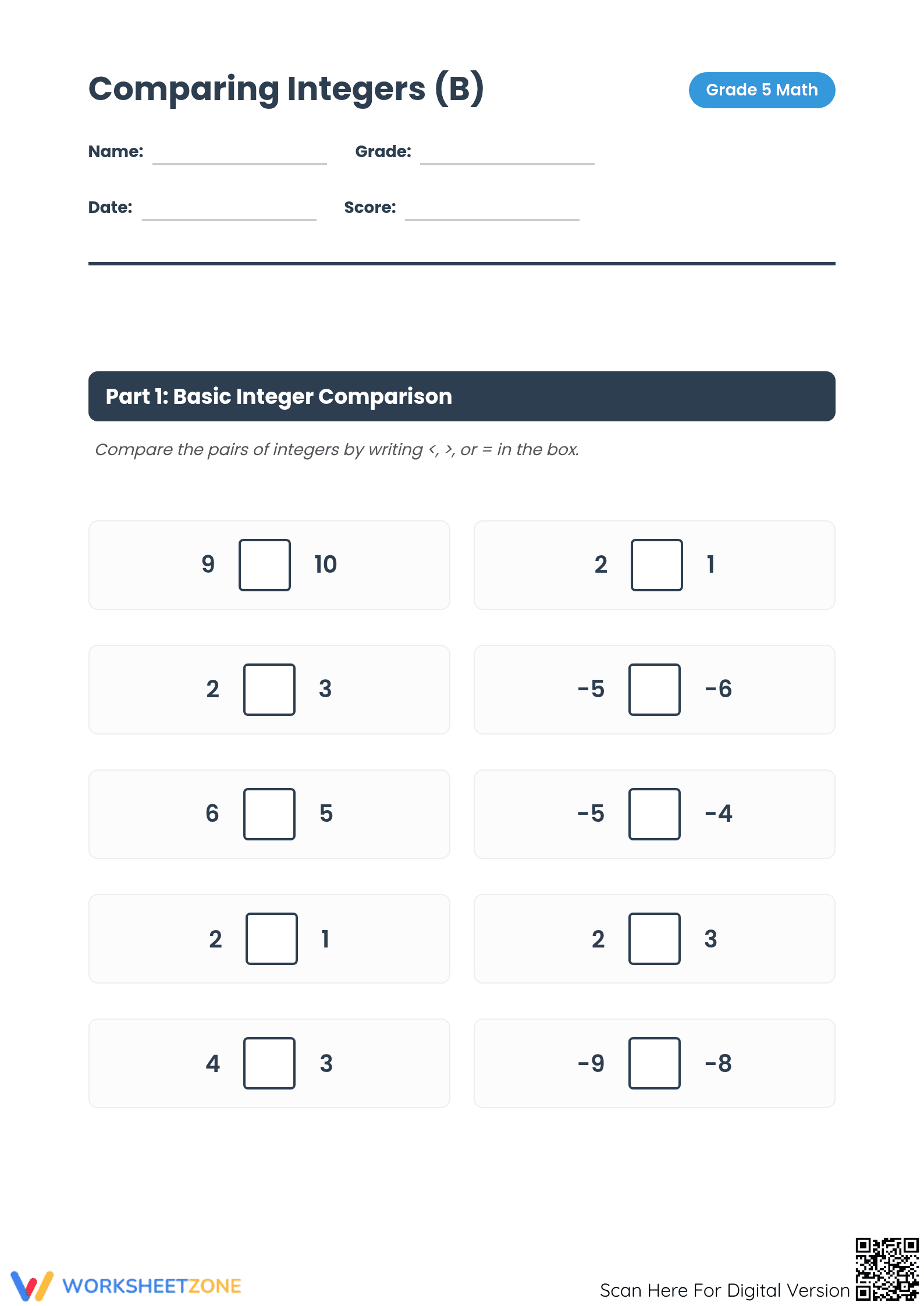
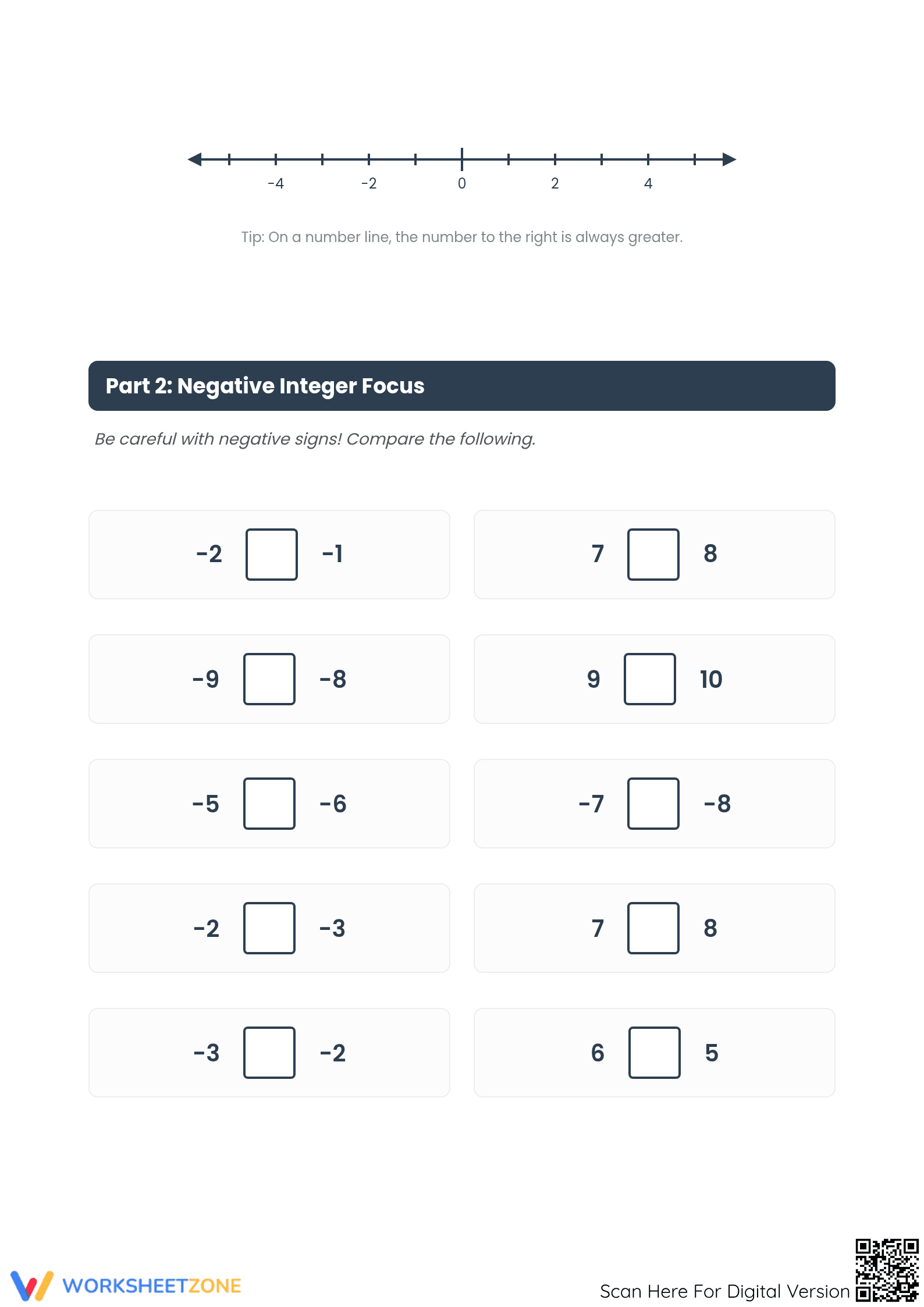
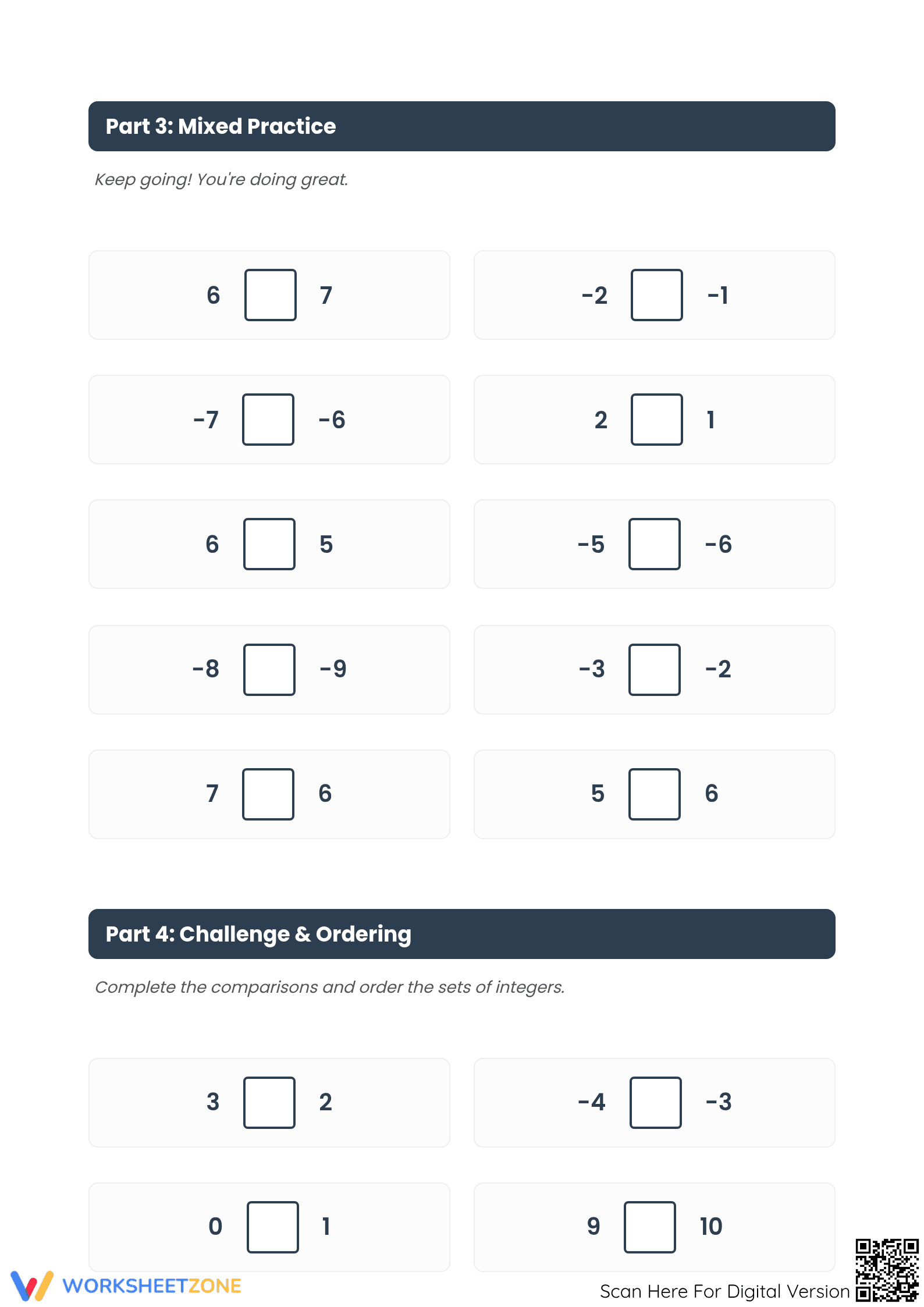
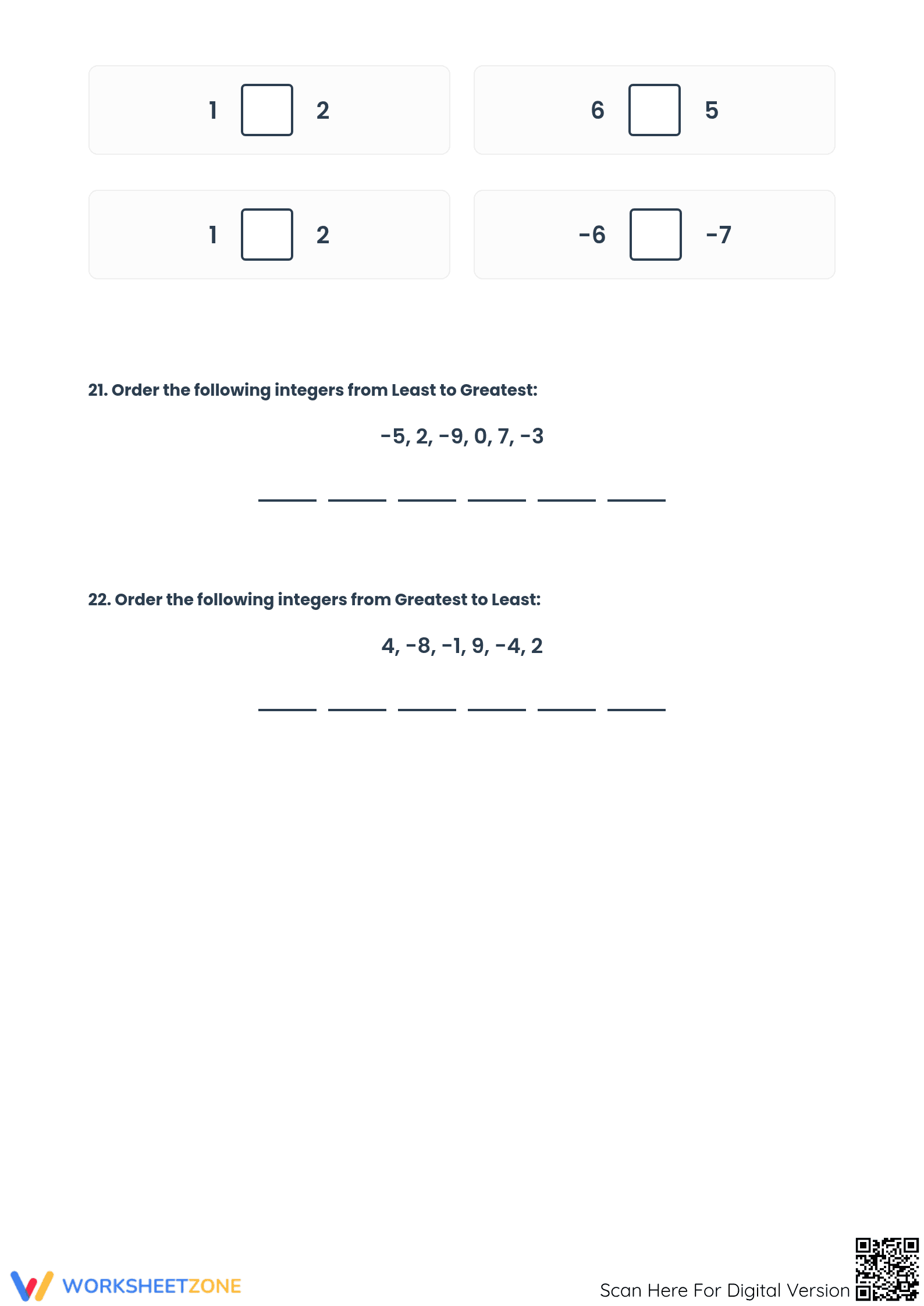

Printable Grade 5 Math Comparing Integers Worksheet (B)

Paste this activity's link or code into your existing LMS (Google Classroom, Canvas, Teams, Schoology, Moodle, etc.).
Students can open and work on the activity right away, with no student login required.
You'll still be able to track student progress and results from your teacher account.
Essential Integer Comparison Skills
This comprehensive integer comparison worksheet empowers students to master the relationships between positive and negative numbers. Moving through four distinct sections, learners develop a concrete understanding of how values shift relative to zero. Students will build confidence in identifying larger values when navigating the transition between negative and positive integers.
At a Glance
- Grade: 5 · Subject: Math
- Standard:
CCSS.MATH.CONTENT.6.NS.C.7— Compare and order integers based on their relative positions on number lines.- Skill Focus: Comparing and Ordering Integers (-9 to 10)
- Format: 4 pages · 38 problems · Answer key included · PDF
- Best For: Independent practice and formative assessment
- Time: 20–30 minutes
What's Inside
This four-page instructional packet contains 38 targeted tasks designed for mathematical mastery. It begins with basic comparisons and transitions into a specialized focus on negative signs, supported by a visual number line tip. The final pages offer mixed practice and challenge activities, including ordering sets of integers from least to greatest and vice versa. A complete answer key is provided for immediate grading.
Zero-Prep Workflow
The zero-prep workflow for this resource is designed for maximum classroom efficiency. Teachers can print the entire four-page packet in under 30 seconds for a full class set. Distribution takes less than a minute, as the instructions are self-explanatory and require no additional lecturing. Reviewing the work is streamlined by the included answer key, allowing for a total teacher time investment of under two minutes from start to finish.
Standards Alignment
This worksheet aligns directly with `CCSS.MATH.CONTENT.6.NS.C.7`, specifically focusing on interpreting inequality statements about the relative position of two integers on a number line. While labeled for Grade 5 to support advanced placement or early introduction, it meets the rigorous demands of middle school number system standards. This standard code can be copied directly into lesson plans, IEP goals, or district curriculum mapping tools.
How to Use It
Use this resource as a secondary practice tool following a direct instruction lesson on the number line. It works exceptionally well as a "mid-week" check to identify students who struggle with the concept that a larger absolute value in a negative number actually represents a smaller overall value. For a formative assessment, observe students during Part 2 to see if they utilize the number line tip provided on page two.
Who It's For
This resource is ideal for fifth-grade students ready for pre-algebraic concepts or sixth graders needing remedial support. The structured sections provide natural differentiation, allowing teachers to assign specific pages to different learners. Pair this worksheet with a physical number line or floor-sized integer walk for a multi-sensory learning experience.
The mastery of integer comparison is a critical prerequisite for algebraic fluency and real-world data interpretation. This worksheet aligns with CCSS.MATH.CONTENT.6.NS.C.7 by requiring students to compare integers in close proximity, a task that isolates the cognitive load on the negative sign's impact on value. According to a RAND AIRS 2024 study, systematic practice with negative numbers on a number line significantly reduces magnitude interference errors where students assume larger numerals always indicate larger values. By providing 38 distinct opportunities for practice, this resource ensures that the abstract concept of negative values becomes a concrete procedural skill. The progression from basic comparison to complex ordering mirrors the best practices for cognitive scaffolding in middle-level mathematics. Educators can confidently utilize this data-driven tool to bridge the gap between elementary arithmetic and secondary algebraic reasoning, ensuring all students are prepared for more complex rational number operations.


