




























Views
Downloads

Ready-to-Use Integers Worksheet | Grade 5 Math

Paste this activity's link or code into your existing LMS (Google Classroom, Canvas, Teams, Schoology, Moodle, etc.).
Students can open and work on the activity right away, with no student login required.
You'll still be able to track student progress and results from your teacher account.
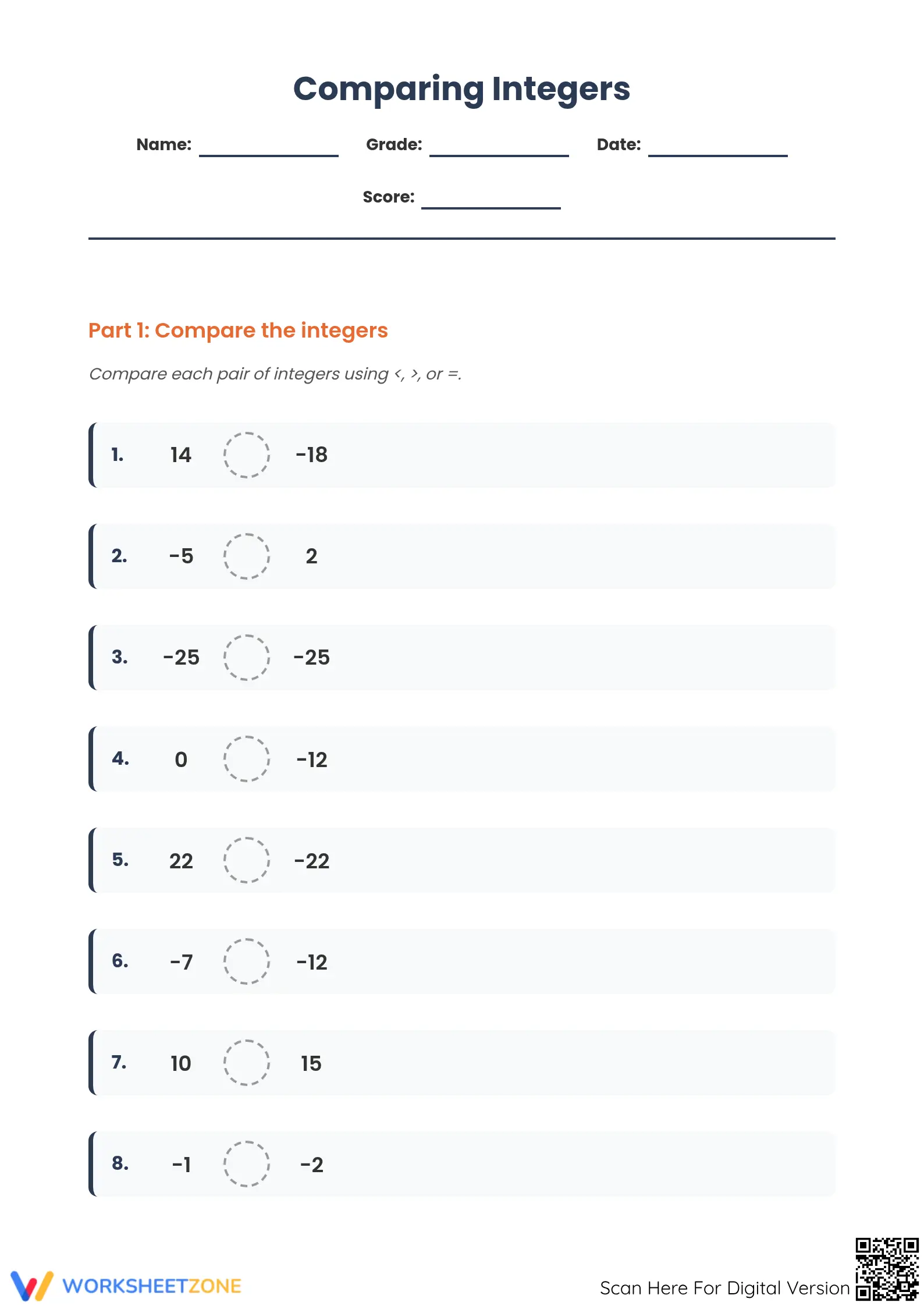
Empower your students to master number relationships with this comparing integers worksheet. Designed for Grade 5 learners, this resource provides essential practice in identifying the relative value of positive and negative numbers. Students will gain confidence using inequality symbols to communicate mathematical logic and build a solid foundation for future algebraic concepts.
At a Glance
- Grade: 5 · Subject: Math
- Standard:
CCSS.MATH.CONTENT.6.NS.C.7— Compare integers using inequality symbols to understand relative position on number lines- Skill Focus: Comparing Integers (-25 to 25)
- Format: 3 pages · 28 problems · Answer key included · PDF
- Best For: Independent practice or formative assessment
- Time: 15–20 minutes
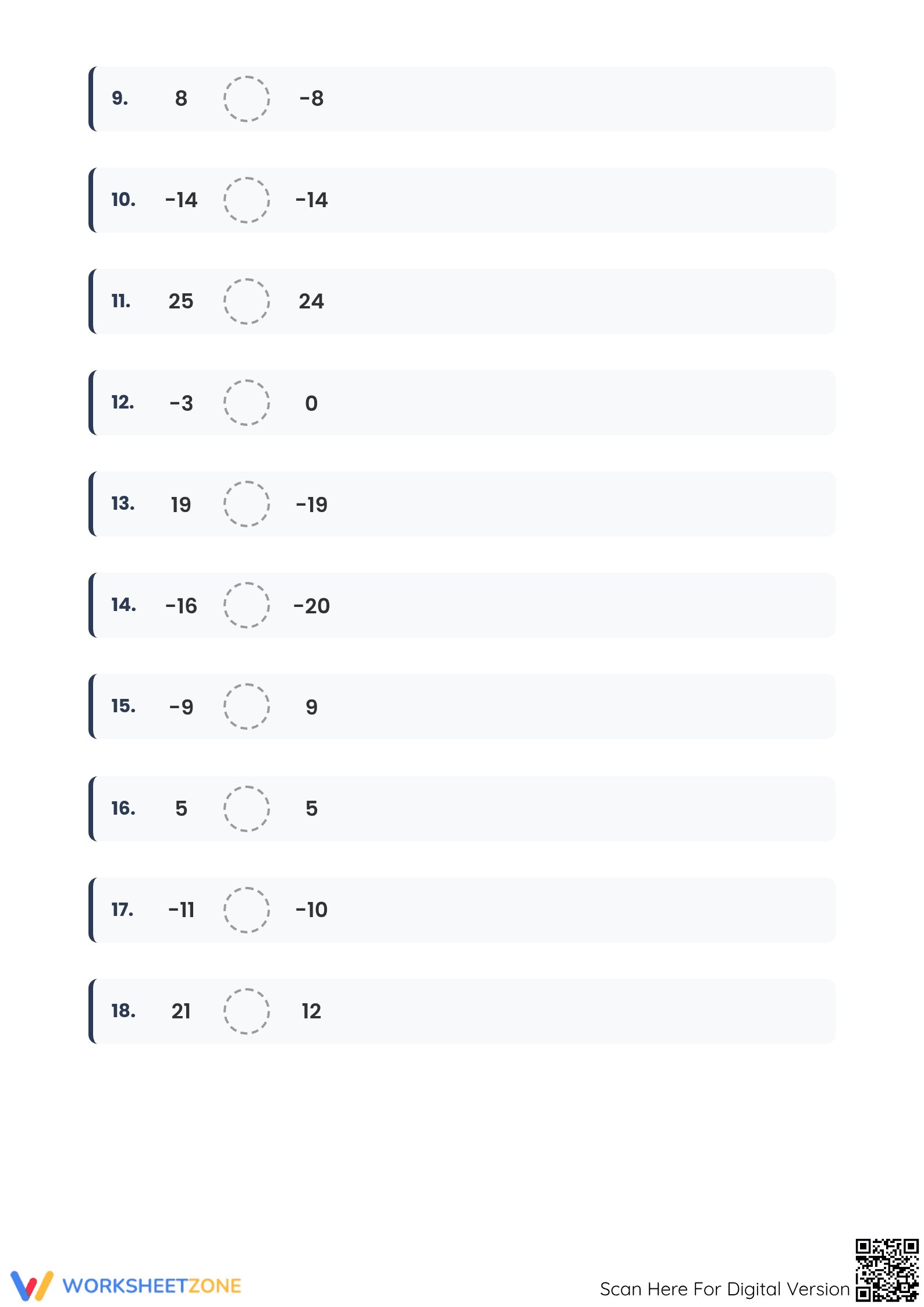
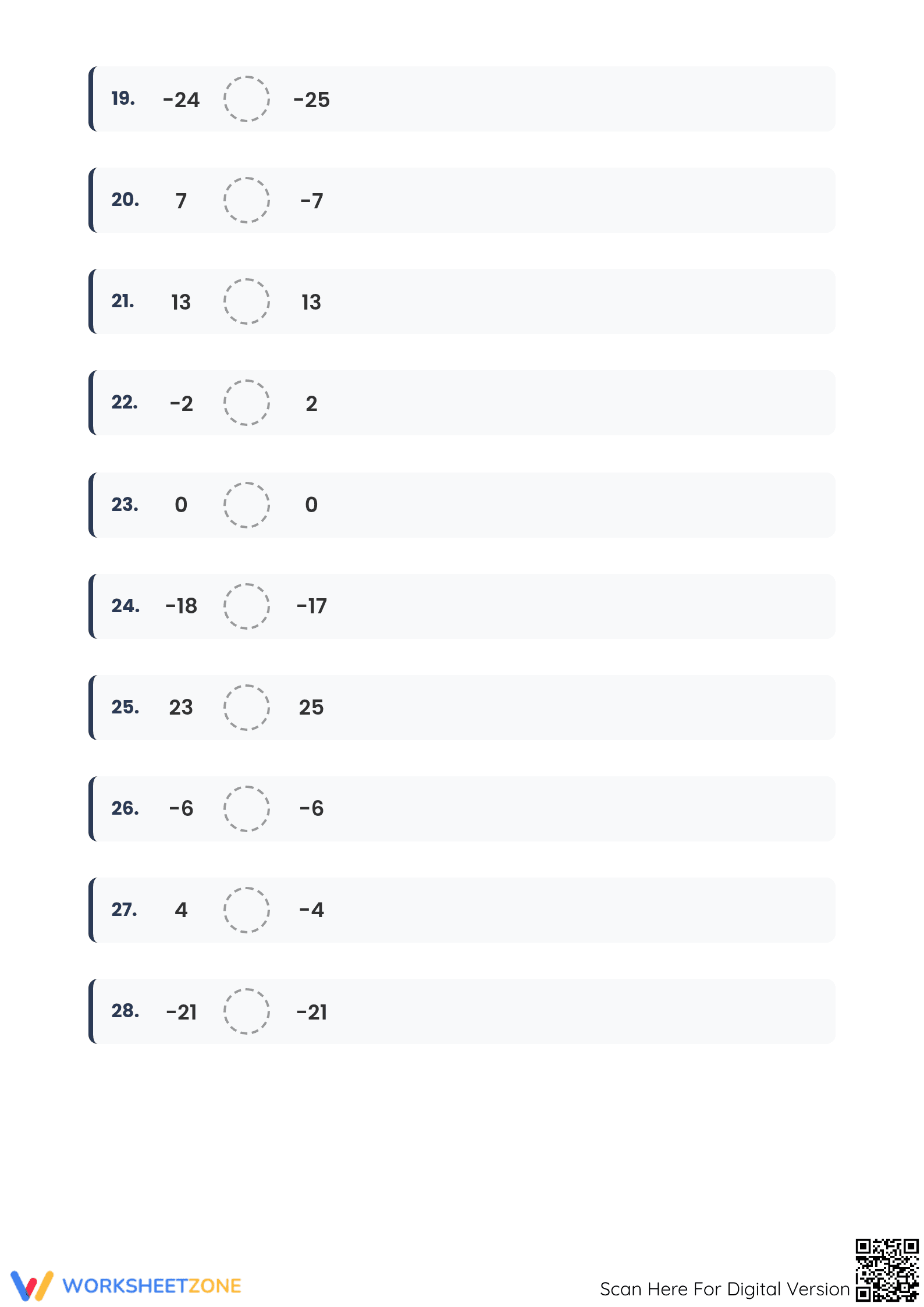
This three-page PDF features 28 targeted problems challenging students to compare integers ranging from -25 to 25. The clean layout provides space for writing inequality symbols (<, >, or =) within dashed circles. It includes a complete answer key for rapid grading, making it an efficient tool for any classroom requiring immediate student feedback and progress monitoring.
Zero-Prep Workflow
Implementing this worksheet requires zero teacher setup, making it an ideal choice for sub plans. First, print the three pages for your class in under 60 seconds. Second, distribute materials and allow 15 minutes for independent practice. Finally, use the included answer key to review results in under two minutes, identifying misconceptions about negative values instantly. This streamlined workflow ensures students remain engaged while reducing the teacher’s administrative burden significantly.
Standards Alignment
The primary alignment is `CCSS.MATH.CONTENT.6.NS.C.7`, focusing on understanding the ordering of rational numbers. Students learn to interpret statements of inequality as statements about relative position. While used at Grade 5, this standard code can be copied directly into lesson plans or IEP goals to document student progress toward secondary math readiness, ensuring alignment with rigorous state and national curriculum benchmarks.
How to Use It
This worksheet is perfect for the "You Do" phase of instruction. After teaching that negative numbers further from zero are smaller, assign this for independent practice. Alternatively, use it as a timed exit ticket to gauge class mastery. Students typically finish the 28 problems within 20 minutes, allowing for a quick closing discussion about why -25 is actually less than -5 despite the larger digit.
Who It's For
This resource is tailored for Grade 5 students exploring the integer system. It provides scaffolding for English Language Learners through a repetitive, predictable format. Pair this worksheet with a physical number line or a digital interactive tool to provide a visual anchor. It is especially effective for students needing extra reinforcement on the counter-intuitive nature of negative number magnitude.
According to the RAND AIRS 2024 study on mathematics instructional materials, consistent exposure to structured practice with negative integers is a critical predictor of success in middle school algebra. This worksheet addresses the foundational skill of comparing integers, which the National Assessment of Educational Progress (NAEP) identifies as a common stumbling block. By requiring students to apply inequality symbols to numbers between -25 and 25, the resource reinforces the conceptual shift that a larger absolute value does not always represent a larger quantity in the negative domain. This range bridges the gap between concrete counting and abstract number theory. Educators can utilize the standard code `CCSS.MATH.CONTENT.6.NS.C.7` to track mastery of plain-English skills, specifically the ability to order rational numbers, ensuring that all learners meet essential college and career readiness benchmarks.


