


























Views
Downloads

Comparing Integers Worksheet | Essential Grade 5 Math
Paste this activity's link or code into your existing LMS (Google Classroom, Canvas, Teams, Schoology, Moodle, etc.).
Students can open and work on the activity right away, with no student login required.
You'll still be able to track student progress and results from your teacher account.
Help students master the fundamental concept of integer order with this comprehensive practice set. This Grade 5 math worksheet focuses on comparing values between -15 and 15, ensuring students understand how negative numbers relate to one another and to zero. By completing these exercises, learners develop a solid foundation for more complex algebraic concepts.
At a Glance
- Grade: 5 · Subject: Math
- Standard:
CCSS.MATH.CONTENT.6.NS.C.7— Understand ordering and absolute value of rational numbers- Skill Focus: Comparing integers using inequality symbols
- Format: 3 pages · 42 problems · Answer key included · PDF
- Best For: Homework, formative assessment, or independent practice
- Time: 20–30 minutes
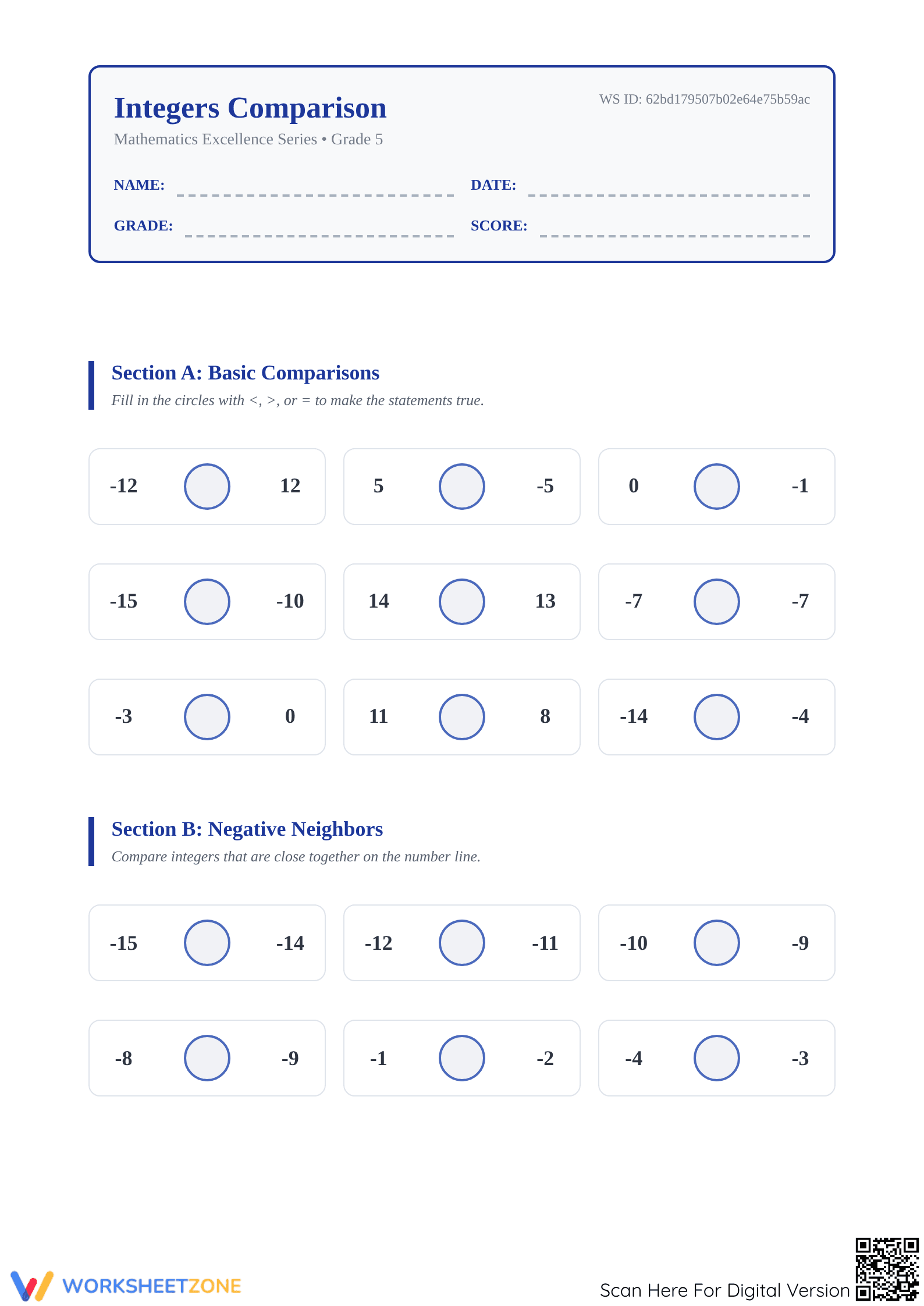
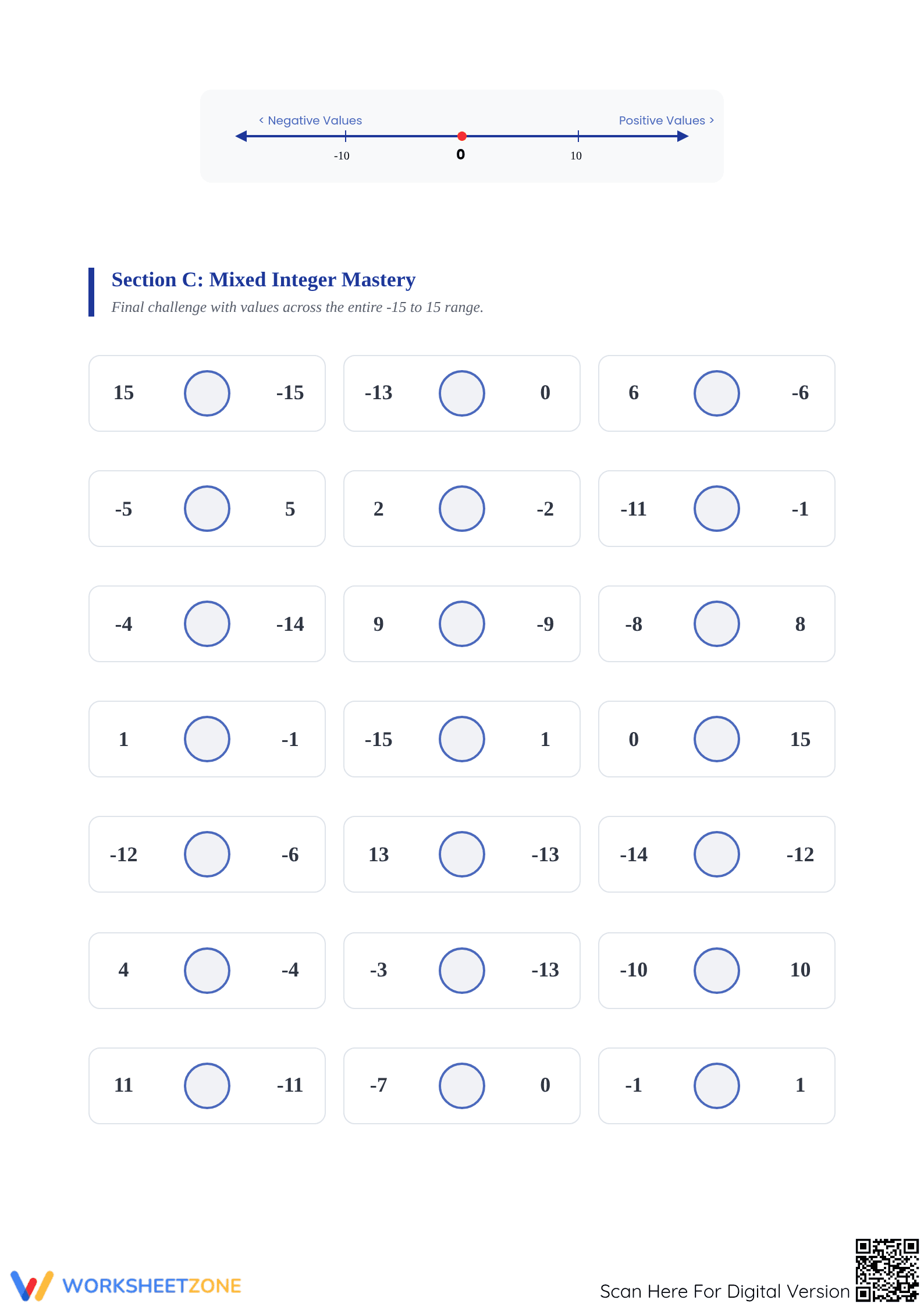
This 3-page PDF provides 42 structured problems designed to build confidence in integer comparison. The worksheet includes three distinct sections that increase in complexity, a visual number line reference for support, and clear instructions for using greater than, less than, and equal to symbols. A complete answer key is provided to facilitate quick grading or student self-correction.
Skill Progression
- Guided Practice: 15 basic comparison problems featuring a mix of positive and negative integers to establish baseline fluency.
- Supported Practice: 6 "Negative Neighbors" tasks focusing on numbers in close proximity on the number line to target absolute value misconceptions.
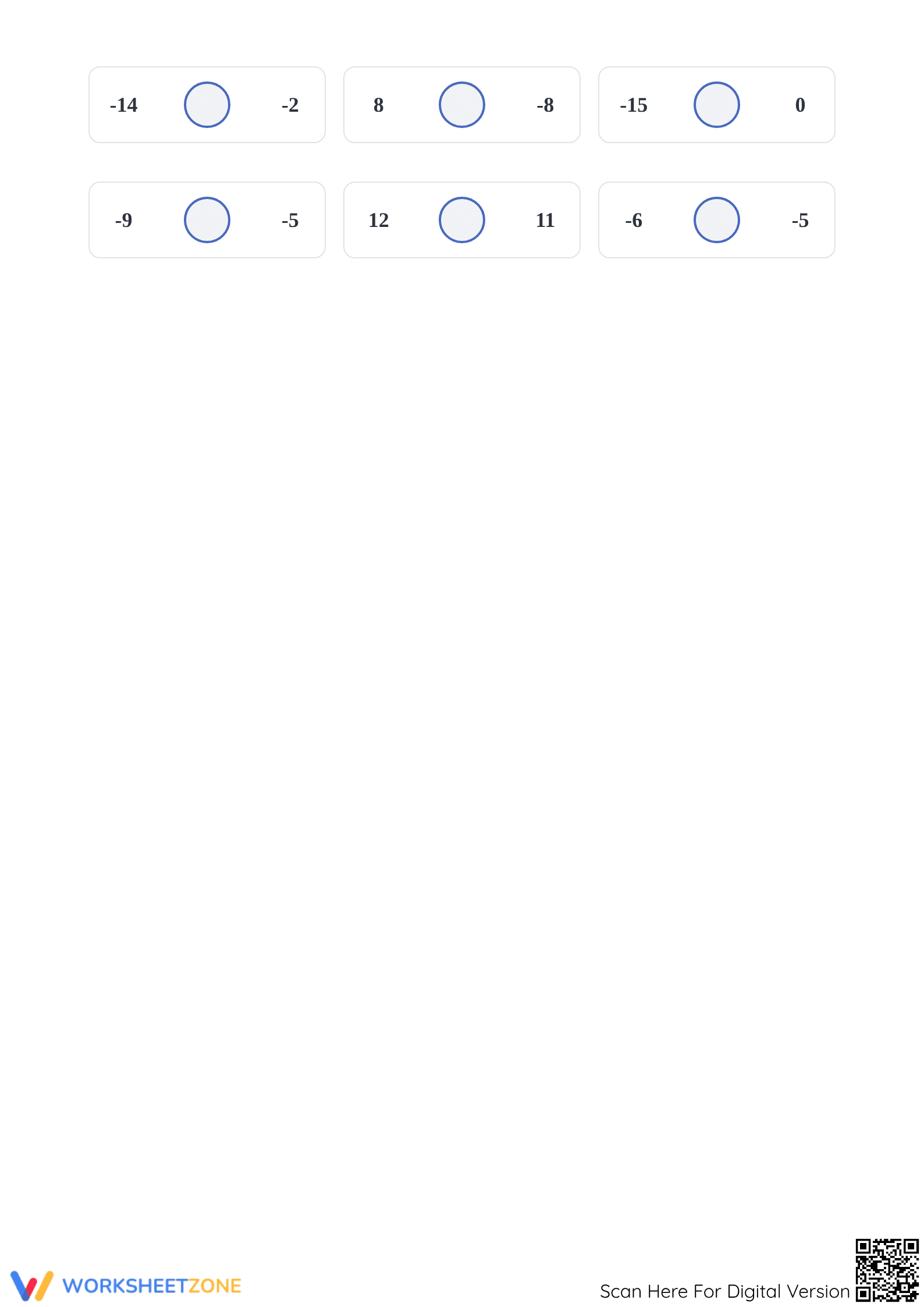
- Independent Practice: 21 mixed mastery problems covering the full -15 to 15 range with no additional visual aids.
This structured sequence follows a gradual-release approach, transitioning students from scaffolded identification to independent application.
Standards Alignment
This resource is aligned to `CCSS.MATH.CONTENT.6.NS.C.7`, which requires students to understand ordering and absolute value of rational numbers. Specifically, students must be able to write, interpret, and explain statements of order for rational numbers in real-world contexts. Both standard codes can be copied directly into lesson plans, IEP goals, or district curriculum mapping tools.
How to Use It
Use this worksheet as a post-lesson check after introducing the concept of the number line. It serves as an excellent formative assessment tool; observe if students struggle more with negative-to-negative comparisons compared to positive-to-negative ones. Most students can complete the full set in 25 minutes, making it ideal for a focused class period.
Who It's For
This worksheet is tailored for Grade 5 students who are ready for pre-algebraic concepts or Grade 6 students requiring remediation. It is particularly effective for learners who confuse absolute value with numerical value. Pair this with a physical or digital number line anchor chart to provide additional scaffolding for students who are new to negative numbers.
Research highlights that "largest absolute value doesn't equal larger value for integers," a common hurdle addressed by this worksheet's "Negative Neighbors" section. According to a RAND AIRS 2024 analysis, instructional materials that explicitly target these misconceptions through scaffolded practice are significantly more effective in building long-term mathematical fluency. This resource utilizes a clear visual number line and 42 specific tasks to ensure students bridge the gap between whole number understanding and rational number systems. By focusing on the CCSS.MATH.CONTENT.6.NS.C.7 standard, the worksheet provides the necessary repetition for students to internalize that -15 is less than -14, despite 15 being greater than 14. This evidence-based approach to integer comparison is essential for preparing students for the rigors of middle school algebra and data analysis.


