




























Views
Downloads

Essential Comparing Integers Worksheet | Grade 5 Math

Paste this activity's link or code into your existing LMS (Google Classroom, Canvas, Teams, Schoology, Moodle, etc.).
Students can open and work on the activity right away, with no student login required.
You'll still be able to track student progress and results from your teacher account.
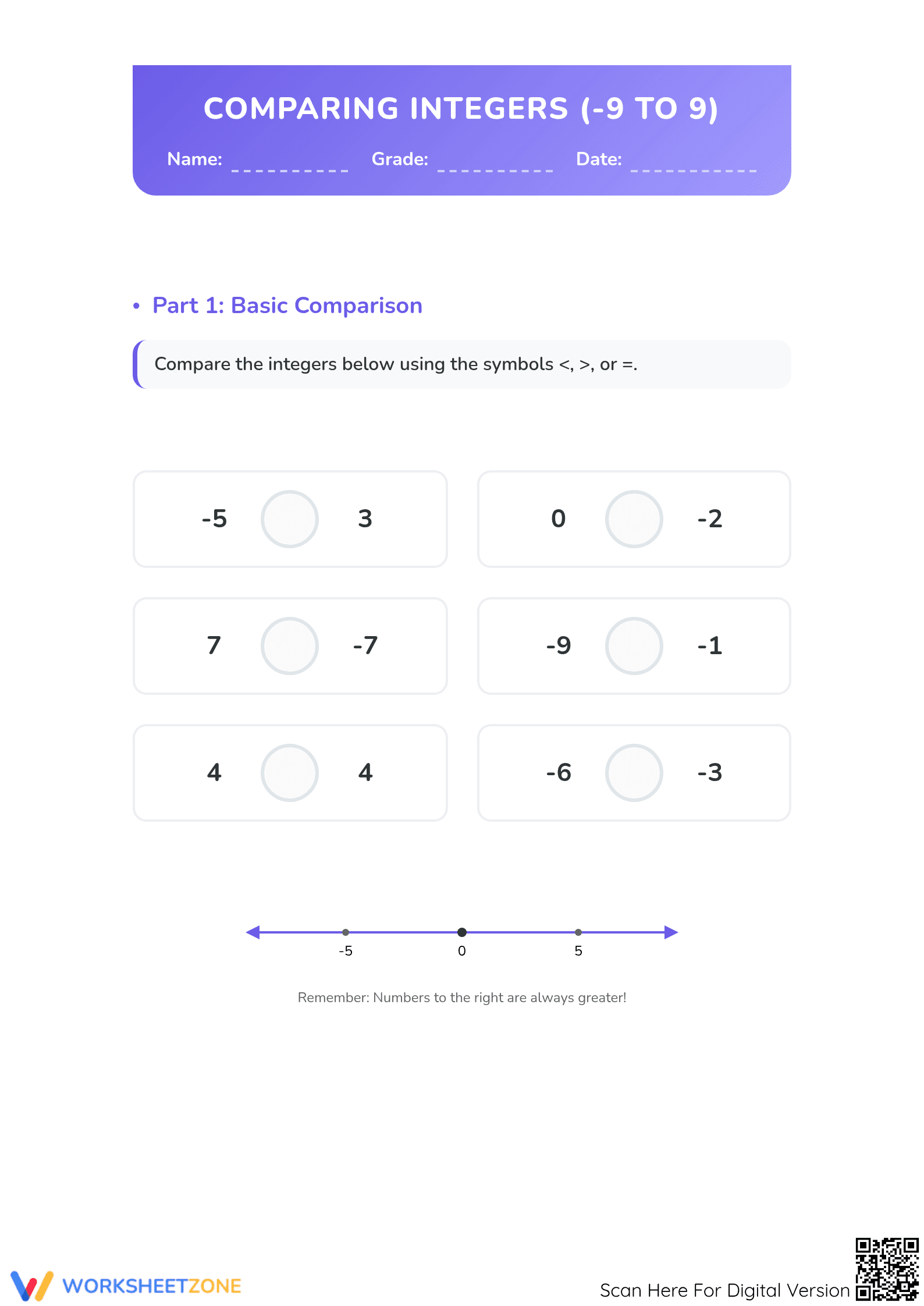
This comprehensive math worksheet helps Grade 5 students master the foundational skill of comparing integers within the range of -9 to 9. By utilizing a clear number line and structured practice, students transition from basic understanding to confident application of inequality symbols. This resource ensures that learners recognize how numerical position correlates to value in the integer system.
At a Glance
- Grade: 5 · Subject: Math
- Standard:
6.NS.C.7— Compare and order integers on a number line using inequality symbols- Skill Focus: Positive and negative integer comparison
- Format: 3-page PDF · 30 tasks · Full answer key included · Printable
- Best For: Individual practice, homework assignments, or guided small group instruction
- Time: 20–30 minutes
What's Inside
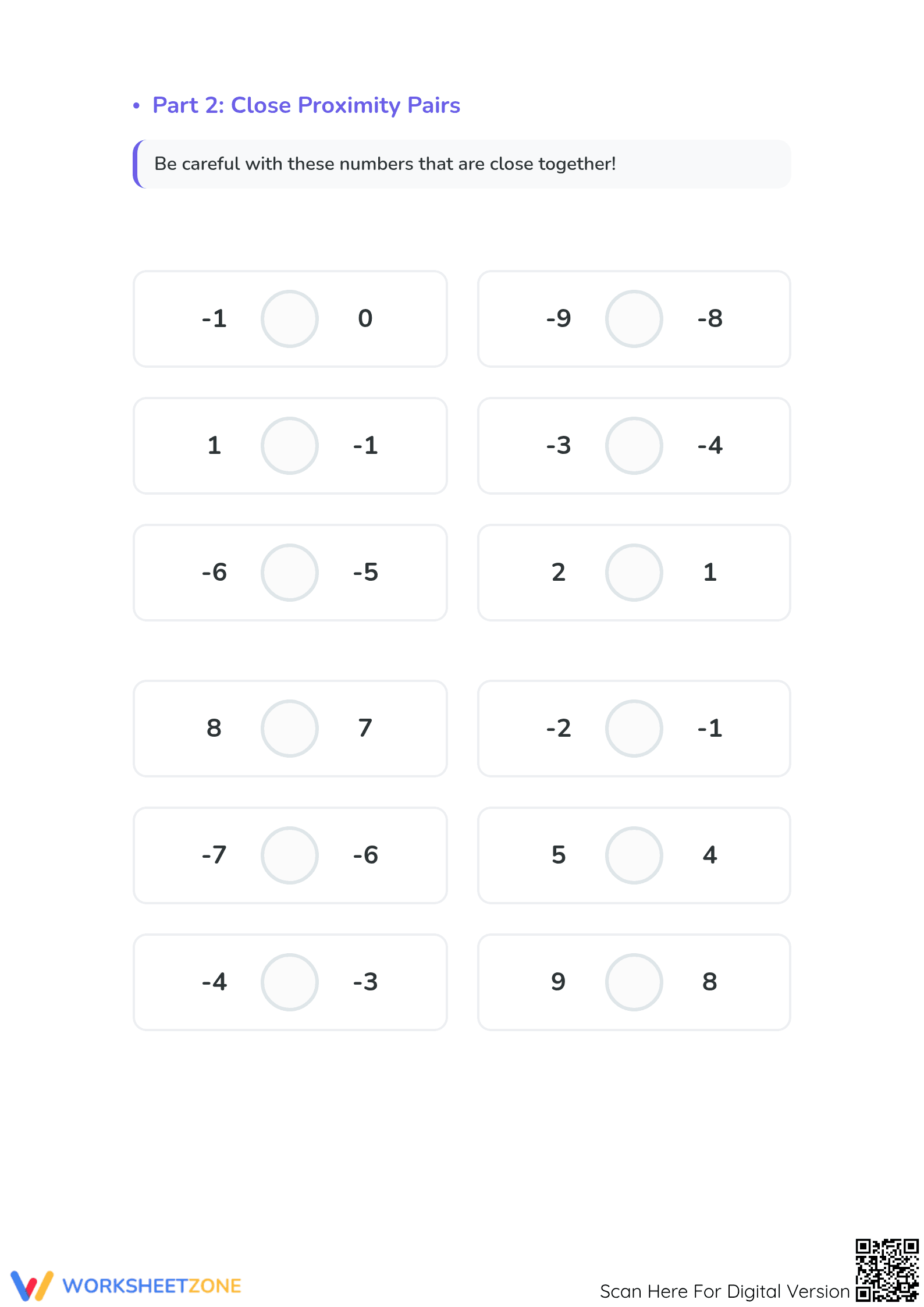
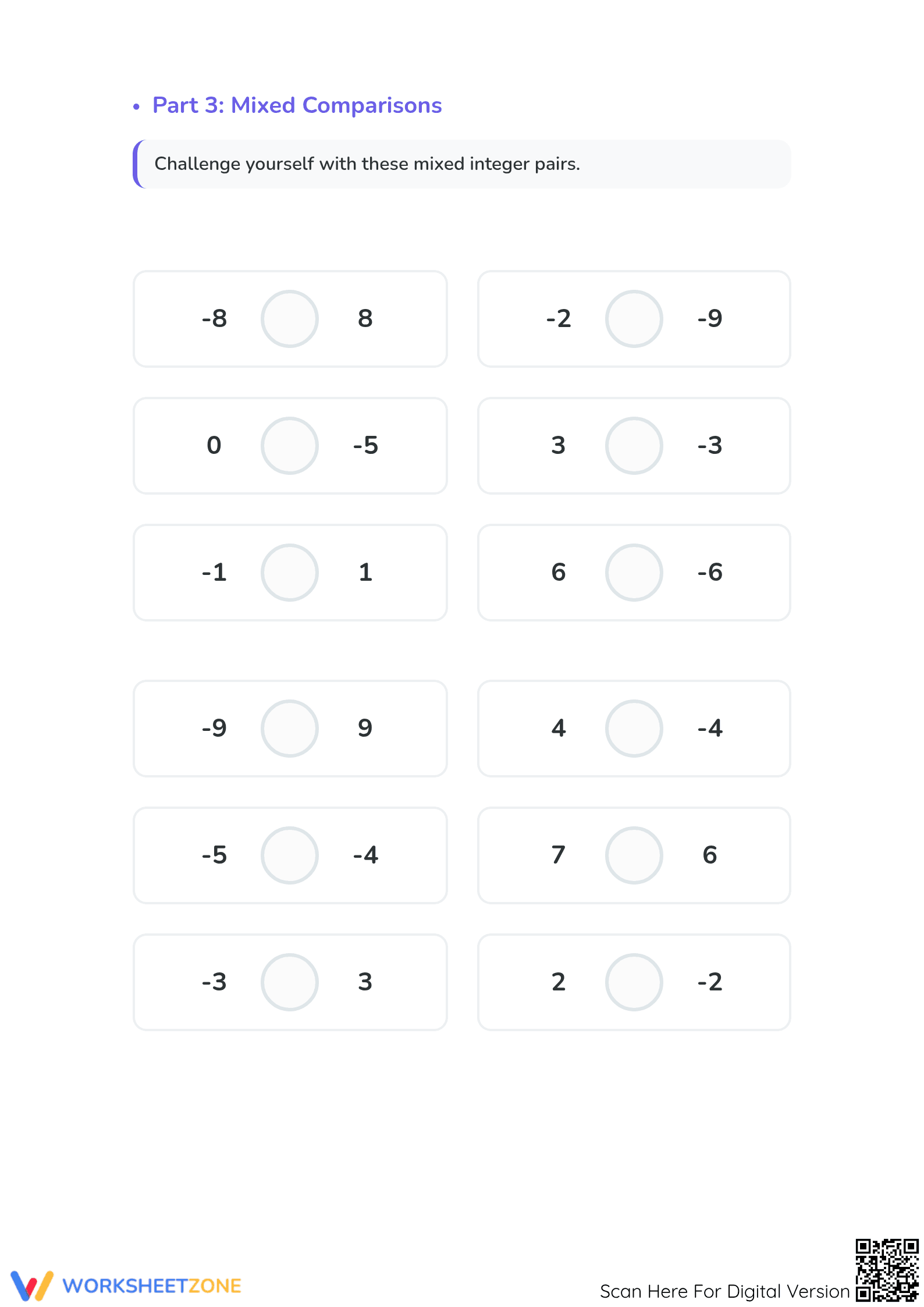
This three-page PDF package includes thirty distinct comparison tasks, a visual number line for immediate reference, and a comprehensive answer key for self-correction. The worksheet is organized into three logical segments: basic comparisons, close-proximity pairs designed to challenge misconceptions, and mixed sets that build cognitive flexibility and automaticity when working with both positive and negative values across the zero point.
Skill Progression
- Guided Practice: The first six tasks provide a visual number line as a scaffold, allowing students to map values directly before assigning symbols to ensure conceptual accuracy.
- Supported Practice: Twelve "Close Proximity" tasks force students to look beyond absolute value, focusing on pairs like -9 and -8 to reinforce the rule that numbers to the right are greater.
- Independent Practice: Twelve final mixed-set problems remove specific scaffolds to test mastery and ensure students can independently evaluate integer values without visual aid.
This progression follows the gradual-release model, moving students from supported visual identification to abstract mental evaluation of number pairs.
Standards Alignment
The primary alignment for this resource is 6.NS.C.7. It addresses the ability to interpret statements of inequality as statements about the relative position of two numbers on a number line diagram. This worksheet also supports coordinate plane readiness by securing number system fundamentals. Standard codes can be copied directly into lesson plans, IEP goals, or district curriculum mapping tools.
How to Use It
Implement this during the independent practice phase of a lesson. Observe students as they work through the "Close Proximity" pairs, noting if they incorrectly label -9 as greater than -8. The expected completion time is 25 minutes, making it an excellent formative assessment for coordinate graphing readiness.
Who It's For
Designed for Grade 5 students introduced to negative numbers, this set is also ideal for middle school intervention or as a warm-up for algebra. It pairs naturally with a vertical thermometer anchor chart or a physical number line activity. Differentiation is built into the sequence, supporting both struggling learners and those ready for abstract comparisons.
According to research by Fisher & Frey (2014) on the gradual release of responsibility, structured practice that moves from high-scaffold visual aids to independent abstract tasks is critical for mastery of complex numerical concepts. Comparing integers is a threshold skill in mathematics, and failing to secure this understanding early can lead to persistent errors in algebra and coordinate geometry. This Grade 5 worksheet addresses 6.NS.C.7 by providing 30 targeted problems that explicitly address common student misconceptions, such as the confusion between absolute magnitude and actual value in the negative range. By integrating a permanent number line visual and specifically targeting close-proximity pairs, this resource aligns with best practices for mathematical fluency. The inclusion of a full answer key further supports the instructional cycle by allowing for immediate feedback and error analysis, which are essential components of effective math instruction as cited in current pedagogical frameworks.


