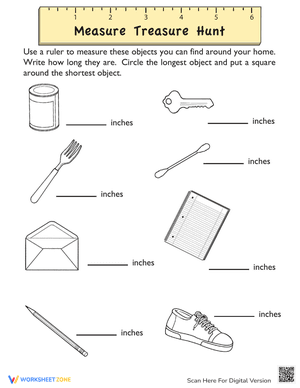
These comparing and ordering length worksheets give K–2 teachers a structured sequence of printable practice that moves students from basic "which is longer" judgments all the way through arranging multiple objects by size — without requiring manipulatives, prep kits, or special materials. Print and go.
What Skills Do These Comparing and Ordering Worksheets Address?
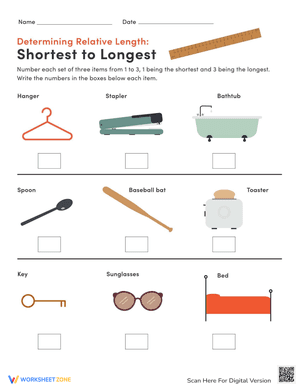
The worksheets address a progression that tightens as grade level increases. At the entry point, students look at two illustrated objects — a paintbrush next to a marker, say — and circle the longer or shorter one. From there, tasks move to ordering sets of three, four, or five objects from shortest to longest, which demands something the two-object comparison does not: holding multiple relationships in mind at once. Cut-and-paste pages add a kinesthetic layer well-suited to Kindergarten and early Grade 1, where physically placing the pictures in sequence often clarifies what a pencil-and-paper task leaves fuzzy.
Later pages introduce indirect comparison — using a third object as a go-between when two items can't be placed side by side — and non-standard unit tasks where students count paper clips or cubes and compare the totals. Both skills move thinking from perceptual ("it looks longer") toward relational reasoning, which is exactly what second-grade measurement instruction builds on.
Standards Alignment
CCSS K.MD.A.2 asks Kindergartners to directly compare two objects with a measurable attribute and describe the difference — longer, shorter, same length. That standard maps cleanly onto the two-object comparison pages. The jump to Grade 1 is meaningful: CCSS 1.MD.A.1 formalizes ordering three objects by length and introduces indirect comparison through a third object. Teachers sometimes underestimate how much harder ordering is than comparing; students who can immediately identify the longer of two pencils will still hesitate when asked to sequence five objects because the task requires iterative comparison rather than a single perceptual judgment. The Grade 1 worksheets in this set are calibrated to that expectation, with object sets ranging from three to five items and some tasks that ask students to mark their reasoning rather than just circle a final answer.
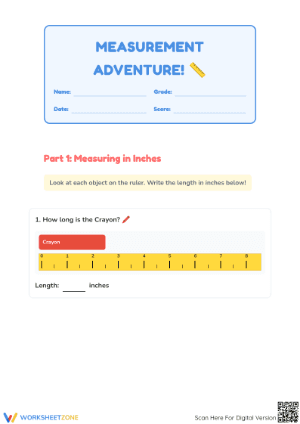
By Grade 2, the standards pivot toward standard units and rulers, but measurement vocabulary and comparative thinking remain relevant — especially for students who are still shaky on which end of a ruler anchors the measurement. Teachers at that grade often pull the more complex ordering pages as a warm-up or review tool in the first weeks of a measurement unit.
Common Mistake Of Students That Teachers Should Aware and Address
The most consistent error in direct-comparison tasks is baseline misreading: a student sees two objects that aren't aligned at a common left edge and picks the one that extends farthest to the right, regardless of where it starts. This error almost never surfaces when students are comparing real objects they can hold — it's a picture-reading problem, not a length-concept problem. Worksheets where one object is shifted slightly right trip up this group every time. When students make this error repeatedly, the fix is usually a brief anchor lesson where they draw a vertical line down the left edge of both objects before comparing.
Ordering tasks surface a different pattern: students correctly identify the shortest and longest but place the middle object by feel rather than by checking it against both neighbors. A fifth-grader watching a first-grader work through a five-item ordering page will see this immediately — the child locks in the two endpoints and then eyeballs the middle. Worksheets that require students to mark or number each object in sequence make this shortcut visible and give you a clear re-teaching signal before moving to indirect comparison.
Recommended Lesson Planning Strategies To Take Full Advantages Of These Worksheets
The most effective use in Kindergarten is immediately after a brief manipulative introduction — three minutes of physically lining up crayons at a common baseline, then moving straight to the worksheet while the experience is fresh. Cognitive load is lowest right after the concrete task, and students transfer what they just did with their hands to what they're now doing on paper. Waiting until the following day costs you that transfer window.
In Grade 1, these pages work well as math center rotation materials. A bin of three real objects alongside the corresponding worksheet gives students a self-checking mechanism: complete the ordering on paper, then line up the actual objects to confirm. Students who disagree with their own earlier answer often self-correct without teacher intervention, which frees you to work with the group that needs reteaching on indirect comparison.
For formative purposes, a two-object comparison sheet takes about four minutes to complete and tells you immediately which students are ready to move toward ordering tasks. Running one of these as a pre-lesson check on a Monday saves the whole class from sitting through a lesson pitched at the wrong level.
Frequently Asked Questions
What's the right order — manipulatives first, or worksheet first?
Manipulatives first, always, for initial instruction. The concrete experience gives students something to anchor the picture-based task to. Once the concept is established over several lessons, worksheets can precede or replace the manipulative step for students who have internalized it. Don't skip the physical work during initial introduction; it shortens the re-teaching cycle later.
Can these work for Grade 2 review, or are they too easy?
The indirect-comparison and non-standard-unit pages hold up for Grade 2 review, especially for students who are inconsistent with early measurement vocabulary. The basic two-object pages are genuinely too simple for most Grade 2 students working at grade level, but they're appropriate for students receiving support in measurement who haven't solidified the foundation.
How do I use these for formative assessment without turning every worksheet into a quiz?
The most useful formative move is a brief verbal follow-up after students complete the page — ask one student to explain why they chose their answer for a specific problem. That thirty-second conversation tells you more than the circled answer does. If you're checking the whole class, scan for the baseline-misreading error described above; it clusters predictably and tells you exactly where to direct small-group time the next day.
















 Interactive Worksheet Maker
 Quiz Maker
 Word Search Maker
 Crossword Puzzle Maker
 Word Scramble Generator
 Sentence Scramble Generator
 Handwriting Worksheet Generator
 Name Tracing Generator
 Fill In The Blank Generator