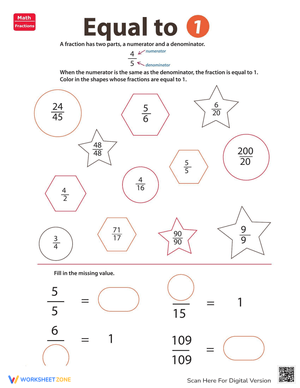
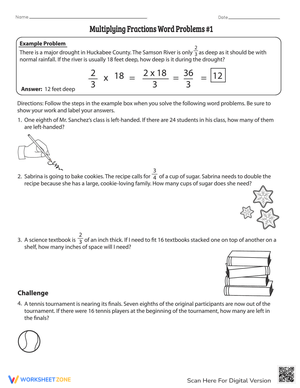
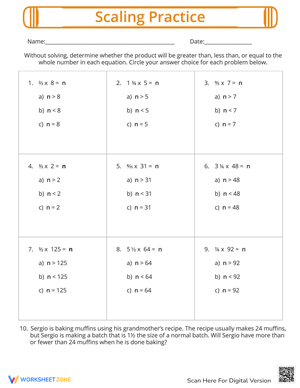
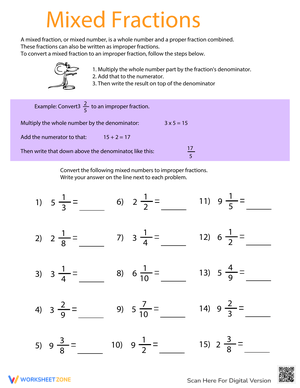
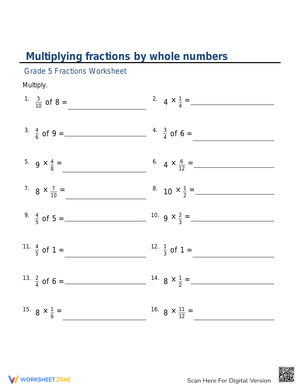
These whole numbers as fractions worksheets give 3rd and 4th grade teachers a direct, reusable tool for one of the trickier conceptual transitions in elementary math — the moment students need to stop treating whole numbers and fractions as separate categories and start seeing them as the same number expressed different ways. Each page targets both directions of that skill: writing whole numbers as fractions and recognizing when a fraction simplifies to a whole number.
Concepts on Each Page
The bedrock skill is the denominator-of-1 rule: any whole number n written as n/1. Students write 6 as 6/1, rewrite 9 as 9/1, and start to understand why the denominator matters as much as the numerator. From there, the worksheets move into equivalent forms — fractions like 8/2, 9/3, and 12/4 that divide evenly and land exactly on a whole number. Students mark, underline, or circle these on number lines printed directly on the page, then record the simplified result.
Later pages ask students to generate multiple equivalent fractions for a single whole number. Given the whole number 4, can they produce four/1, eight/2, twelve/3, sixteen/4? That generative step is where the rule stops being a trick and becomes a transferable idea. It also surfaces which students have genuinely internalized the concept versus which ones are applying a memorized procedure without understanding why it works.
Where These Fit in a Lesson
Most teachers reach for one of these pages during the independent practice block that follows direct instruction — the 12 to 15 minutes after a number line demonstration when students need something structured to work through on their own. They also work well as Monday warm-ups during the week a class is mid-unit on fractions, because returning to the whole-number connection each morning keeps the conceptual anchor fresh without taking more than 5 minutes of instructional time.
The pages with fraction-bar visuals printed alongside the problems are better suited to the early days of instruction, when students are still building a mental model. The cleaner symbolic pages — problems only, no embedded visuals — work better once students are consolidating, or as a brief formative check at the end of a lesson. Swapping between the two formats across a unit is a low-effort way to manage cognitive load: scaffolded support early, gradual release as fluency develops.
Patterns You'll Recognize in Student Work
The most consistent error appears when students treat the denominator as arbitrary. A student who correctly writes 5 as 5/1 will sometimes also write 5/2 or 5/3 as equivalent — they understand that the 5 belongs in the numerator but haven't yet internalized that the denominator must divide evenly into the numerator for the fraction to equal a whole number. These worksheets surface that error quickly because problems like "does 10/3 equal a whole number?" require students to actually check, not just recall a rule.
A second pattern shows up with fractions like 4/4, 9/9, and 12/12. Students see the matching numerator and denominator and correctly say the fraction equals 1 — but when asked whether 8/8 and 5/1 both equal whole numbers, they hesitate at 5/1. The denominator-of-1 form looks unfamiliar next to the denominator-equals-numerator form, even though the underlying logic is the same. Pages that mix both types in the same problem set force students to apply the concept rather than recognize a visual pattern, which is where the real learning happens.
Why This Skill Lands at Third and Fourth Grade
Third grade is when the standards introduce fractions as numbers on a number line — not just as shaded pictures, but as positions with precise locations. That shift makes the whole-number connection essential: if 1/2 is a point between 0 and 1, then 2/2 must be exactly at 1, and 4/2 must be exactly at 2. Students who can place 4/2 on a number line and name it as 2 are doing something more sophisticated than students who only know 2/2 = 1 as a memorized fact. In 4th grade, that understanding becomes load-bearing when students add fractions with unlike denominators and need to convert whole numbers to match a common denominator.
Under CCSS 3.NF.A.3c, students are expected to express whole numbers as fractions and recognize fractions equivalent to whole numbers. The standard specifically names examples like 3/1 = 3 and 4/4 = 1, which is exactly the territory these worksheets cover. Teachers working with this standard for the first time often find that their students can answer 4/4 = __ correctly but struggle to explain why — these pages provide the repeated, varied practice that moves students from correct answer to secure understanding.
Adjusting for the Range in the Room
For students still working on basic fraction vocabulary — numerator, denominator, equal parts — the pages with embedded number lines reduce the working memory demand enough that they can focus on the conversion itself. A reference strip showing the denominator-of-1 rule in one corner helps students who freeze when they see an unfamiliar denominator.
Students who move through the standard problems quickly can extend by working in the other direction: given a whole number, generate as many equivalent fractions as they can in two minutes, then check each one by dividing. That self-checking habit — dividing to verify — is the same mental move they'll use when simplifying fractions in 4th and 5th grade, so building it here is worth the two extra minutes.
Frequently Asked Questions
1. How do you write a whole number as a fraction?
Write the whole number as the numerator and place 1 in the denominator. So 7 becomes 7/1, 12 becomes 12/1. Students can also express the same whole number using other equivalent fractions — 14/2 or 21/3 both equal 7 — as long as the numerator divides evenly by the denominator and produces the original whole number.
2. Do these pages work for students who are behind grade level in fractions?
Yes, particularly the pages that include number lines or fraction bar diagrams. Students who are still developing the part-whole understanding of fractions benefit from seeing the visual alongside the symbolic problem. Starting with fractions where the numerator and denominator match (2/2, 5/5) gives them an accessible entry point before moving to denominator-of-1 forms and other equivalent fractions.
3. How many problems per page?
Most pages in this set include 12 to 20 problems, with format varying by page — some are fill-in-the-blank, others ask students to circle all fractions equal to a given whole number, and a few include short constructed-response items where students explain their reasoning. The shorter pages work well as 5-minute warm-ups; the longer ones are sized for a full independent practice block.













 Interactive Worksheet Maker
 Quiz Maker
 Word Search Maker
 Crossword Puzzle Maker
 Word Scramble Generator
 Sentence Scramble Generator
 Handwriting Worksheet Generator
 Name Tracing Generator
 Fill In The Blank Generator