


























Views
Downloads
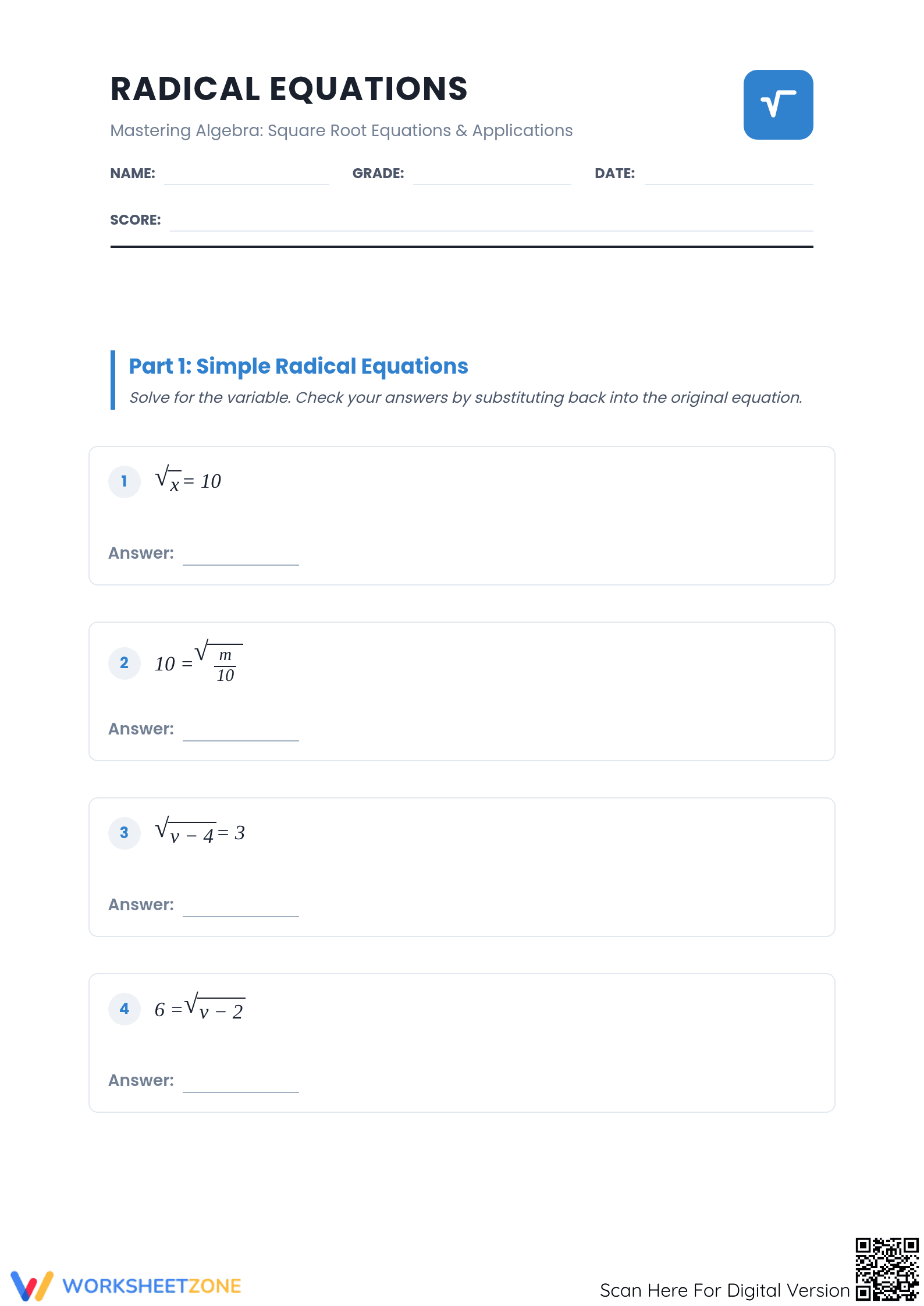


Printable Radical Equations Worksheet | Grade 8 Math
Paste this activity's link or code into your existing LMS (Google Classroom, Canvas, Teams, Schoology, Moodle, etc.).
Students can open and work on the activity right away, with no student login required.
You'll still be able to track student progress and results from your teacher account.
This comprehensive radical equations worksheet provides middle and high school students with targeted practice in solving square root equations. By working through these carefully sequenced problems, students will develop the algebraic reasoning required to isolate variables, square both sides, and identify extraneous solutions with confidence.
At a Glance
- Grade: 8 · Subject: Math
- Standard:
CCSS.MATH.CONTENT.HSA.REI.A.2— Solve simple radical equations in one variable- Skill Focus: Solving Radical Equations
- Format: 5 pages · 25 problems · Answer key included · PDF
- Best For: Independent practice and review
- Time: 30–45 minutes
Inside this printable math resource, educators will find 25 meticulously structured problems spread across five pages. The worksheet is divided into four distinct sections: Simple Radical Equations, Multi-Step Radical Equations, Equations with Variables on Both Sides, and Challenge & Extraneous Solutions. A complete answer key is included to streamline grading and allow for quick student self-assessment.
Skill Progression
- Guided practice: Part 1 introduces simple radical equations (8 problems) where students practice the fundamental step of squaring both sides to isolate the variable.
- Supported practice: Parts 2 and 3 (16 problems) increase the complexity, requiring students to perform multi-step algebraic manipulation and handle variables on both sides of the equation.
- Independent practice: Part 4 challenges students with advanced equations where they must actively check for and identify extraneous solutions.
This gradual-release approach ensures students build foundational confidence before tackling more rigorous algebraic concepts.
Standards Alignment
This resource is directly aligned to CCSS.MATH.CONTENT.HSA.REI.A.2: "Solve simple rational and radical equations in one variable, and give examples showing how extraneous solutions may arise." It also supports foundational Grade 8 expressions and equations standards. Both standard codes can be copied directly into lesson plans, IEP goals, or district curriculum mapping tools.
How to Use It
Deploy this worksheet during the core instructional block after your initial direct instruction on inverse operations and square roots. It serves as an excellent independent practice assignment or homework packet. As a formative assessment tip, monitor students as they transition from Part 2 to Part 3; watch closely to ensure they are correctly squaring binomials when variables appear on both sides. Most students will complete the full problem set in 30 to 45 minutes.
Who It's For
This resource is optimized for 8th-grade pre-algebra and 9th-grade Algebra 1 students. For learners needing additional support, teachers can assign only Parts 1 and 2 to focus on foundational isolation techniques. Advanced students will benefit from the rigorous extraneous solution checks in Part 4. It pairs perfectly with an anchor chart detailing the steps for isolating radicals and checking answers.
Mastering algebraic manipulation requires consistent, structured practice that gradually increases in cognitive demand. Aligned with CCSS.MATH.CONTENT.HSA.REI.A.2, this resource helps students solve simple radical equations in one variable while explicitly checking for extraneous solutions. According to EdReports 2024, high-quality instructional materials in mathematics must provide intentional progressions that move students from procedural fluency to deep conceptual understanding. By structuring the practice into four distinct phases—from simple isolation to complex equations with variables on both sides—this worksheet minimizes cognitive overload. Students are able to internalize the core algorithm before applying it to more complex scenarios where extraneous solutions frequently emerge. This systematic approach ensures learners build the robust algebraic reasoning skills necessary for success in advanced high school mathematics courses and standardized assessments.


