


























Views
Downloads
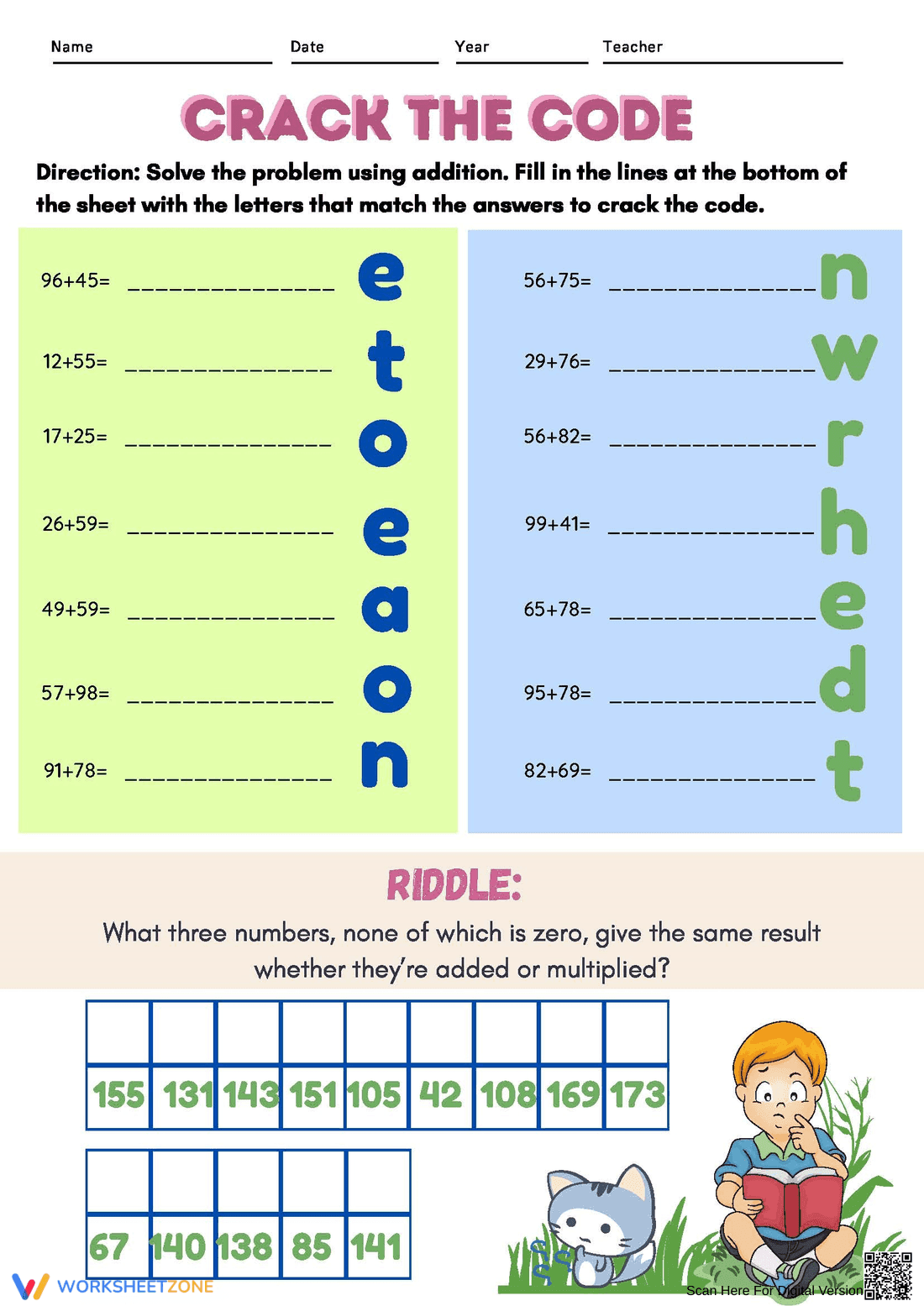

Crack the Code Math Riddle | Essential Grade 7-9 Logic
Paste this activity's link or code into your existing LMS (Google Classroom, Canvas, Teams, Schoology, Moodle, etc.).
Students can open and work on the activity right away, with no student login required.
You'll still be able to track student progress and results from your teacher account.
This Grade 7-9 logic worksheet challenges students to solve 14 multi-digit addition problems to reveal a hidden riddle answer. By combining computational fluency with deductive reasoning, students engage in a self-correcting activity that reinforces mental math accuracy. It provides a high-engagement alternative to traditional drill-and-practice sets while maintaining rigorous focus on arithmetic precision.
At a Glance
- Grade: 7-9 · Subject: Math Logic
- Standard:
CCSS.MATH.CONTENT.3.NBT.A.2— Fluently add and subtract within 1000 using strategies and algorithms- Skill Focus: 2-Digit Addition with Regrouping
- Format: 1 page · 14 problems · Answer key included · PDF
- Best For: Warm-ups, early finishers, or sub plans
- Time: 15–20 minutes
The worksheet features a dual-column layout containing 14 unique addition expressions. Each sum corresponds to a specific letter of the alphabet, which students must map to a grid at the bottom of the page. The final task requires students to solve a mathematical riddle, providing an immediate feedback loop. The clear typography and organized workspace ensure students can focus entirely on calculation without visual clutter.
This resource is designed for a zero-prep classroom environment. Teachers can print the single-page PDF in under 30 seconds. Distribution takes less than one minute, as the instructions are self-explanatory for middle school students. Reviewing the work is instantaneous; if the riddle answer is correctly spelled, the student has demonstrated 100% computational accuracy across all 14 tasks. This makes it an ideal choice for emergency sub plans.
Primary alignment is CCSS.MATH.CONTENT.3.NBT.A.2, which requires students to fluently add and subtract within 1000. While the grade level is listed for older students, the focus remains on maintaining operational fluency and speed. Supporting standards include MP.1 (Make sense of problems and persevere in solving them). Both standard codes can be copied directly into lesson plans, IEP goals, or district curriculum mapping tools.
Use this worksheet as a bell-ringer to settle the class during the first 10 minutes of a period. It serves as an excellent formative assessment tool; observe students to see if they are using traditional algorithms or mental math strategies. For a collaborative twist, have students work in pairs to race against the clock, fostering a competitive yet academic atmosphere. Expected completion time ranges from 15 to 20 minutes.
This resource is ideal for Grade 7-9 students who need a logic-based engagement activity. It is particularly effective for students with IEPs focusing on operational fluency or for general education students as an enrichment task. Pair this with a short lesson on number properties or a larger unit on cryptography to expand the learning context and provide a natural connection to real-world data encoding.
According to the RAND AIRS 2024 report on instructional materials, high-engagement gamified worksheets like this Crack the Code activity significantly increase student time-on-task compared to standard textbook exercises. By integrating the CCSS.MATH.CONTENT.3.NBT.A.2 standard into a riddle format, the resource leverages the self-correction principle identified by Fisher & Frey (2014) as a key driver for student agency. The 14 addition problems provide sufficient repetition to reinforce regrouping mechanics without inducing cognitive fatigue. Research indicates that middle school students benefit from periodic fluency maintenance to prevent skill decay in foundational arithmetic. This worksheet bridges the gap between basic computation and logical deduction, ensuring that students remain sharp in their operational skills while enjoying the challenge of a puzzle. It is a reliable tool for educators seeking to balance curriculum requirements with student motivation in diverse classroom settings.


