


























Views
Downloads

Grade 1 Regrouping Math — Printable No-Prep Worksheet
Paste this activity's link or code into your existing LMS (Google Classroom, Canvas, Teams, Schoology, Moodle, etc.).
Students can open and work on the activity right away, with no student login required.
You'll still be able to track student progress and results from your teacher account.
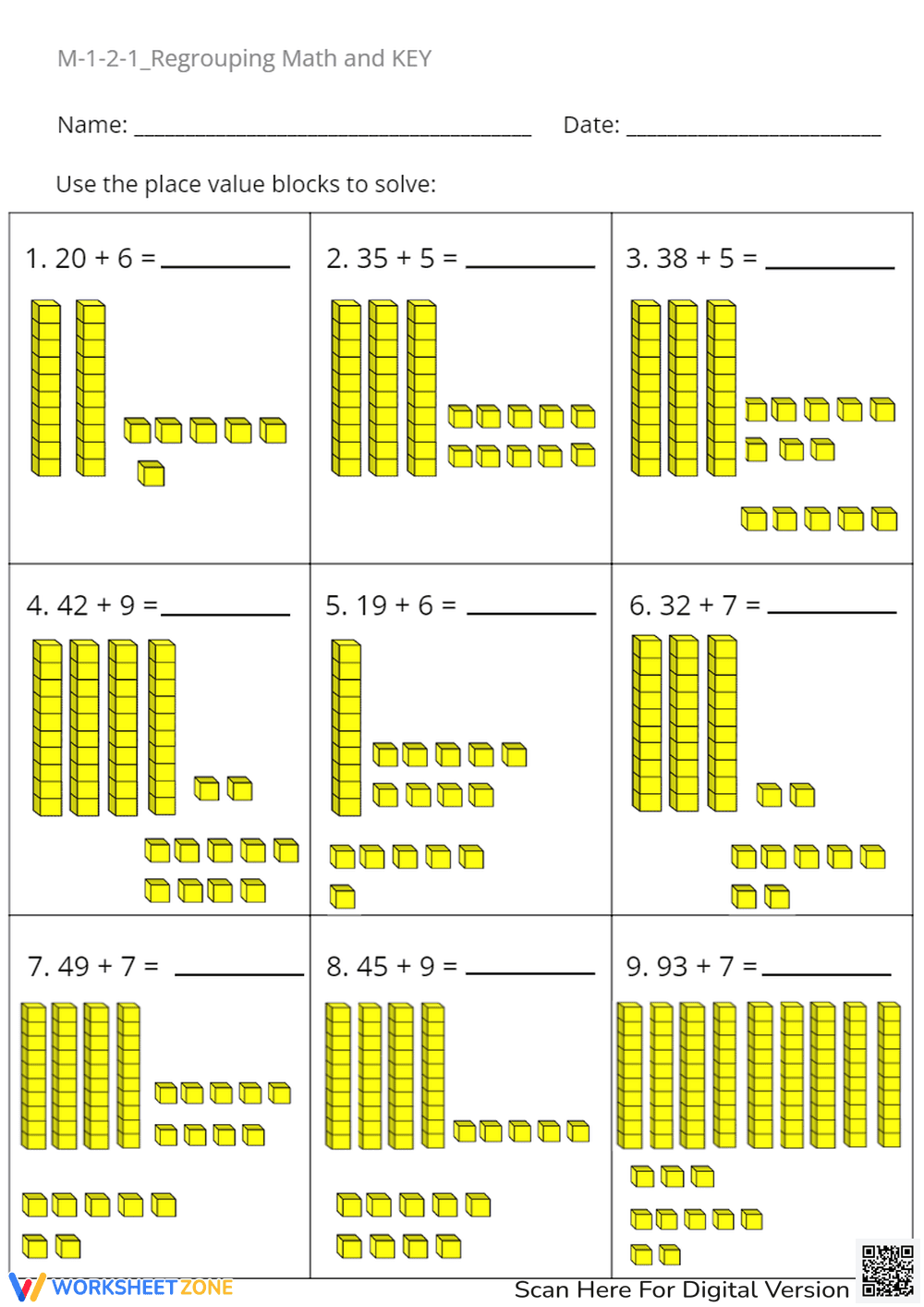
This Grade 1 addition worksheet helps students master regrouping concepts using visual place value blocks. By solving 9 structured problems, learners connect concrete base-ten representations to abstract addition equations. This resource builds conceptual understanding of composing and decomposing numbers, ensuring students grasp the mechanics of carrying ones to the tens place.
At a Glance
- Grade: 1 · Subject: Math
- Standard:
CCSS.MATH.CONTENT.1.NBT.C.4— Add within 100 using concrete models or drawings and strategies based on place value- Skill Focus: Addition with regrouping
- Format: 1 page · 9 problems · Answer key included · PDF
- Best For: Independent practice and formative assessment
- Time: 15–20 minutes
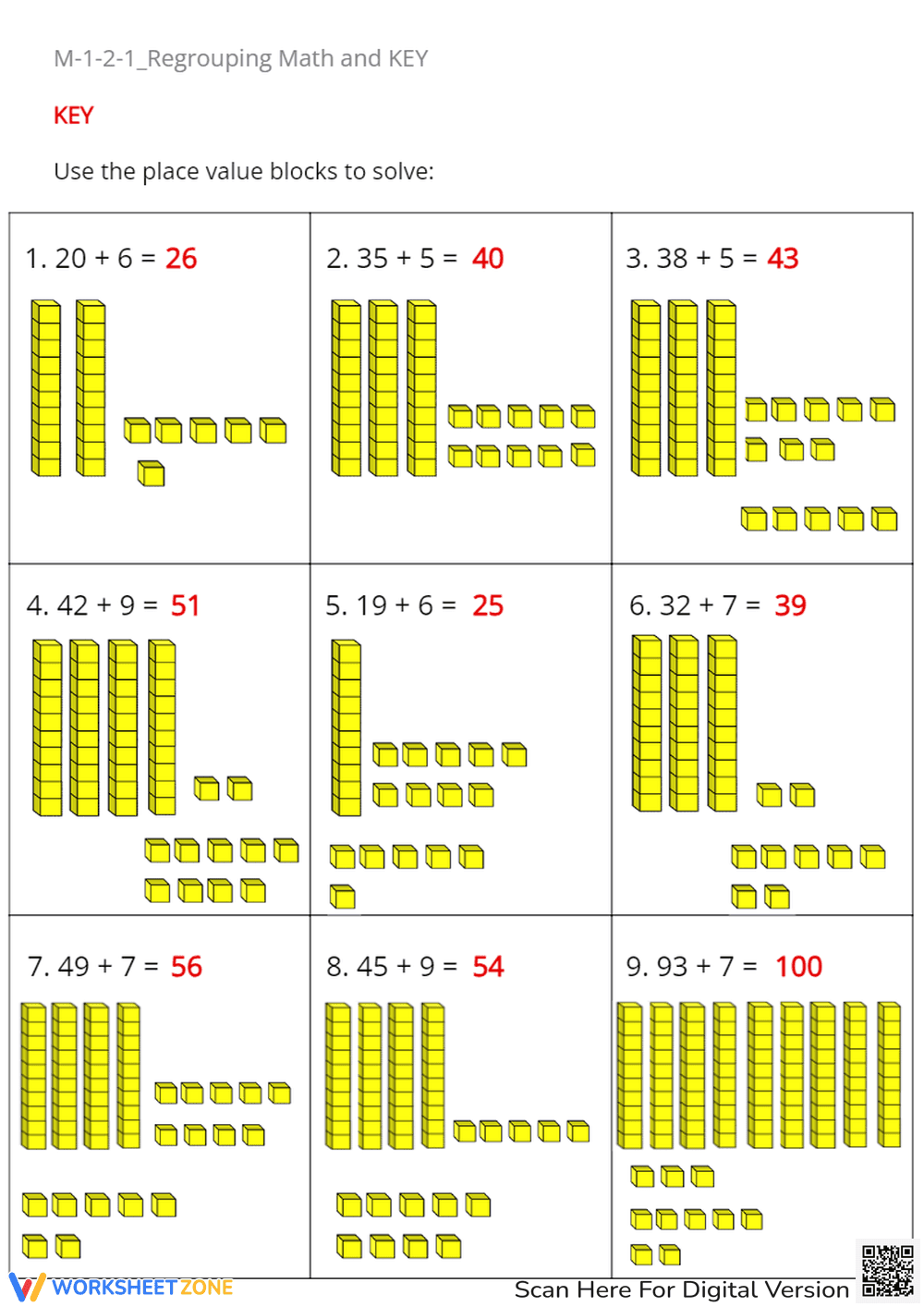
This single-page PDF contains 9 distinct addition problems pairing a two-digit number with a single-digit number. Each problem features clear, high-resolution illustrations of base-ten blocks (tens rods and ones units) to scaffold student calculations. The layout provides dedicated space for writing the final sum, and a complete teacher answer key is included for rapid grading.
Zero-Prep Workflow
This resource requires under 2 minutes of teacher prep. First, print the single-page sheet (30 seconds). Next, distribute copies and read the directions (1 minute). Finally, review answers using the visual key (30 seconds). This layout is ideal for emergency sub plans, morning work, or independent math centers.
Standards Alignment
This activity aligns with CCSS.MATH.CONTENT.1.NBT.C.4, requiring students to add within 100 using concrete models. It supports foundational place value concepts by demonstrating how ten ones compose a new ten rod. Both standard codes can be copied directly into lesson plans, IEP goals, or district curriculum mapping tools.
How to Use It
Use this worksheet during independent practice following direct instruction on regrouping. Alternatively, assign it as an exit ticket to assess understanding of composing tens. Observe if students count every block or recognize tens rods immediately for a quick formative assessment. Completion takes 15 to 20 minutes.
Who It's For
This worksheet is tailored for first-grade students, but serves as an intervention tool for second graders needing concrete reinforcement. Differentiate by providing physical base-ten blocks for struggling learners to manipulate alongside the printed images. Pair this with a hands-on base-ten matching game to deepen conceptual understanding.
This educational resource targets the standard CCSS.MATH.CONTENT.1.NBT.C.4, focusing on the plain-English skill of adding a two-digit number and a one-digit number using concrete place value models. According to research from Fisher & Frey (2014) on the gradual release of responsibility, visual scaffolds like base-ten illustrations bridge the gap between concrete manipulation and abstract mathematical reasoning. By representing numbers visually, the worksheet helps young learners conceptualize regrouping before they transition to standard algorithms. This structured approach prevents common misconceptions, such as incorrectly writing double-digit values in the ones column. The 9 problems provide sufficient practice to build procedural fluency while maintaining student engagement. Educators can confidently integrate this worksheet into their curriculum, knowing it aligns with evidence-based practices for early numeracy development and supports systematic skill acquisition in diverse classroom settings.


