


























Views
Downloads
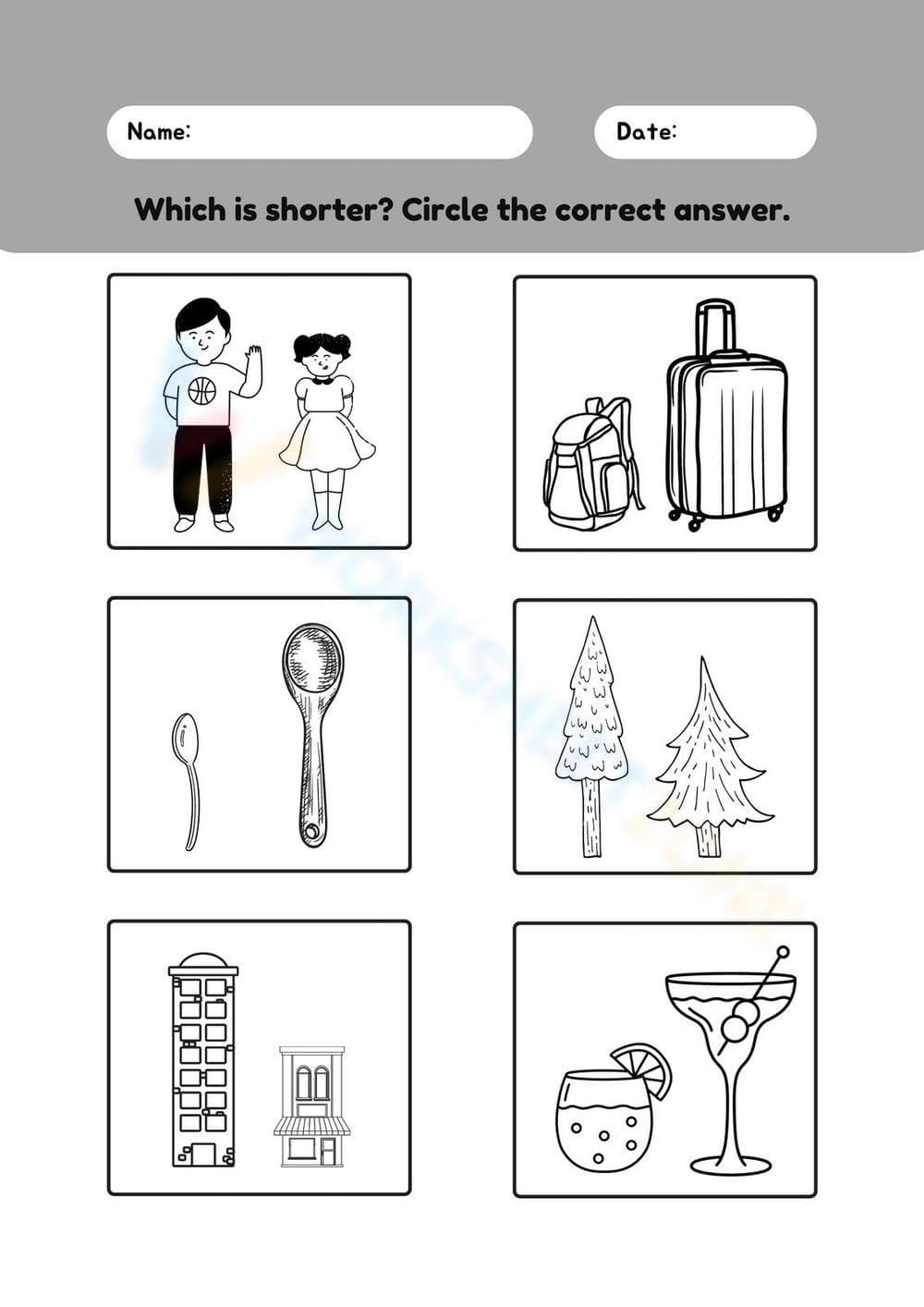

Which Is Shorter? Printable Grade K Measurement Worksheet
Paste this activity's link or code into your existing LMS (Google Classroom, Canvas, Teams, Schoology, Moodle, etc.).
Students can open and work on the activity right away, with no student login required.
You'll still be able to track student progress and results from your teacher account.
This Kindergarten measurement worksheet helps students master the concept of relative length by identifying shorter objects. By comparing 6 distinct pairs of everyday items, learners develop the foundational vocabulary and visual discrimination skills necessary for formal measurement. It provides a clear, distraction-free environment for early math success.
At a Glance
- Grade: Kindergarten · Subject: Math
- Standard:
CCSS.MATH.CONTENT.K.MD.A.2— Directly compare two objects with a measurable attribute in common to see which is shorter- Skill Focus: Comparing lengths and heights
- Format: 1 page · 6 problems · Answer key included · PDF
- Best For: Early finishers or morning work
- Time: 5–10 minutes
Inside this resource, you will find a single-page, black-and-white activity featuring 6 side-by-side comparisons. Each box contains two illustrations—such as people, bags, spoons, or trees—of varying sizes. The simple "Circle the correct answer" instruction ensures students can work independently without complex reading requirements.
The zero-prep workflow is designed for busy educators. First, print the single-page PDF (30 seconds). Next, distribute the sheets to students during your math block or as a transition activity (1 minute). Finally, review the answers as a whole group to reinforce measurement vocabulary like "shorter" and "taller" (2 minutes). This makes it an ideal choice for emergency sub plans.
This activity aligns with `CCSS.MATH.CONTENT.K.MD.A.2`, which requires students to directly compare two objects with a measurable attribute in common and describe the difference. It specifically targets the "shorter" descriptor. Both standard codes can be copied directly into lesson plans, IEP goals, or district curriculum mapping tools.
Use this worksheet as a quick formative assessment after a hands-on lesson with manipulatives. Observe if students can distinguish height (the trees) from length (the spoons). It also serves as an excellent exit ticket to gauge student understanding before moving to non-standard units of measurement. Expected completion time is under 10 minutes.
This resource is ideal for Kindergarten students, preschool learners ready for enrichment, and English Language Learners (ELLs) who need visual support to master comparative adjectives. It pairs naturally with a classroom scavenger hunt where students find objects shorter than a standard pencil or a direct instruction lesson on size.
According to Fisher & Frey (2014), the gradual release of responsibility begins with clear, focused tasks that allow students to apply new vocabulary in a structured context. This worksheet facilitates that application by isolating the attribute of length. By focusing on CCSS.MATH.CONTENT.K.MD.A.2, the activity ensures that students are not just guessing but are actively comparing physical properties. Research from the NAEP suggests that early mastery of comparative language is a significant predictor of later success in geometry and spatial reasoning. This 6-task exercise provides the repeated exposure necessary for Kindergarteners to internalize the concept of shorter versus longer or taller. It is a foundational tool for building the mathematical fluency required for more complex measurement standards in first grade and beyond, providing a reliable data point for early childhood progress monitoring.


