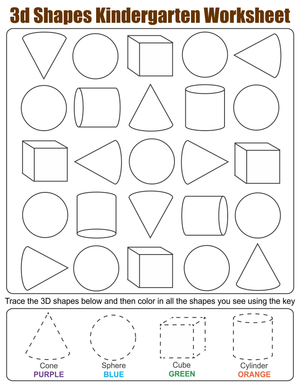
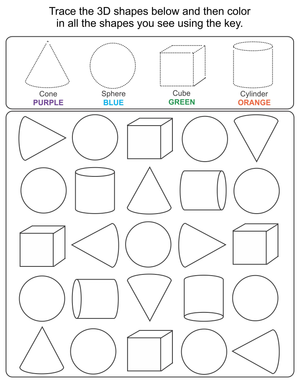
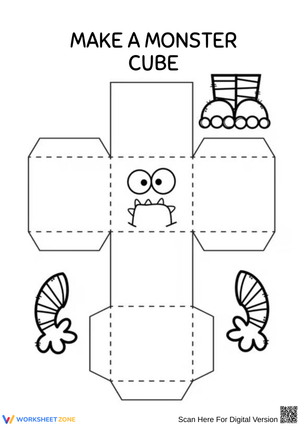
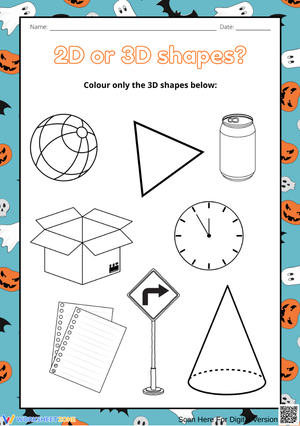
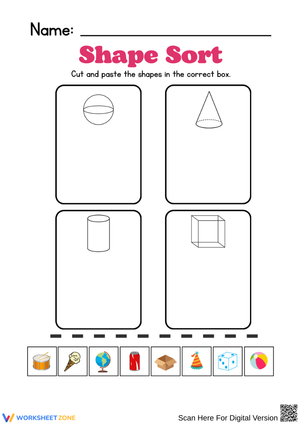
If you teach kindergarten math, you already know that solid shapes trip up young learners more than flat ones. A cube looks like a square until a student picks it up and feels its corners. 3D shapes worksheets for kindergarten give you a low-prep way to bridge that gap between hands-on exploration and the vocabulary students need for later grades. Instead of building a geometry unit from scratch, you can slot these pages into morning work, math centers, or small-group time and know the skills line up with what your standards require.
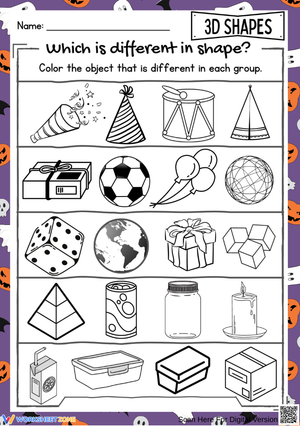
Kindergarten geometry is not about proofs or formulas. It is about noticing that a ball rolls because it has no flat side, and that a box stacks because it has faces that meet at corners. Worksheets that ask students to sort, circle, and name solid shapes reinforce that noticing in a format you can grade in seconds and file for parent conferences or intervention notes.
What CCSS K.G.A.3 and K.G.B.4 Ask of Five- and Six-Year-Olds
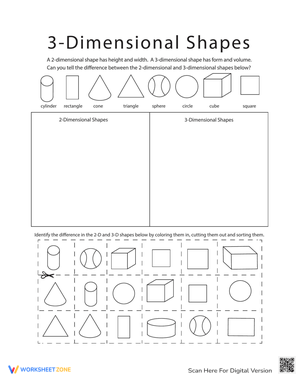
Two standards drive most kindergarten geometry instruction. CCSS K.G.A.3 asks students to identify shapes as two-dimensional, meaning flat, or three-dimensional, meaning solid. CCSS K.G.B.4 pushes further, asking students to analyze and compare 2D and 3D shapes using informal language about sides, corners, and other attributes.
Neither standard expects formal terms like vertex or polyhedron on day one. The expectation is informal description: a cube has flat sides and pointy corners, a sphere is round all over, a cylinder has two flat ends and a curved side in between. Worksheets built around this informal language, rather than jumping straight to technical vocabulary, match the actual grain size of the standard and keep struggling students from checking out.
Pairing Real Classroom Objects with the Four Core Solids
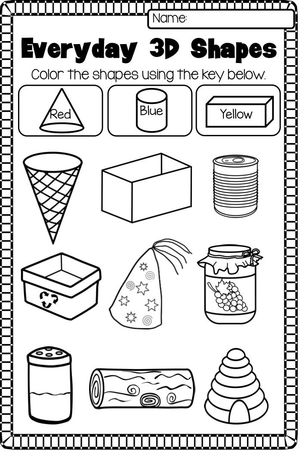
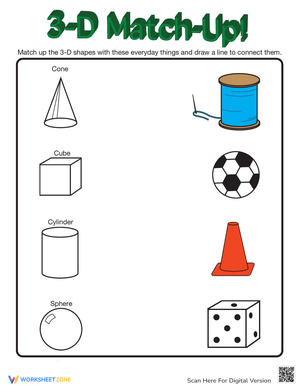
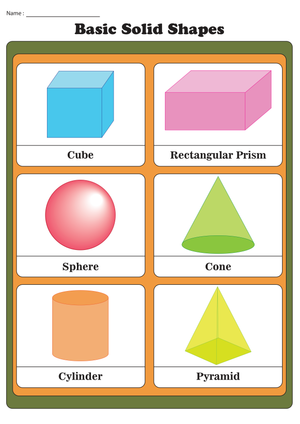
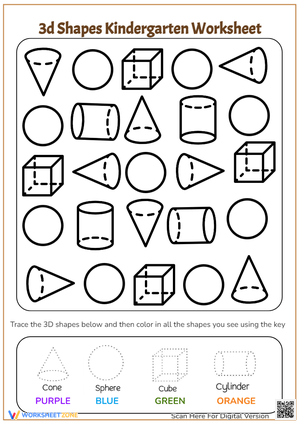
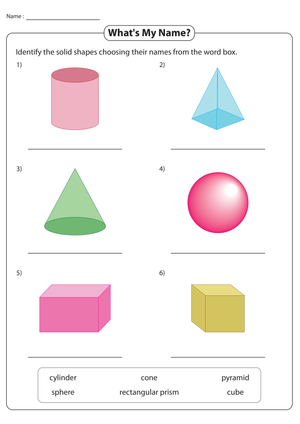
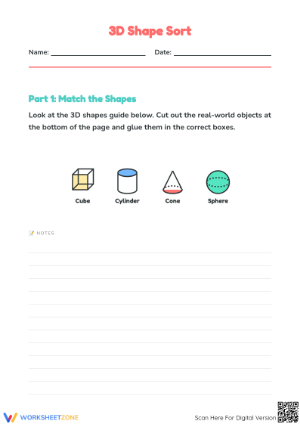
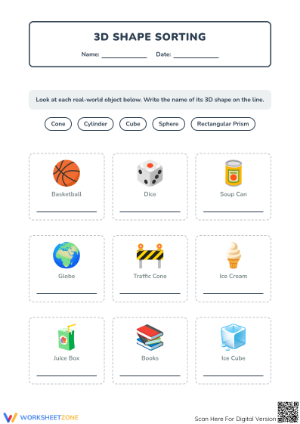
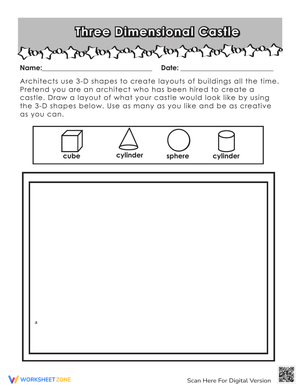
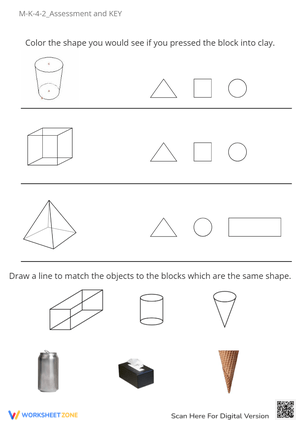
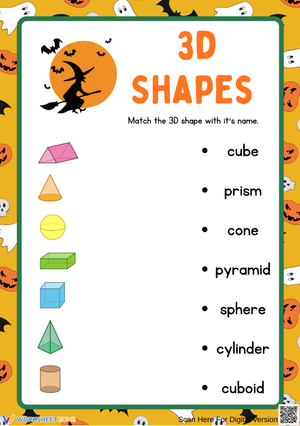
The four solids kindergarten standards focus on are the cube, sphere, cylinder, and cone. Worksheets land best when they are used alongside real objects students can hold: a tissue box for the cube, a playground ball for the sphere, a soup can for the cylinder, and a party hat or ice cream cone for the cone.
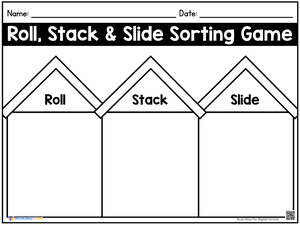
A simple routine works well. Before handing out a shapes worksheet, pass around three or four real objects and ask students to describe what they feel: flat sides, round surfaces, pointed tips. Then have them complete the matching worksheet, sorting pictures of objects under the correct solid shape name. This concrete-to-abstract sequence keeps the worksheet from feeling like an isolated drill and instead makes it the written record of something students already explored with their hands.
Teacher Tips
Keep a few practical habits in mind as you build out a 3D shapes unit. First, introduce one new solid shape every two to three days rather than all four at once; kindergartners need repeated exposure before names stick. Second, always connect a worksheet to a physical object in the same lesson, even if it is just holding up a die for the cube.
- Laminate a set of shape-sorting worksheets for reuse at centers with dry-erase markers.
- Send a simple shapes worksheet home for a family shape hunt, asking students to find one real cube, sphere, cylinder, and cone in their house.
- Use the same worksheet format across weeks so students focus on shape content rather than relearning new page layouts.
- Pair struggling students with a peer during independent worksheet time for quick verbal checks.
Frequently Asked Questions
1. What 3D shapes should kindergartners learn to identify?
Kindergarten standards focus on four core solids: the cube, sphere, cylinder, and cone. Students should be able to name each one and connect it to a familiar real-world object.
2. How do these worksheets align with Common Core kindergarten geometry standards?
They support CCSS K.G.A.3, which asks students to classify shapes as flat or solid, and CCSS K.G.B.4, which asks students to compare 2D and 3D shapes using informal attribute language like sides and corners.
3. What is the difference between teaching 2D and 3D shapes in kindergarten?
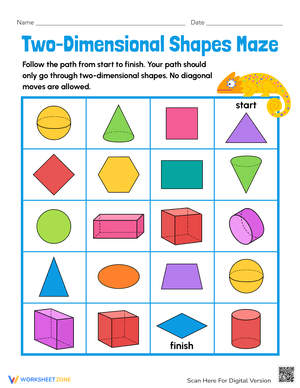
Two-dimensional shapes are flat, like a square or circle drawn on paper. Three-dimensional shapes are solid and can be held, like a box or a ball, and instruction should let students physically compare both types.
4. How can teachers use 3D shapes worksheets for small-group intervention?
Pull students who confuse flat and solid shape names into a small group, pair each worksheet page with a real object, and ask students to explain their answer aloud before moving to independent practice.
5. What real classroom objects pair well with 3D shapes worksheets?
A tissue box works for the cube, a playground ball for the sphere, a soup can for the cylinder, and a party hat or ice cream cone for the cone. Using these alongside worksheets builds a concrete link to the abstract shape names.













 Interactive Worksheet Maker
 Quiz Maker
 Word Search Maker
 Crossword Puzzle Maker
 Word Scramble Generator
 Sentence Scramble Generator
 Handwriting Worksheet Generator
 Name Tracing Generator
 Fill In The Blank Generator