These cubes worksheets move through the full arc of 3D geometry instruction — from a kindergartner circling the block-shaped object among a row of pictures to a fifth grader applying V = s³ to a word problem about packing boxes. Each page targets a specific skill rather than giving students a general tour of the topic, which makes them easy to slot into the right moment of instruction.
Concepts Covered in These Cube Worksheets
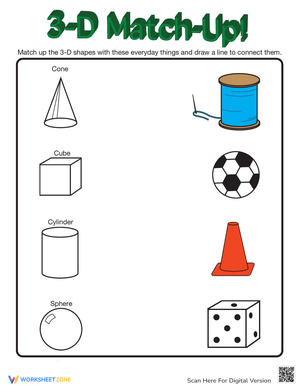
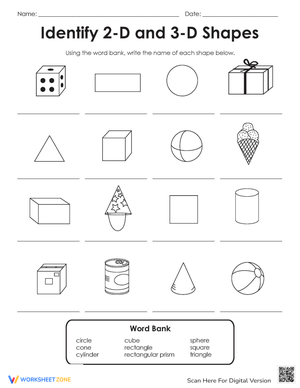
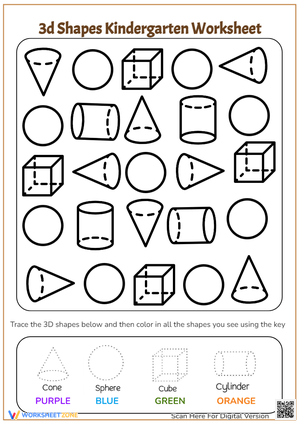
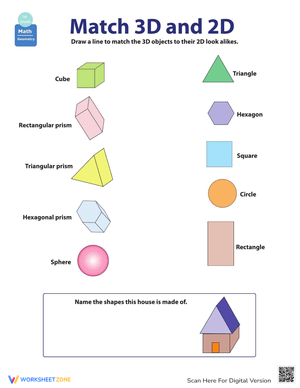
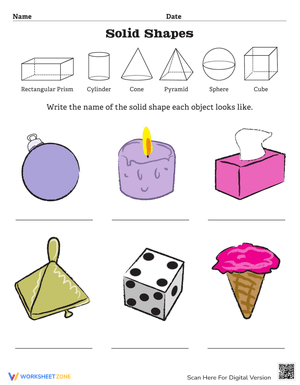
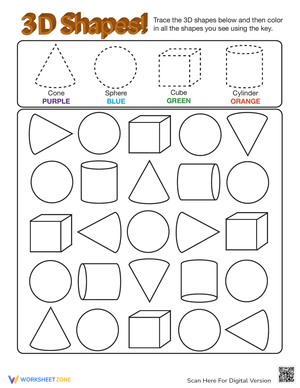
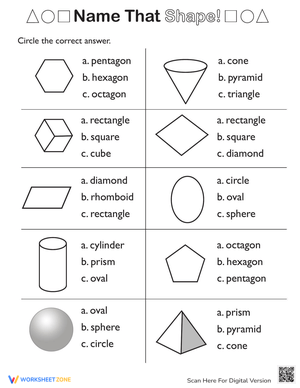
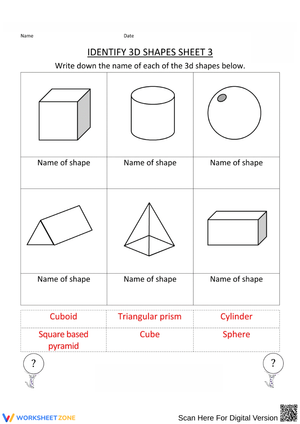
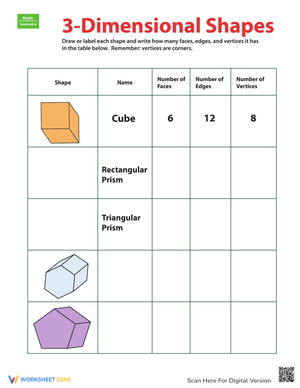
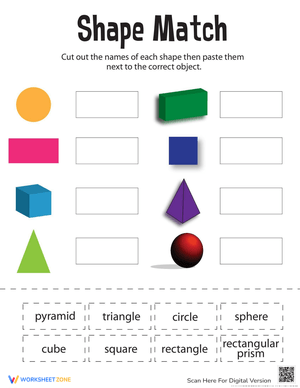
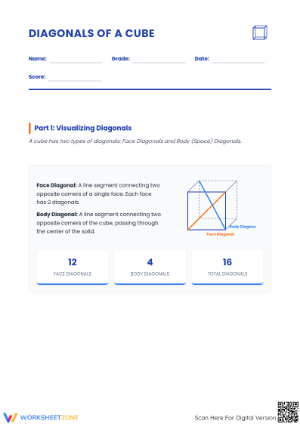
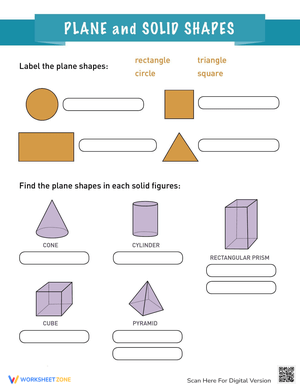
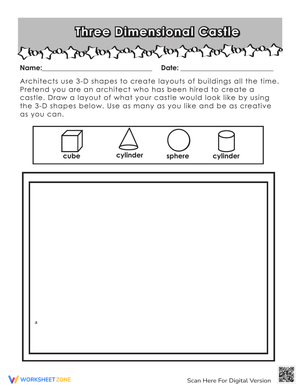
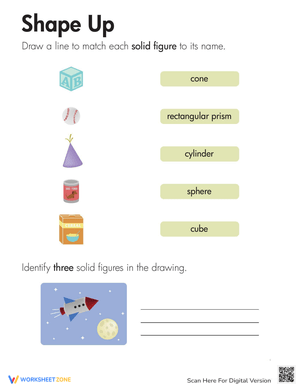
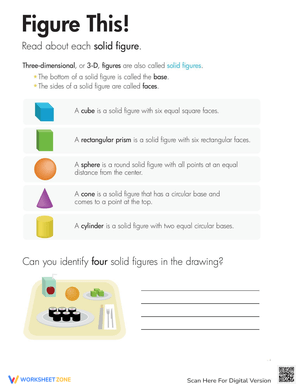
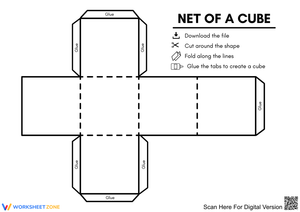
These worksheets cover the range of skills that appear across elementary geometry instruction. Early pages ask students to identify cubes within mixed groups of 3D solids — spheres, cylinders, cones, rectangular prisms — and to match cube-shaped objects from everyday life to the geometric figure. Students then move to labeling: coloring each face, tracing each edge in a contrasting color, and marking the eight vertices. Later pages introduce the cube net, where students examine a flat cross-shaped pattern and predict which folds produce a closed solid. Upper-grade pages focus on measurement:
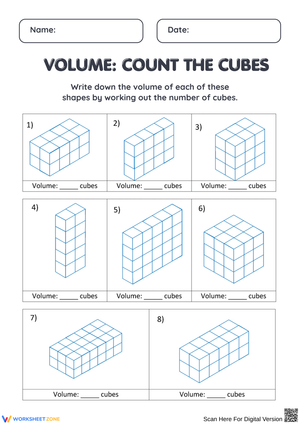
- Counting unit cubes packed inside a larger rectangular prism to build intuition before any formula is introduced
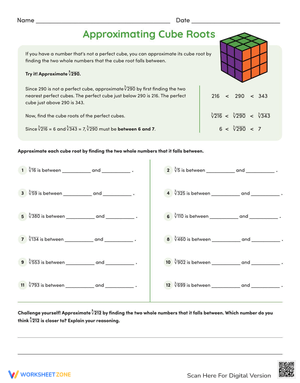
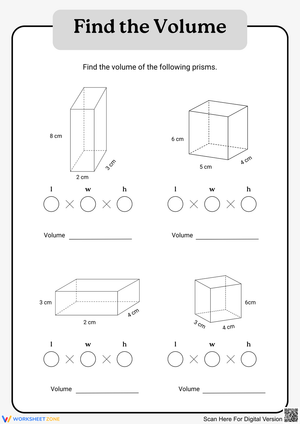
- Applying V = s³ to straightforward calculations with whole-number edge lengths
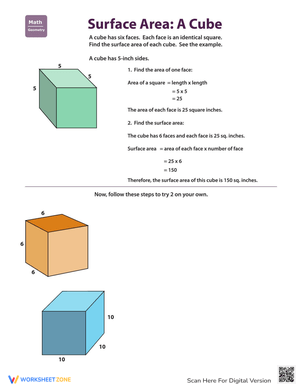
- Finding surface area by calculating the area of one square face and scaling by six
- Solving word problems that embed volume or surface area in real contexts — wrapping paper, storage containers, shipping dimensions
Standards Alignment
Cube geometry appears at two distinct pressure points in the Common Core sequence.
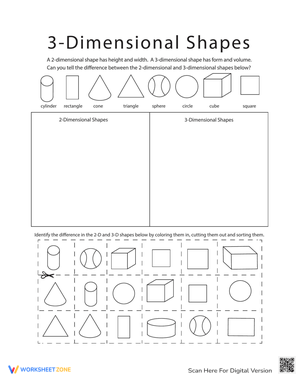
At kindergarten, standard K.G.A.3 asks students to sort shapes as two-dimensional or three-dimensional — and the cube is the anchor solid for that distinction because it is the most visually unambiguous. Students who have handled wooden unit blocks since preschool still need explicit instruction on why a cube is different from the square it resembles when drawn on paper; the vocabulary of face, edge, and vertex does not arrive naturally.
The second pressure point comes in fifth grade with 5.MD.C.5, which ties volume to the operations students already own. Because a cube's three dimensions are equal, it is the cleanest entry point for V = s³ before students generalize to rectangular prisms with unequal dimensions. Teaching the cube case first reduces cognitive load — students manage the formula structure without also tracking three separate measurements.
Student's Error Patterns That Teachers Should Notice
The most common early error is edge-counting confusion. Students scan the outside of a cube drawing and count the visible line segments — typically nine in a standard isometric sketch — rather than understanding that a cube has twelve edges total. A worksheet that asks students to color edges works well here only if you first model the hidden edges shown as dashed lines; otherwise students ignore them entirely and record nine with complete confidence.
In upper grades, the surface area calculation produces a reliable slip-up: students find the area of one face correctly, then add six rather than multiply by six. This usually signals that they understood the procedure ("do something with six") without retaining the reasoning. Worksheets that include a small diagram of the unfolded net alongside the calculation prompt tend to catch this — the six visible squares remind students what they are actually computing. Volume errors cluster differently. Students who memorize V = l × w × h without connecting it to the cube case will write three separate measurements even when all sides are equal, then multiply correctly and arrive at the right answer by accident. The better indicator of understanding is whether a student can explain why 4³ gives the same result.
How To Use These Worksheets In a Lesson Plan
Most teachers reach for these during the practice phase of a geometry unit, after direct instruction but before any formal assessment. They work as independent seat work during the main block, as a warm-up review in the five minutes before the lesson pivots, or as a leave-behind for students who finish the primary task early. The identification and labeling pages are a reliable Monday morning warm-up at the start of a 3D shapes unit — students complete them with minimal re-teaching, which frees the first few minutes of class for vocabulary review rather than procedure review.
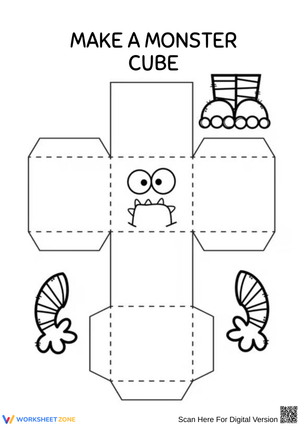
The net pages deserve their own moment. Printing them on cardstock and having students cut and fold before completing the written questions gives a concrete referent for the rest of the page. A student who holds a folded paper cube in one hand while counting faces on the worksheet in the other makes fewer errors than a student working from a flat diagram alone. The assembled models are reusable: stack them to explore volume informally, roll them as number cubes for computation games, or display them as a reference during standardized test review.
Frequently Asked Questions
How do I explain the difference between a square and a cube to students who keep conflating them?
Hold a flat paper square in one hand and a wooden unit block in the other, and ask students which one you could put something inside. That question — can it hold something? — captures the dimensional difference more cleanly than length-width-height vocabulary for students in kindergarten and first grade. A square is a region; a cube is a container. Once that clicks, the formal language tends to follow.
At what point should I introduce the volume formula rather than counting unit cubes?
Wait until students can predict the count before they verify it. If a student looks at a 3 × 3 × 3 arrangement and says "27" before counting — because they understand they are finding how many layers of nine — the formula is a shortcut for something they already grasp. Introducing V = s³ before that moment produces students who execute the multiplication and cannot explain what the number means.
Do these worksheets work for students who have not yet memorized multiplication facts?
Yes, with modification. The identification, labeling, and net pages require no computation at all and work across the full elementary range. For volume pages, pairing the worksheet with a multiplication chart keeps the focus on the geometric reasoning rather than the arithmetic — which is appropriate during initial instruction. Fact fluency is a separate goal.













 Interactive Worksheet Maker
 Quiz Maker
 Word Search Maker
 Crossword Puzzle Maker
 Word Scramble Generator
 Sentence Scramble Generator
 Handwriting Worksheet Generator
 Name Tracing Generator
 Fill In The Blank Generator