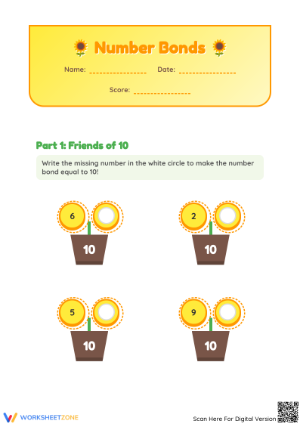
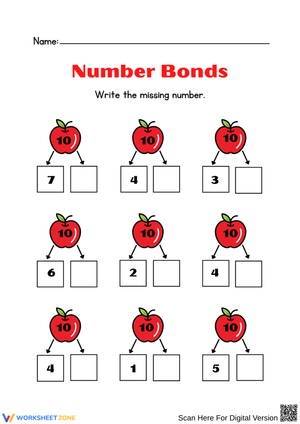
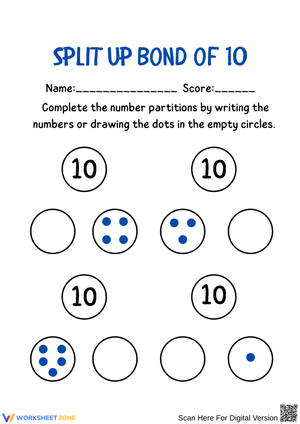
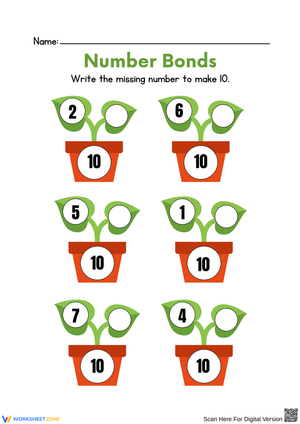
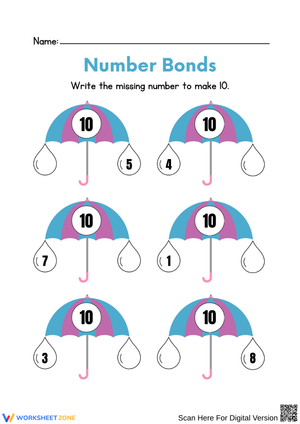
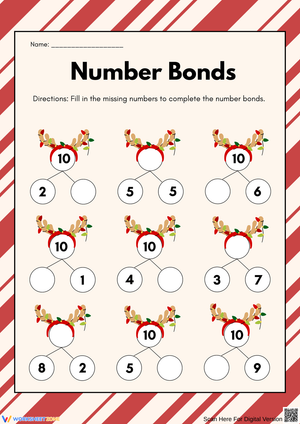
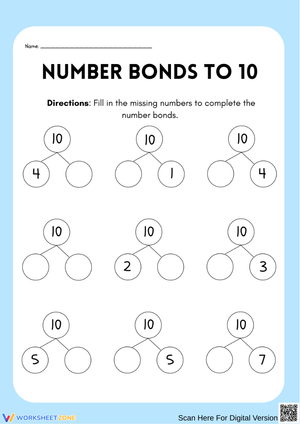
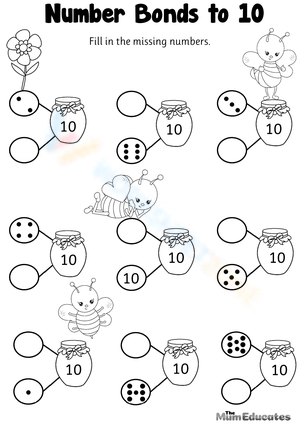
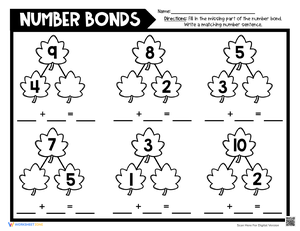
These kindergarten number bond to 10 printable worksheets give teachers a reliable entry point into part-part-whole reasoning — one of the clearest indicators of whether a student is building number sense or still treating every new problem as a fresh counting task. Each worksheet targets compositions and decompositions within 10, and the set moves deliberately from picture-supported bonds toward problems where students supply the missing part without any visual cues.
What's Inside the Set
Each worksheet focuses on a specific angle of part-part-whole thinking rather than repeating the same structure from one end of the set to the other. The formats include:
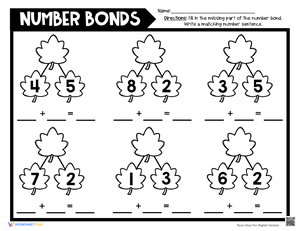
- Picture-supported bonds: Students count two groups of objects and record both parts and the whole inside the diagram.
- Ten-frame matching: Students interpret a filled ten frame and identify which number pair it represents.
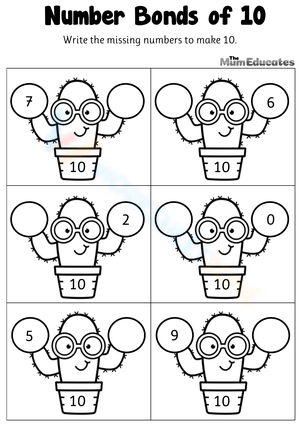
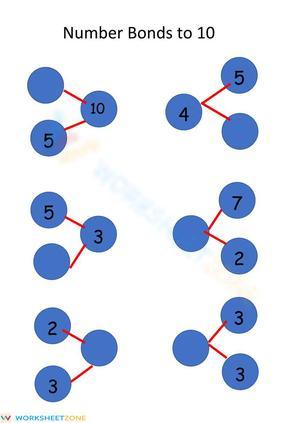
- Missing-part bonds: One circle is blank — students determine the unknown part or the whole based on what's provided.
- Cut-and-sort activities: Students match number pairs that total 10 and glue them into bond circles.
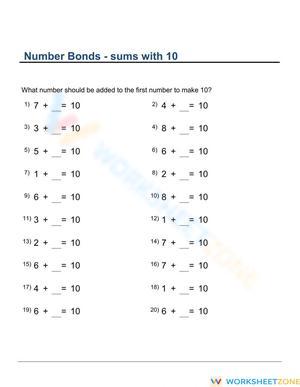
- Numeral-only tasks: No pictures — students work from written numbers alone, which reveals whether they've internalized the relationships or learned to read the visual structure.
That last format is the real checkpoint. A student who handles numeral-only bonds accurately understands the concept. A student who needs to draw dots first is telling you exactly where the thinking hasn't solidified yet.
Mistakes Students Make That These Worksheets Help You Catch
The most consistent error is writing the whole in both circles. A student sees 10 in the whole position and, unable to determine the missing part, copies 10 into the empty part circle as well. The logic is understandable — 10 is the only number they feel certain about — but it reveals that the student hasn't yet grasped that a part must be less than the whole. Catching this during a center check takes under two minutes and prevents weeks of practiced misunderstanding going unaddressed.
A separate error appears when students correctly identify both parts but record the wrong whole. They write 6 and 4 in the part circles, then write 9 in the whole. When you ask them to explain, they've counted on from 6 — "seven, eight, nine" — stopping one count short. That's a counting-on error surfacing through the bond format, not a misunderstanding of the bond concept itself. The structure makes it visible because all three numbers have to be recorded, which a standalone addition equation doesn't always require.
There's also a ten-frame dependency that shows up later: students who performed confidently on the visual worksheets stall when pictures disappear. They've learned to read the image, not reason about the quantity. The set handles this by removing visual support gradually across worksheets rather than cutting it all at once — but teachers should watch for students who've been relying on the pictures more heavily than it appears.
Fitting These Worksheets Into Your Teaching Week
Morning work is a natural place to start. One worksheet with four to six items settles students while attendance runs, and because the format stays familiar, students can begin without waiting for directions. Choose a format students already know — this is not the time for first exposure to a new task type.
Centers work best when each worksheet comes with a small container of counters on the table. Students build the bond with objects first, then write what their hands figured out. That sequence — physical before written — matters more than it might seem. Small group is where the diagnostic value is highest: watch the first two items without intervening and you'll see within 90 seconds who counts all, who counts on from the larger part, and who retrieves the combination without counting at all. That sorting shapes the next day's grouping more precisely than most written pre-assessments.
For intervention, staying with one whole number across several sessions before moving on builds the reasoning that later transfers. A student who struggles with all bonds to 10 often does better spending two days on bonds with 7 as the whole, then shifting to 8, then 9 — familiarity with one number builds the conceptual structure that generalizes outward.
Adjusting the Set for a Spread of Readiness Levels
Kindergarten classrooms hold students who are still working on reliable counting within 10 alongside students who already retrieve most combinations from memory. A kindergarten number bond to 10 printable worksheets set with formats ranging from picture-heavy to numeral-only makes it possible to keep the whole class working toward the same math target while adjusting the level of support each student receives.
- Students building number sense: Use picture-supported worksheets and leave a ten frame visible on the desk as a reference. Three or four items completed carefully is enough — accuracy at a slower pace builds more than speed with guessing.
- On-level students: Assign missing-part bonds where one part and the whole are given. Ask them to check their answer by counting on from the known part to confirm it.
- Students ready for more independence: Use numeral-only worksheets and ask them to record a second pair that makes the same whole. That pushes flexible thinking rather than simple retrieval.
Varying the response method also helps. Some students circle answers from a set of choices; others write numerals independently; others build the bond with counters and then record it. The math goal stays constant while the access point shifts to match what each student can manage.
Standard Alignment
These worksheets address CCSS K.OA.A.3 — decomposing numbers less than or equal to 10 into pairs in more than one way — and K.OA.A.4, which expects students to find the number that makes 10 when added to any given number from 1 through 9. In practice, K.OA.A.3 comes first: students explore multiple ways to split one whole. K.OA.A.4 narrows that work to 10 specifically and targets the missing addend. The worksheets in this set sequence through both standards in that order, so the format a teacher assigns at a given moment signals clearly where a student sits relative to each standard.
Frequently Asked Questions
When should kindergarteners begin using number bond worksheets independently?
After repeated hands-on practice with physical materials — counters, linking cubes, two-color chips — and after students can talk through what they built using words like part, whole, and put together. A student who builds a bond with objects and explains it has the understanding that makes the written format useful. A student who still counts every object from 1 each time probably needs more concrete work before the worksheet captures anything real.
How is a number bond diagram different from an addition equation?
The diagram holds the whole visually separate from the two parts, letting students read the relationship in both directions at once — these parts make this whole, or this whole can be split into these parts. An equation reads left to right and implies a single operation. The visual structure of the bond is specifically useful for students who haven't yet attached meaning to the plus symbol or the equals sign, because the diagram communicates the math without requiring symbol literacy.
Can these worksheets replace manipulative practice?
No — and it's worth being direct about that. These worksheets document and extend what students have already built through hands-on work. Introducing them before students have touched the concept with physical materials typically produces worksheets full of guesses. A stronger move is to keep counters accessible even during independent worksheet time so students have a physical reference when the abstract reasoning hasn't yet become automatic.
Are these appropriate for early first grade?
The picture-supported worksheets suit first graders who didn't consolidate bonds to 10 in kindergarten. The numeral-only and missing-part formats work for first-grade intervention as a quick diagnostic and for reinforcing fluency before moving into addition within 20. The full kindergarten number bond to 10 printable worksheets set travels well into first-grade small groups, where teachers can identify quickly which combinations a student has internalized and which still require counting support.
Can these be sent home for family practice?
Yes, selectively. Picture-supported worksheets travel home well because families can follow along without knowing classroom vocabulary. Missing-part bonds work better staying in school until students have practiced the format with a teacher present — the confusion those generate at home tends to arrive back unresolved the next morning. Once families understand the basic structure from simpler tasks, any format in the kindergarten number bond to 10 printable worksheets set can be sent home as review.













 Interactive Worksheet Maker
 Quiz Maker
 Word Search Maker
 Crossword Puzzle Maker
 Word Scramble Generator
 Sentence Scramble Generator
 Handwriting Worksheet Generator
 Name Tracing Generator
 Fill In The Blank Generator