




























0
Views
0
Downloads

0.0
0
Save
0 Likes
Share
Master Number Bonds to 10
0 Views
0 Downloads

Paste this activity's link or code into your existing LMS (Google Classroom, Canvas, Teams, Schoology, Moodle, etc.).
Students can open and work on the activity right away, with no student login required.
You'll still be able to track student progress and results from your teacher account.
Information
Description
What It Is:
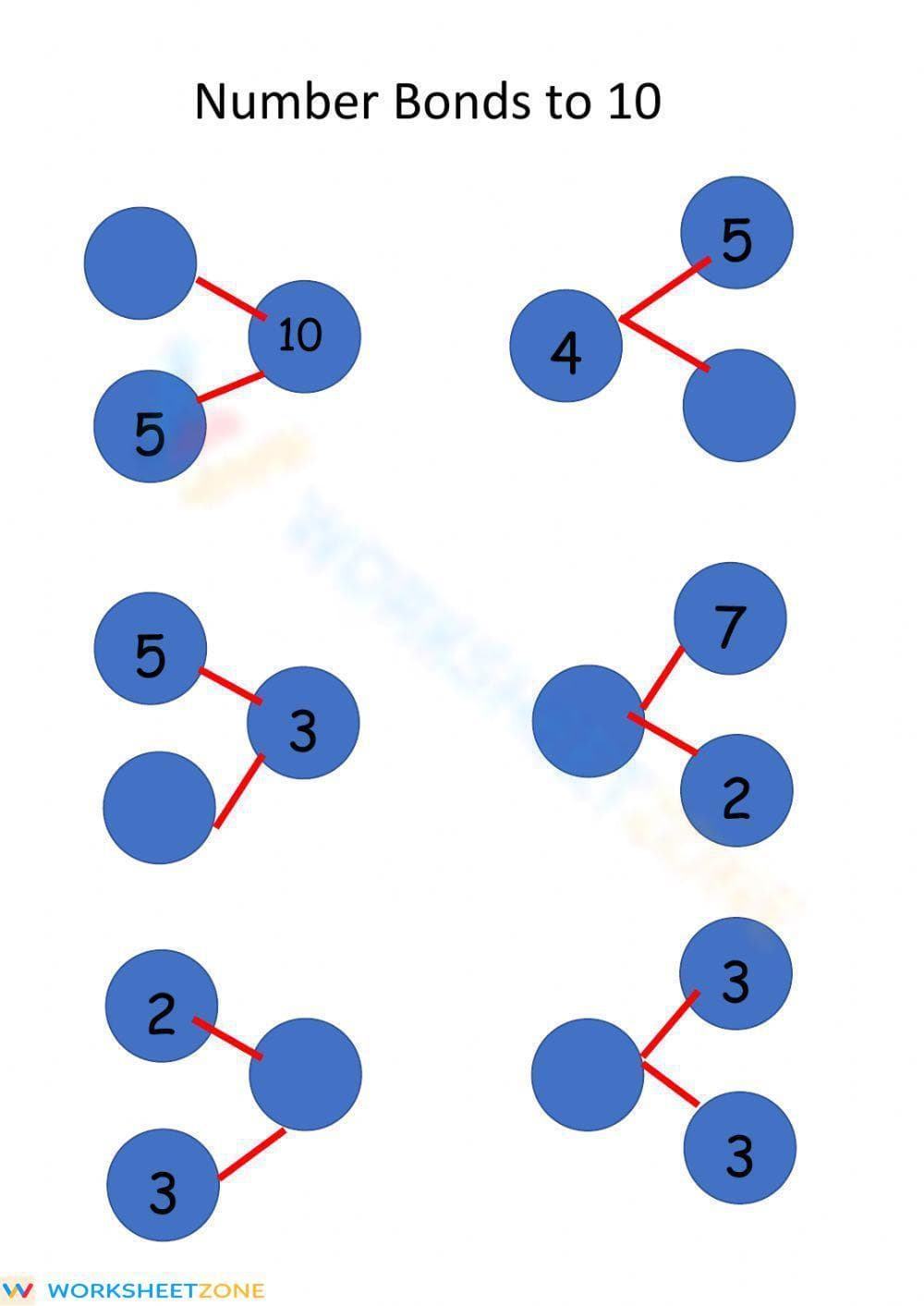
This is a math worksheet focused on number bonds to 10. It presents a series of diagrams where two circles are connected by red lines to a third circle. Some circles contain numbers (e.g., 5, 10, 4, 7, 2, 3), while others are blank, requiring the user to fill in the missing number to complete the number bond.
Grade Level Suitability:
This worksheet is suitable for Kindergarten and Grade 1 students. It reinforces basic addition and subtraction skills within the context of number bonds, a fundamental concept introduced in early elementary grades. The visual representation makes it easy for young learners to grasp the relationship between numbers.
Why Use It:
It helps children understand the relationship between numbers and how they can be combined to make a specific total (10). This worksheet builds number sense, promotes addition and subtraction fluency, and provides a visual aid for learning number bonds. It reinforces the concept of part-part-whole relationships in mathematics.
How to Use It:
Students should look at the numbers provided in each diagram. They need to determine the missing number that, when combined with the other given number, equals the target number (10, or the number implied by the other two numbers in the last two examples). They should then write the missing number in the empty circle.
Target Users:
This worksheet is designed for kindergarten and first-grade students who are learning about number bonds, addition, and subtraction. It's also beneficial for students who need extra practice with basic number concepts and visual representations of mathematical relationships. It can be used by teachers, parents, or tutors.
This is a math worksheet focused on number bonds to 10. It presents a series of diagrams where two circles are connected by red lines to a third circle. Some circles contain numbers (e.g., 5, 10, 4, 7, 2, 3), while others are blank, requiring the user to fill in the missing number to complete the number bond.
Grade Level Suitability:
This worksheet is suitable for Kindergarten and Grade 1 students. It reinforces basic addition and subtraction skills within the context of number bonds, a fundamental concept introduced in early elementary grades. The visual representation makes it easy for young learners to grasp the relationship between numbers.
Why Use It:
It helps children understand the relationship between numbers and how they can be combined to make a specific total (10). This worksheet builds number sense, promotes addition and subtraction fluency, and provides a visual aid for learning number bonds. It reinforces the concept of part-part-whole relationships in mathematics.
How to Use It:
Students should look at the numbers provided in each diagram. They need to determine the missing number that, when combined with the other given number, equals the target number (10, or the number implied by the other two numbers in the last two examples). They should then write the missing number in the empty circle.
Target Users:
This worksheet is designed for kindergarten and first-grade students who are learning about number bonds, addition, and subtraction. It's also beneficial for students who need extra practice with basic number concepts and visual representations of mathematical relationships. It can be used by teachers, parents, or tutors.


