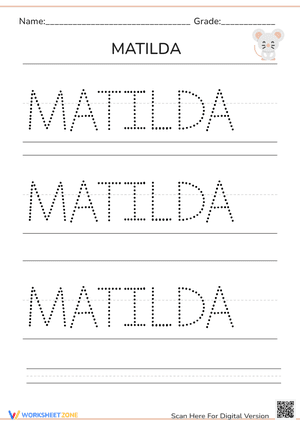
These drawing and painting pdf worksheets for kindergarten give teachers a ready art activity without the long prep window. Each worksheet centers on one clear task — tracing into a drawing, painting within a large shape, finishing part of a scene — so students can start independently while the teacher circulates or works with a small group. The set is compatible with crayons, dot markers, watercolor trays, and paint sticks, which means one batch of printables can carry a class through multiple tool rotations across the year.
Skills Each Worksheet Builds
Fine motor work shows up in every task across the set. Applying controlled pressure with a crayon, making short deliberate lines without dragging the tool, and gripping a marker at a usable angle — rather than a fist grip — all appear repeatedly. That repetition matters because kindergartners often don't know they're pressing too hard or too lightly until the result makes it obvious: the crayon tip snaps on the second stroke, or the lines disappear entirely. These worksheets create enough low-stakes practice that teachers can observe and address grip and pressure habits before they carry over into early writing.
Shape production is another core thread. Students use circles, squares, triangles, and rectangles to build simple images, which mirrors directly what appears in pre-writing and early mathematics instruction. The range of task types across the set includes:
- Trace-then-draw: Students trace a basic form and extend it into a recognizable picture.
- Finish-the-picture: Part of an image is provided; students complete it with drawing or color.
- Shape-to-image: Students convert a printed shape into an object using lines, detail, and deliberate color choice.
- Directed visual starts: A first mark is given, and students carry the composition from there.
- Color and paint fills: Students work inside large areas with a chosen tool, building awareness of brush or marker pressure.
Working These Worksheets Into a Real Kindergarten Day
The most useful sorting system for these resources isn't by theme or season — it's by tool. Keep one folder labeled "crayon and pencil only," one for "dot markers," one for "watercolor." When you have 12 minutes before lunch or a transition that has stretched longer than expected, you pull a worksheet that matches what's already available at the table. No last-minute supply scramble, no mid-task retooling.
Drawing and painting pdf worksheets for kindergarten fit most naturally into three classroom windows: morning work (crayon-based, low setup), art centers (one worksheet choice with two tool options set out in advance), and sub days (picture-direction worksheets that students can interpret without verbal explanation). For painting worksheets specifically, cotton swabs and small sponge tips manage better than full brushes with students who haven't yet learned to rinse and reload without muddying every color. Paint sticks remove the water cup problem entirely, which makes painting worksheets far more manageable in classrooms without a dedicated sink nearby.
What Student Work Reveals About Early Art Skills
The most consistent pattern across a stack of kindergarten art worksheets is uneven pressure — some students make marks so light they're barely visible; others press hard enough that the crayon drags and tears. Neither group is usually aware of it. They're attending to the image, not the tool. A few rounds of these worksheets make the pattern legible, which gives teachers an opening to address it directly before it becomes a settled habit in handwriting as well.
A more revealing gap shows up in finish-the-picture tasks. Students who can trace a circle cleanly will sometimes draw a shapeless blob when asked to complete one freehand on the same worksheet. But the more diagnostic moment is when a student adds random marks to a half-drawn object with no apparent sense of what the object looks like as a whole. That's not a fine motor problem — it's a gap in visual memory of real-world objects. When that pattern shows up across multiple students' work, it signals that classroom conversation about what things look like (animals, plants, vehicles) matters more than additional drawing drills.
Adjusting Each Worksheet for the Range of Readiness in Your Room
The same worksheet can serve students at very different readiness levels without printing separate versions. A student still developing grip control completes only the tracing component — that's a finished task at their stage. A student with stronger control finishes the image, adds background details, and makes deliberate color choices. The worksheet doesn't change; the expectation does.
Drawing and painting pdf worksheets for kindergarten that include generous negative space around the central prompt make extension easy. Students who finish quickly can add a sky, ground, or surrounding objects without needing a separate activity or a verbal prompt from the teacher. For students who freeze when the workspace looks too open, a simple teacher mark — a dot where the first line goes, or a lightly traced circle in pencil — gives them a concrete starting point without removing the creative task. Students who find watercolor difficult can complete the same painting worksheet with dot markers, which deliver immediate color payoff and require less nuanced pressure control than a brush.
Standard Alignment
These worksheets connect to the National Core Arts Standards (NCAS) anchor standard for Creating, specifically the kindergarten-level expectation that students "explore use of materials and tools to create works of art or design" (VA:Cr2.1.Ka). In classroom practice, that standard lands during the window when students are discovering that tools behave differently from one another — that a dot marker makes a different mark than a watercolor brush, that pressing harder with a crayon changes color intensity, that cotton swabs produce dots while sponges produce soft edges. The worksheets put that exploration into a context where teachers can observe it and respond in the moment rather than leaving it entirely to unstructured free choice time.
Fine motor and tool-use goals also connect to the Head Start Early Learning Outcomes Framework (ELOF) domain for Perceptual, Motor, and Physical Development, particularly indicators around hand control and purposeful tool use. That alignment gives art worksheets standing in classroom planning conversations well beyond the art block — they contribute to developmental goals that programs already track and document.
Frequently Asked Questions
Can kindergartners complete these worksheets without teacher support for each one?
Most worksheets are set up so that the visual prompt communicates the task without verbal directions. Some students need one demonstration early in the year — what "finish the picture" means, or how to know when to stop adding lines — and then the routine carries itself. The trace-and-draw format is usually the quickest to become independent because students can see both where to start and where they're headed.
What tools work best for kindergartners using these worksheets?
Crayons and colored pencils cover most drawing worksheets without any additional setup. For painting worksheets, dot markers and paint sticks require less cleanup and fewer procedural steps than watercolor. If you do use watercolor, limiting students to one color cup at a time and providing a single blotting sponge reduces the gray-water problem that develops when kindergartners rinse frequently. Cotton swabs work well for dot painting and keep the scale of mark-making manageable for small hands.
How often should these worksheets appear in the weekly schedule?
One to two drawing and painting pdf worksheets for kindergarten per week is a sustainable pace for most classroom schedules. More frequent use and art starts to feel like a worksheet rotation rather than a creative practice. Less than one per week and students lose the tool-use routine that makes art centers run independently — and the teacher ends up re-explaining procedures every time the activity reappears.















 Interactive Worksheet Maker
 Quiz Maker
 Word Search Maker
 Crossword Puzzle Maker
 Word Scramble Generator
 Sentence Scramble Generator
 Handwriting Worksheet Generator
 Name Tracing Generator
 Fill In The Blank Generator