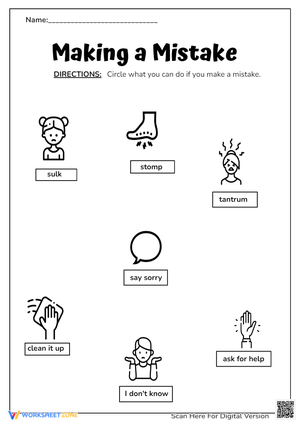
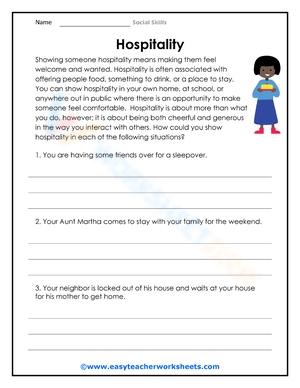
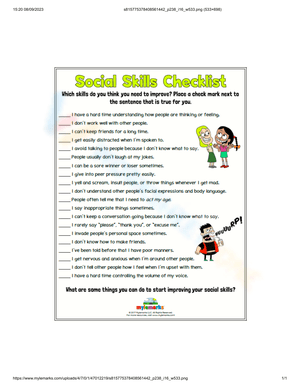
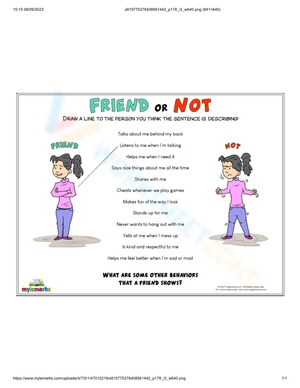
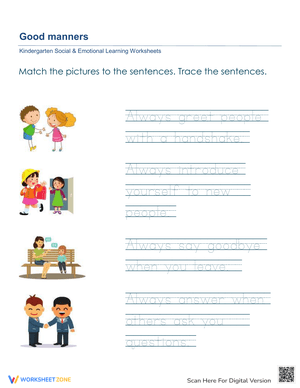
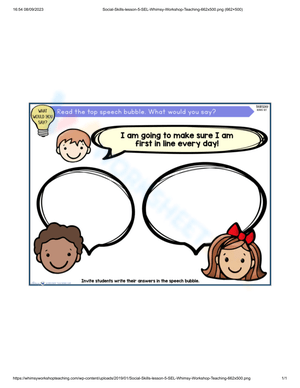
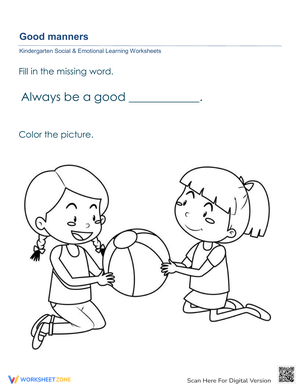
These kindergarten social skills for kids pdf worksheets give teachers something the first weeks of school rarely offer on their own: a structured, repeatable way to teach the peer behaviors five-year-olds need most — before conflicts start doing the teaching instead. Children at this age can learn to name feelings, ask to join a game, and take a breath instead of grabbing, but not without deliberate practice built into the daily routine. The set makes that practice concrete.
Concepts the Set Builds
The worksheets work through the core social-emotional competencies that early childhood research consistently identifies as foundational at this age: emotion recognition, self-regulation, social awareness, relationship skills, and responsible decision-making. In a kindergarten classroom, those translate to specific observable moments — a child naming the frustrated face before she throws her pencil, a boy saying "can I play?" instead of hovering at the edge of a game and hoping someone notices. Each worksheet targets one of those moments with a single, focused activity rather than trying to cover all of early SEL at once.
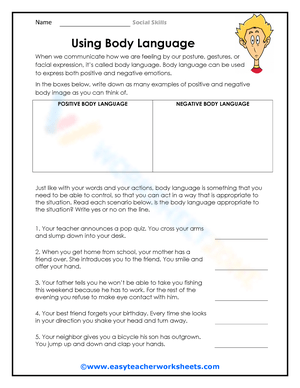
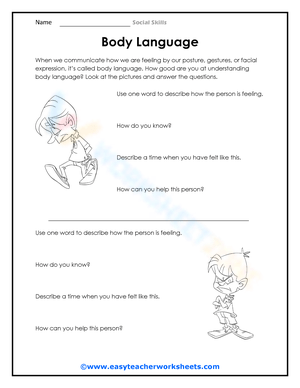
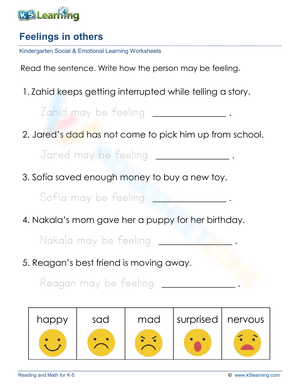
- Emotion identification: Students match facial expressions to situation pictures, circle the feeling word that fits a scenario, or draw a face showing a named emotion. The vocabulary — frustrated, proud, left out, nervous — gets introduced here so children have the words available when an actual conflict arrives later in the day.
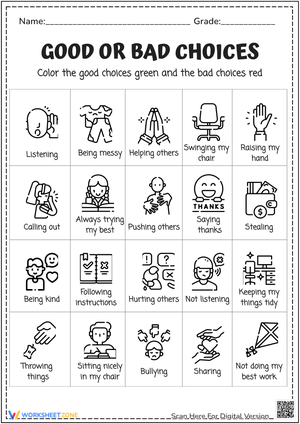
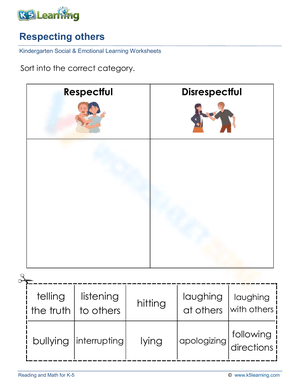
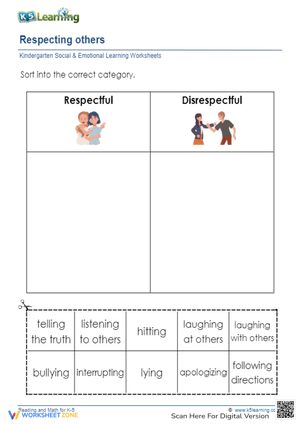
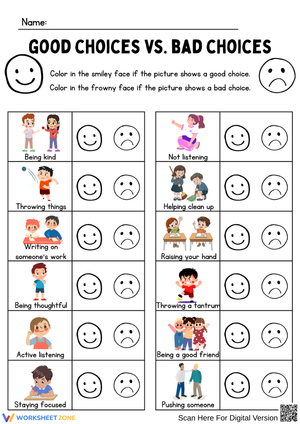
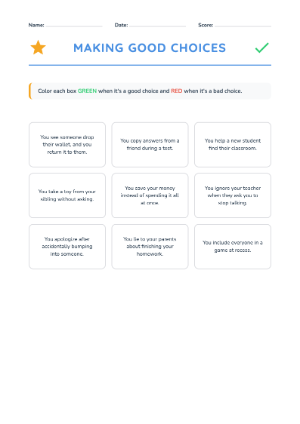
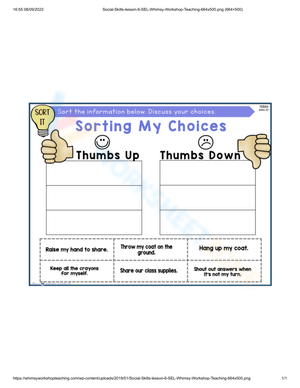
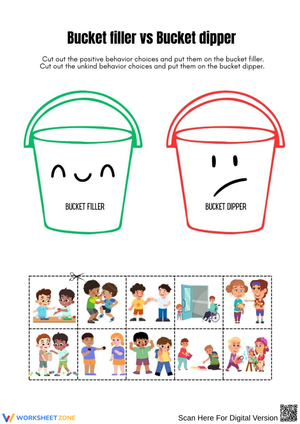
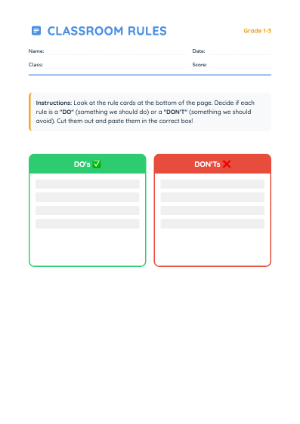
- Sharing and turn-taking: Sorting tasks ask students to mark "friendly choice" or "unfriendly choice" across a set of scenarios. Physically marking an answer, rather than just hearing the rule stated aloud, produces noticeably stronger recall when a similar situation happens at recess.
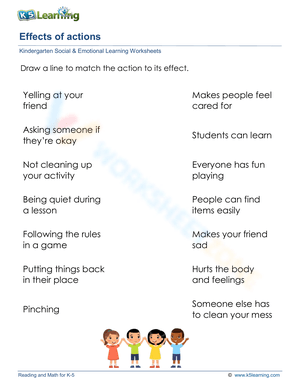
- Conflict resolution steps: Sequencing worksheets show a problem, a pause, and a resolution. Students cut and order the steps — or number them — which requires thinking through cause and effect rather than jumping straight to the happy ending.
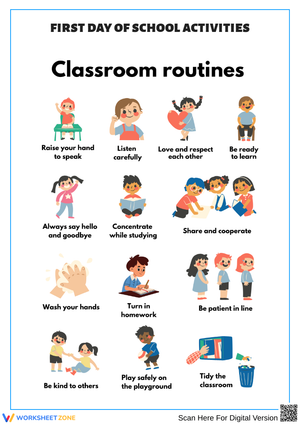
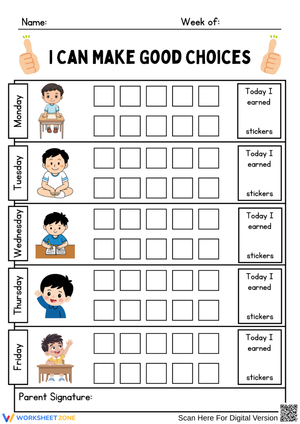
- Classroom expectations: Worksheets on listening, walking feet, and raising hands reinforce the physical routines of the school day. These land hardest in August and September, before procedures are fully automatic for most students.
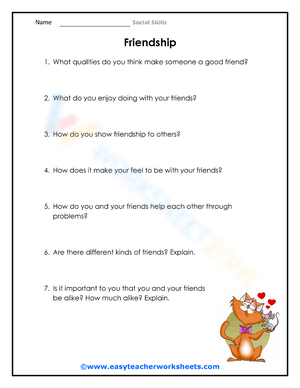
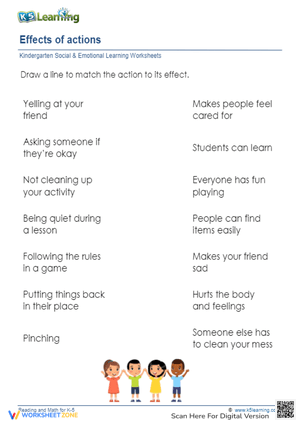
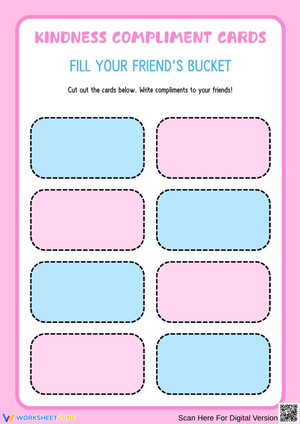
- Friendship skills: Inviting a peer to join a game, giving a compliment, and noticing when someone is left out are each addressed through picture-based activities where students identify and mark the kind behavior.
Every worksheet relies on clear illustrations rather than written directions, which is not an accident. Kindergarteners who are still cracking the phonics code cannot access a text-heavy social lesson. A picture of two children trading crayons delivers the concept immediately, without requiring a single decoded word. That same visual format opens the resources to English language learners, who can engage with a social scenario before the surrounding vocabulary is fully in place.
Where These Worksheets Fit in the School Day
Morning meeting is the natural starting point. Display a worksheet on the board, walk through the scenario with the class, and then send students to their seats to complete their own copies. The group preview gives every child a shared frame before they work independently — and it surfaces the students who need more processing time before you've moved on to something else.
The higher-yield move happens right after the worksheet activity: a thirty-second role-play while the concept is still fresh. If a worksheet covers asking a friend to play, have students finish their copies and then immediately turn to a partner to say the exact phrase shown in the picture. That pivot from paper to practice is where kindergarteners actually absorb the lesson. Leaving the concept on the worksheet and shifting to the next subject loses most of the transfer.
These kindergarten social skills for kids pdf worksheets also work as a deliberate calm-down transition after recess. The focused, quiet act of looking at a picture and making a choice helps students physically shift gears — and when the worksheet that day addresses self-regulation, the timing is unusually effective. Some teachers keep a laminated copy of two or three worksheets at the calm-down corner so students can point to a face when they're too activated to speak.
Where the Gap Between Paper and Practice Shows Up
The most consistent pattern we see in early SEL teaching is this: a child correctly circles "ask first" on a worksheet, then turns around and grabs a marker from a neighbor thirty seconds later. This is not defiance — it is the developmental reality of five-year-olds. Applying a learned rule under social pressure, in real time, requires a level of executive function that is years from being automatic. Worksheet performance tells you the child understands the concept at a recognition level. Consistent behavior in the classroom takes weeks of reinforcement, not a single lesson.
A second gap appears between students who arrive with emotional vocabulary already in place and those who are building that vocabulary from scratch. A child who can say "I'm frustrated" without prompting will move through emotion identification worksheets quickly. A child learning those words at the same time as the concepts behind them is carrying a heavier cognitive load and will need more time — and more return visits to the same material. Fast completion is not a reliable signal of mastery here, and slow completion is not a signal of inability.
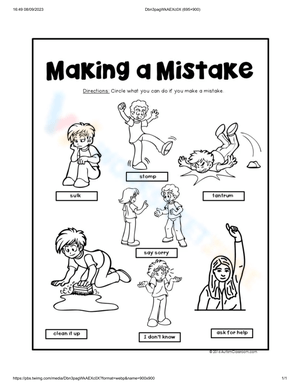
Watch for students who accurately name feelings in a picture scenario but go blank when asked how they feel in a real moment. Third-person worksheet scenarios offer protective distance that first-person self-reflection doesn't. Use the worksheets as a bridge: "Do you remember the picture of the boy who felt left out? What does your face look like right now?" That direct connection between the printed scenario and the live moment is where the learning transfers.
Adjusting the Set for Different Learners in the Room
Students who arrive with strong social language and developed emotion vocabulary will move through most worksheets quickly. For them, the activity works best as a discussion launch rather than a standalone task. After completing the work, pair these students to explain their choices to each other or create a brief three-sentence social story around the scenario. That extension keeps them engaged and often generates useful anchor charts for the rest of the class.
Students with IEPs, social-emotional delays, or limited English proficiency often benefit most from completing each worksheet one-on-one with a paraeducator before the whole-group lesson. The picture-based format makes that feasible — there is no reading barrier to manage, so the adult's attention stays fully on the social concept. Laminating a handful of worksheets from the set and working with dry-erase markers lets those students revisit the same scenario multiple times without burning through paper.
For students who become dysregulated during group work, pull one worksheet for use in a quieter corner setting. The kindergarten social skills for kids pdf worksheets in this set function as standalone activities — there is no sequence you need to preserve to make any single one work, which gives you flexibility to use exactly what a student needs in the moment.
Frequently Asked Questions
How often should I use these worksheets each week?
One per day during the first six weeks of school is a sustainable pace that keeps SEL visible without crowding out reading and math instruction. After classroom routines are established, two or three per week — one for introducing a concept, one for revisiting it — works well for most classrooms. Consistency matters more than frequency: a brief, repeated touchpoint produces better behavioral transfer than an occasional deep-dive SEL block.
Can students who aren't reading yet use these independently?
Yes. The activities are driven by illustrations, not text. Students match, sort, circle, color, and draw rather than read and write sentences. Emotion words appear on some worksheets as vocabulary support, but recognizing those words in print is not required to complete the task. A student who has never seen the word "angry" in writing can still point to the correct face and participate fully in the lesson discussion.
Is it worth sending these home for parents?
Sending completed worksheets home with a brief handwritten note is one of the more practical parent communication moves in early SEL teaching. Parents can reference the pictures during real moments at home: "Remember your worksheet about taking turns? What did the kids in that picture do?" The visual gives a parent something concrete to point to — far more effective than asking a five-year-old to explain what they learned about sharing at school today.
How do I know if a student is actually making progress?
Progress in kindergarten SEL almost never shows up on a rubric — it shows up in behavior. The reliable signals: a child using words like "frustrated" or "left out" in context without being prompted, a child pausing before reacting in a conflict rather than immediately escalating, a child asking to trade instead of just grabbing. The kindergarten social skills for kids pdf worksheets build the vocabulary and the visual memory that make those moments possible — but the transfer happens at recess, at the lunch table, and over weeks of consistent reinforcement.