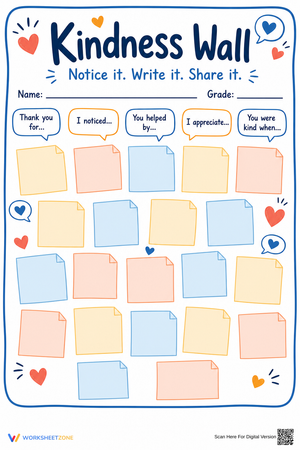
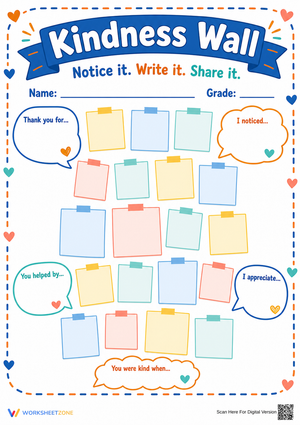
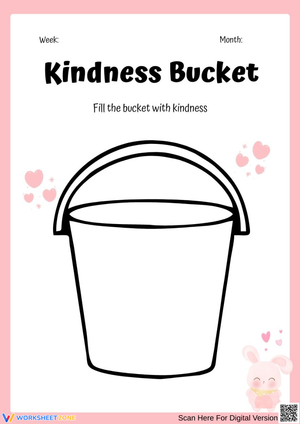
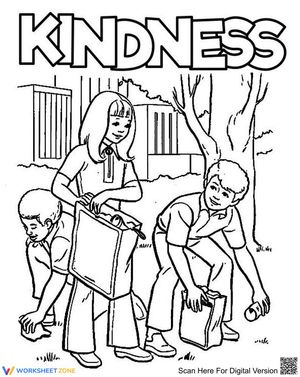
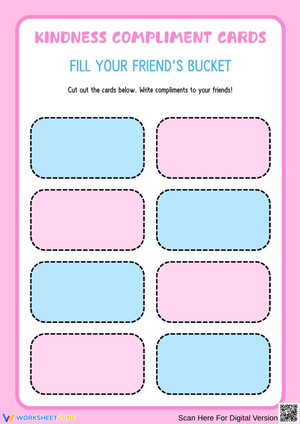
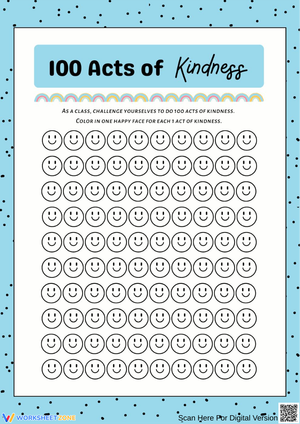
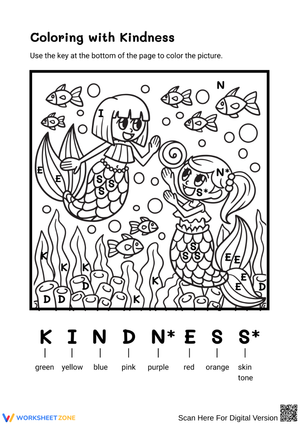
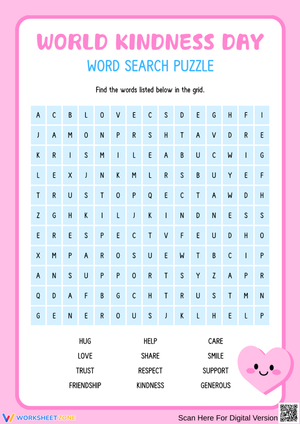
These kindness worksheets pdf for kindergarten give teachers concrete, printable tools for turning abstract social lessons into something students can actually do with their hands. The set covers scenario sorting, emotion recognition, vocabulary tracing, and open-ended drawing prompts—activities that pair social-emotional learning with foundational kindergarten skills like fine motor development and early literacy. Teachers get a practical resource that fits into morning meetings, center rotations, or cool-down corners without additional prep.
What's in Each Worksheet
The activities span five distinct formats, each targeting a different facet of pro-social behavior:
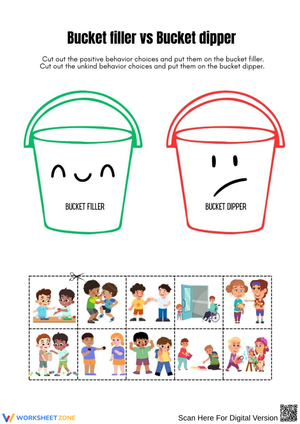
- Scenario sorting: Students look at illustrated cards showing children sharing, helping, pushing, and grabbing, then cut and sort them into "kind" and "unkind" categories. The cutting serves double duty as scissor practice—a genuinely useful pairing at this age.
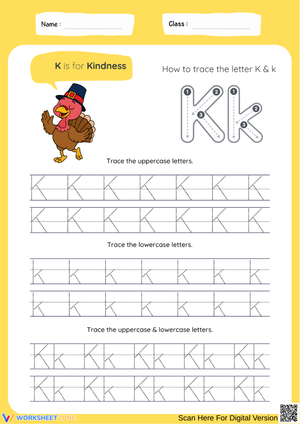
- Vocabulary tracing: Words like help, share, care, and friend appear in large dotted font for students to trace, linking character education to letter formation practice in the same five-minute activity.
- Emotion-matching: Each worksheet pairs an illustrated action with a row of face choices—students circle the face that matches how the other child in the picture likely feels. This is the cognitive step most five-year-olds need explicit practice making: connecting what someone does to how it lands on another person.
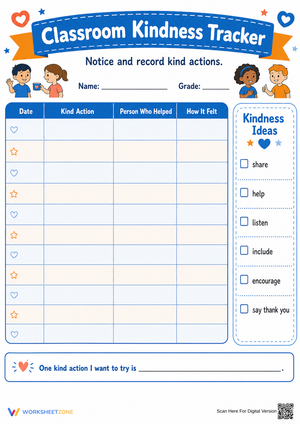
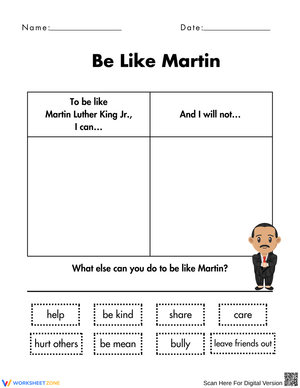
- Challenge tracking charts: Bingo-style grids list specific acts—inviting someone to play, saying please without being reminded, helping clean up a center—that students color in when completed. The specific language matters; "be nice" gives students nothing to act on.
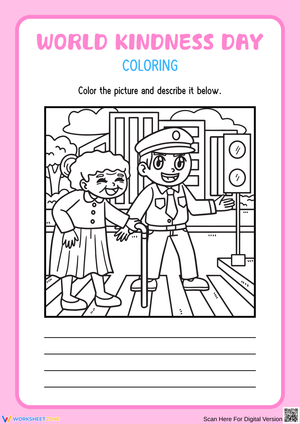
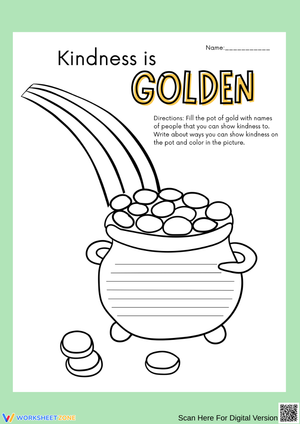
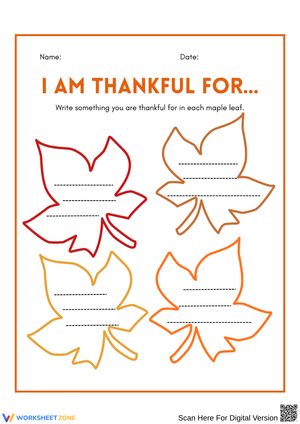
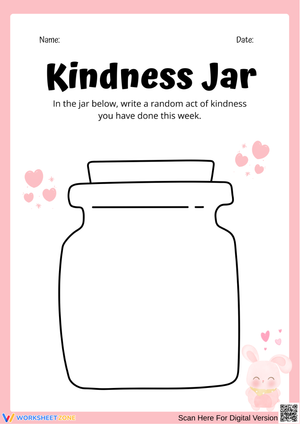
- Drawing prompts: Open-ended prompts like "Draw a time you helped someone today" create space for self-reflection and give teachers a quick formative read on how students are internalizing the concepts.
Patterns in Student Thinking Teachers Should Catch Early
The most consistent error in scenario sorting activities is that students categorize passive unkindness as neutral. Show a kindergartener an illustration of one child walking away while another sits alone crying, and many will place that card in the "kind" pile—or set it aside entirely—because no aggressive action is depicted. The child doing the ignoring isn't hitting or grabbing, so five-year-olds often don't read it as harmful. Pausing on those cards during whole-group discussion and asking "How does the child on the bench feel?" is where the real instructional work happens.
Vocabulary tracing surfaces a different gap. Students who correctly trace the word share in the morning will sometimes refuse to share markers twenty minutes later without conflict. The tracing plants the word; the teacher's verbal follow-through closes the loop—"Remember when you traced 'share' earlier? This is a share moment right now." The worksheet sets the stage. The in-the-moment redirect is the actual instruction. Expecting the activity alone to change behavior skips that second step.
How to Work These Worksheets Into Your Week
The most practical entry point is the morning meeting block. Project a worksheet on the board, walk through it as a group, then hand out individual copies for students to complete at their seats before the first transition. The whole sequence takes about eight minutes and sets a behavioral tone that carries into the first center rotation. Teachers who use this pattern consistently report fewer conflicts during that opening block—students have just spent eight minutes naming and practicing what kind looks like before anyone has had a chance to argue over materials.
A dedicated SEL center works well for the scenario sorting and drawing-prompt worksheets specifically. During rotations, students work independently, which gives teachers an unobserved window into how students interpret social situations. What a child does without adult prompting tells you more than what they do while you're watching. The kindness worksheets pdf for kindergarten format—printable cards and single-topic worksheets—makes restocking that center straightforward; print a fresh batch each week and rotate the activity type.
Cool-down corners are another consistent fit. A tracing worksheet gives a dysregulated child something concrete and calm to do with their hands while they reset. It's low-stakes, it's quiet, and it keeps the social-emotional vocabulary in front of them even when they're not yet ready to talk about it.
Standard Alignment
These worksheets align with the CASEL Framework's core competencies of Social Awareness and Relationship Skills. Social Awareness encompasses perspective-taking and recognizing emotions in others—directly targeted by the emotion-matching and scenario sorting activities. Relationship Skills covers communication, turn-taking, and cooperative behavior, which the challenge charts and drawing prompts address through explicit naming and practice. If you want to document how the kindness worksheets pdf for kindergarten connect to your state's SEL standards, the CASEL competency labels give you the precise language for a lesson plan or progress note.
Many state kindergarten SEL standards specifically require instruction in identifying how one's actions affect others' feelings—that is the explicit objective behind the behavior-to-emotion mapping format used across the set. The drawing prompts and challenge charts also generate student work samples that document growth in areas like "respects others" and "demonstrates cooperative behavior," which appear on most standards-based kindergarten report cards.
Adjusting the Set Across Different Learners
For students still developing fine motor control, pre-cut the scenario sorting cards before the activity begins. That one adjustment shifts the child's attention entirely to the sorting decision rather than the cutting, removing the physical frustration that causes some students to disengage before they've thought about the social content at all. The activity's instructional value is in the categorization—everything else is prep work the teacher can handle in advance.
Students who need more challenge respond well to the drawing-prompt worksheets with a simple extension. Instead of a single illustration, ask them to draw two frames—what happened and what they chose to do about it—and dictate or write a sentence for each. That pushes the task toward narrative thinking and self-reflection without requiring an entirely separate activity. The open-ended format of those prompts accommodates this extension naturally.
For students with limited English proficiency, the emotion-matching and scenario sorting worksheets are the strongest starting points because the task is visual rather than text-dependent. Pairing an ELL student with a partner for the vocabulary tracing worksheet so the word is spoken aloud while they trace it adds an auditory layer that helps the vocabulary land in a way that silent tracing alone does not.
Frequently Asked Questions
How do you explain kindness to a five-year-old without making it abstract?
Anchor the word to specific, observable actions rather than a definition. "Kindness is when you help someone who dropped their crayons" is something a five-year-old can picture and repeat. The scenario illustrations in each worksheet do exactly this work—they show rather than define. After working through a few activities, most students can generate their own examples unprompted, which is the sign the concept has actually taken hold rather than just been memorized.
Can these worksheets go home in family folders?
Yes, and the vocabulary tracing and drawing-prompt worksheets travel best because they require no classroom context to make sense. Families can sit down with a child and complete them without prior explanation. Including a brief note about the focus word that week—"This week we're talking about what 'help' looks like"—gives parents a conversation hook that extends the lesson well past the worksheet itself.
How often should these activities appear in the week?
One or two worksheets per week is enough for kindergarten. Daily use risks turning the activities into routine busywork, which works against the reflective purpose they serve. Spacing them across the week—one on Monday to open a behavioral focus, one on Thursday as a check-in—gives students time to actually practice the behavior between sessions. A kindness worksheets pdf for kindergarten resource works best as a prompt for discussion and real action, not as a workbook to move through from start to finish.
Do these activities work for pre-K students as well?
The emotion-matching and scenario sorting worksheets transfer to pre-K readily—four-year-olds respond to the visual format without much adjustment. The vocabulary tracing activities assume some familiarity with letter formation, so those are better held until mid-year pre-K at the earliest. Drawing prompts work at any age as long as a teacher or aide is available to scribe a sentence for the child after they finish the illustration.












 Interactive Worksheet Maker
 Quiz Maker
 Word Search Maker
 Crossword Puzzle Maker
 Word Scramble Generator
 Sentence Scramble Generator
 Handwriting Worksheet Generator
 Name Tracing Generator
 Fill In The Blank Generator