Honesty Worksheets Printable for Kindergarten
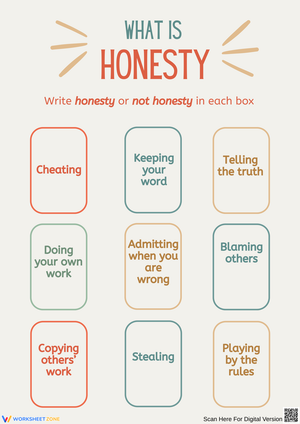
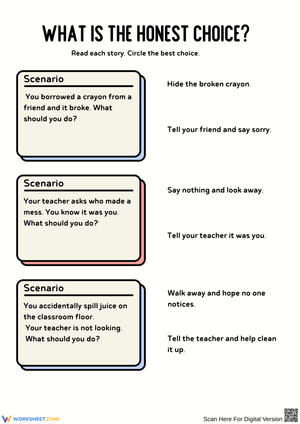
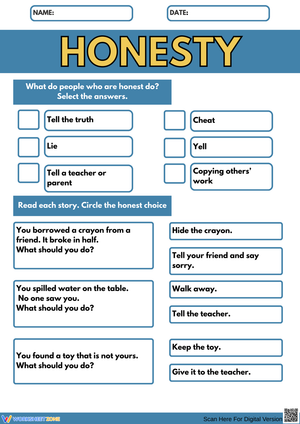
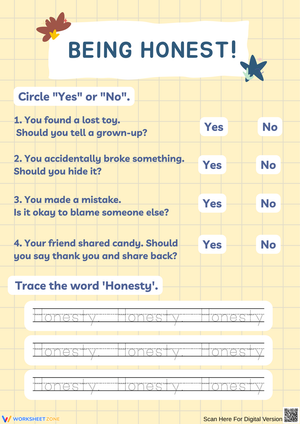
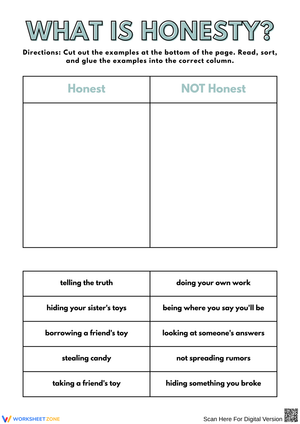
These honesty worksheets printable for kindergarten give teachers a concrete anchor for a concept that five-year-olds understand less reliably than we tend to assume. The set pairs visual sorting tasks, illustrated scenario cards, and reinforcement coloring sheets with sentence-starter frames — practical tools for discussing truthfulness before an incident happens, not scrambling to explain it after one does.
What Kindergarteners Actually Understand About Lying
Children at five and six are still developing what researchers call reality monitoring — the ability to clearly separate what actually happened from what they wished would happen. A child who says "I didn't push him" immediately after pushing someone isn't always lying strategically. Sometimes they're describing the event as they wish it had gone. This doesn't mean the behavior goes uncorrected, but it does mean that lecturing about honesty often misses the actual problem. These worksheets address this by showing students a paired image of what happened alongside what was said, then asking them to identify the mismatch. That visual, concrete format reaches students in a way that an abstract conversation about "telling the truth" rarely does at this age.
The Specific Skills Students Practice
Students work across several overlapping skill areas:
- Sorting illustrated statements as honest or not honest using a thumbs-up/thumbs-down coding system — accessible to students who can't yet read
- Using feeling-face charts to identify how both the honest character and the people around them feel, not only the dishonest character
- Practicing specific language through sentence-starter frames: "I need to tell you..." and "What really happened was..."
- Recognizing how trust operates inside a classroom community, including what rebuilding it looks like after something goes wrong
The sentence-starter frames deserve a separate note. Most SEL activities tell students that honesty matters. These worksheets practice the actual words students need in the moment — which is a different thing, and a more useful one. A student can recite "honesty is the best policy" and still go blank when they need to actually say something hard out loud.
Mistakes Students Make That These Worksheets Surface
The most predictable misunderstanding at this level isn't about whether lying is wrong — students already know the answer they're supposed to give. The tricky area is omission. Many kindergarteners genuinely don't consider staying silent the same as lying, so they'll sort "said nothing" scenarios into the honest column because no false words were technically spoken. Each worksheet that includes omission scenarios will surface this within the first few minutes of whole-group discussion. It comes up almost every time, and when it does, it's one of the most productive conversations of the unit.
A second pattern shows up in the feeling-face activities. Students quickly identify that the character who lied feels nervous or scared afterward. What they miss is that the honest character may also feel scared — scared to confess, worried about consequences. When students skip that detail, they end up with an incomplete picture that makes honesty sound easy and instinctive. Pausing on this during class review reliably generates the most engaged back-and-forth of the lesson.
Fitting These Into Your Routine Without Overplanning
Don't introduce the first worksheet right after a specific child has been caught in a lie. That turns a learning activity into a consequence, and students will associate the materials with punishment from that point on. Introduce the set during a calm, neutral moment — a Monday morning meeting block early in the school year, before any particular incident has given the topic a charged feeling in the room.
A workable rhythm: complete several items together as a whole group on Monday, then leave the scenario cards available at a center through the rest of the week. Students return to them during free choice or partner reading blocks without requiring reteaching. Pairing each worksheet with a picture book where a character faces a truth-telling decision — and completing a short follow-up task after the read-aloud — lets the honesty worksheets printable for kindergarten carry both SEL and early literacy work in the same block. Send completed coloring sheets home in Friday folders with a two-sentence note to families. At this age, what students practice at school about social behavior fades quickly without a parallel conversation happening at home.
Standard Alignment
These worksheets address CASEL's Self-Management competency — specifically impulse control, meaning the ability to resist lying under social pressure — and the Relationship Skills competency, particularly communicating honestly to maintain trust. Most state SEL frameworks place these benchmarks in kindergarten under responsible decision-making and positive relationship building.
The discussion-based use of each worksheet also supports CCSS Speaking and Listening standard K.SL.1, which requires kindergarteners to participate in collaborative conversations about grade-appropriate topics with peers and adults. The whole-group instructional portion of these lessons is a direct fit for that standard — students are not just completing an activity, they are talking through moral reasoning in real time.
Making These Work for Every Kid in the Room
Students still building fine motor control can use dot stickers in place of crayons for the sorting and coding tasks. The reasoning demand stays identical; the physical demand drops significantly. For students ready for more challenge, extend each worksheet by having them generate one new scenario that fits the same category — a student who writes simple sentences can dictate while a partner draws. That pairing also keeps the activity moving for stronger readers without leaving less fluent students behind.
The visual format makes the honesty worksheets printable for kindergarten accessible for English language learners because the core judgment — honest or not honest — doesn't depend on reading the English text. The feeling-face charts carry most of their meaning through facial expression, which translates across language backgrounds without needing additional support structures in place.
Frequently Asked Questions
When in the school year should I introduce these worksheets?
Introducing the honesty worksheets printable for kindergarten during the first few weeks, as part of your community-building work, means students already have a shared reference point when real situations arise in October or November. Waiting until a pattern of untruthfulness has already developed in your classroom makes the materials feel like a reaction. Used early, they're foundational rather than corrective — and that framing matters to students.
How do I complete these as a class without making one child feel singled out?
Whole-group first, always. Work through the first several items on an interactive whiteboard or with a projected copy, narrating your own thinking aloud: "I see this picture shows someone saying they finished their work, but the drawing shows the paper is blank — those don't match, so I'd mark that thumbs-down." Once students understand the task as a class investigation rather than a personal one, independent work feels far less charged.
Are these appropriate for take-home family connection?
Yes, with one caveat: include a short parent note explaining the context. Without it, a family that receives a worksheet about lying may assume their child was specifically in trouble that day. Two sentences — "We're exploring honesty as part of our classroom community work this week" — reframes the activity correctly and often opens up a conversation at home that wouldn't have happened otherwise.
Clear All