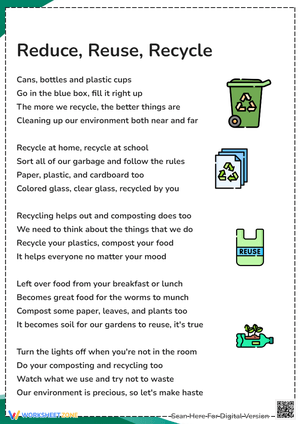
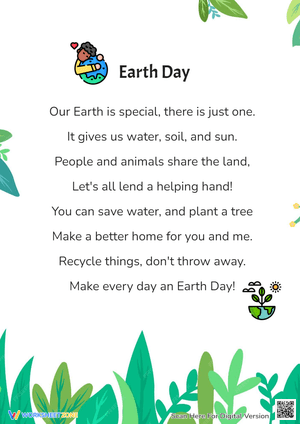
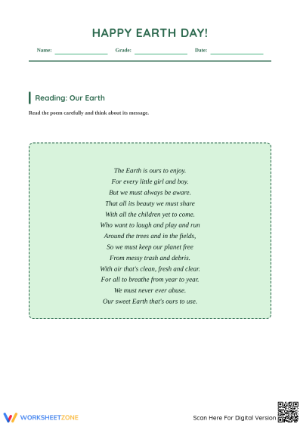
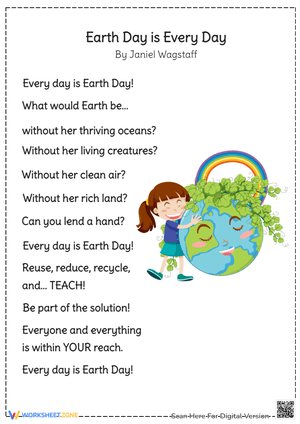
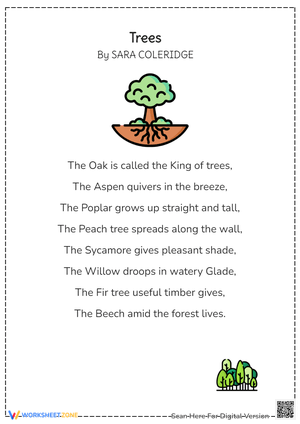
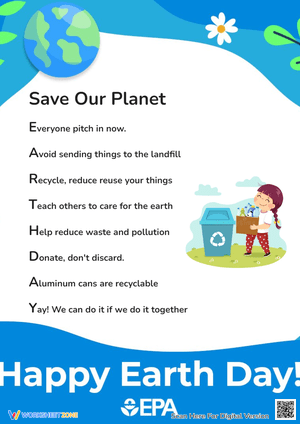
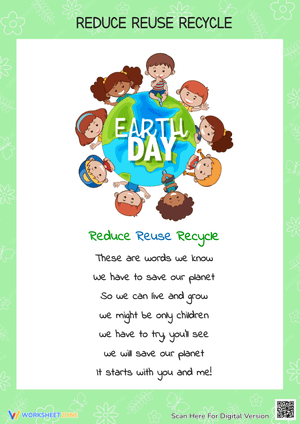
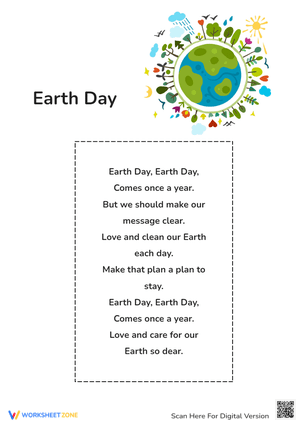
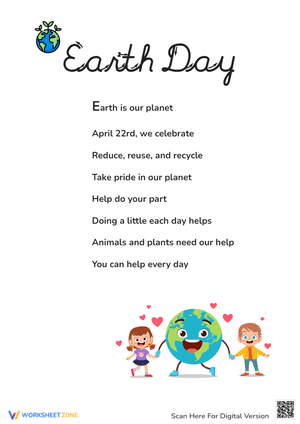
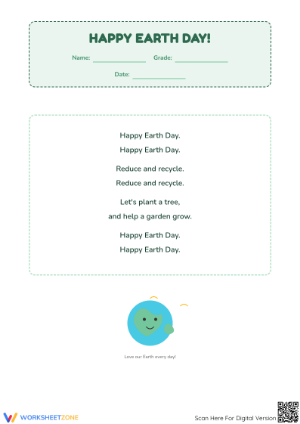
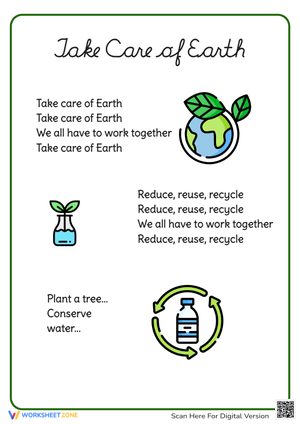
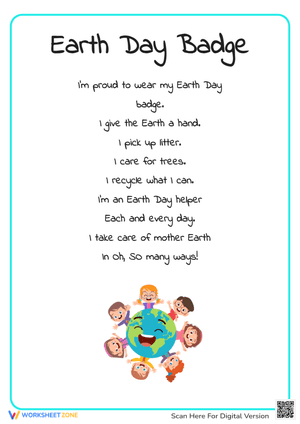
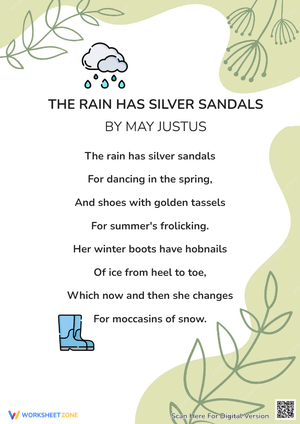
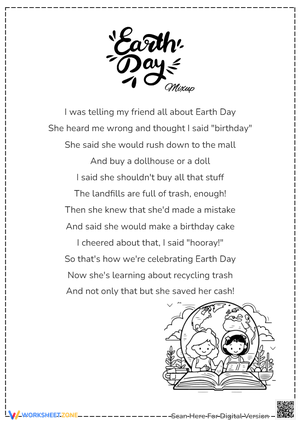
When you need a ready-to-use literacy activity that delivers real results, Earth Day poems are one of the most efficient tools in your classroom library. These structured verses give teachers a clear and direct path to discussing environmental themes without spending hours on lesson prep. Students engage immediately with the rhythm and imagery, making the content easy to absorb from the very first reading. At Worksheetzone, our collection is built so you can print and teach without any extra setup required.
The vocabulary embedded in Earth Day poems - words like conservation, stewardship, and ecology - appears in a natural rhythmic context that makes retention far more effective than a standalone word list. Students at every grade level benefit from hearing and reading these terms within a structured poetic form. This approach builds phonological awareness alongside content knowledge, which is a measurable win for any lesson plan. Teachers can assign independent reading or use the poems for whole-class recitation with equal success.
Pairing these verses with other seasonal activities strengthens your overall unit. Our Earth Day activities for kids guide offers a practical set of complementary exercises that extend the learning beyond the page. Combining literacy-focused poetry with hands-on tasks ensures your students develop a well-rounded understanding of environmental responsibility. It is a straightforward strategy for covering multiple curriculum standards in a single themed week.
If you want to give students a creative outlet alongside their reading, consider adding visual art to your unit. Our printable Earth Day painting and drawing worksheets pair naturally with poetry, allowing learners to illustrate the verses they study. This multimodal approach is especially effective for visual learners and keeps the entire class engaged throughout the session. Both resources are print-ready so your planning time stays minimal.
Every teacher and parent looking for dependable classroom resources will find that Earth Day poems deliver consistent engagement without demanding extra preparation time. The printable format means you can distribute them the moment class begins, keeping your lesson on track from start to finish. Worksheetzone is committed to providing materials that respect your time while supporting meaningful student growth. Add these poems to your lesson plan today and give your students a lasting connection to the planet they share.
Frequently Asked Questions
Question 1: What grade levels are Earth Day poems suitable for?
Earth Day poems are suitable for a wide range of grade levels, from kindergarten through middle school. Simpler verses with short lines and basic vocabulary work well for younger students, while more complex poems exploring themes like climate and biodiversity are appropriate for older learners. Teachers can select poems based on reading level and adjust comprehension questions accordingly to differentiate instruction across their classroom.
Question 2: How can teachers use Earth Day poems in a lesson plan?
Teachers can use Earth Day poems as a warm-up activity, a shared reading exercise, or the centerpiece of a full literacy lesson. Reading a poem aloud together builds fluency and vocabulary, while a follow-up discussion about its environmental message develops critical thinking. Writing response prompts, illustrated poem posters, and recitation practice are all effective extensions that turn a single poem into a multi-day unit.
Question 3: Can parents use Earth Day poems at home with their children?
Yes, parents can easily use Earth Day poems at home as part of bedtime reading or weekend learning activities. Reading poems together encourages a love of language and opens natural conversations about caring for the environment. Printing a poem and asking a child to draw what it describes is a simple and effective activity that reinforces both literacy skills and environmental awareness without requiring any special supplies.
Question 4: What topics do Earth Day poems typically cover?
Earth Day poems typically cover topics such as protecting natural habitats, reducing waste, celebrating trees and wildlife, and appreciating clean air and water. Some poems focus on individual actions students can take, while others explore broader themes of ecological balance and conservation. This variety allows teachers and parents to choose verses that align with the specific environmental topics they are covering in their curriculum or family discussions.












 Interactive Worksheet Maker
 Quiz Maker
 Word Search Maker
 Crossword Puzzle Maker
 Word Scramble Generator
 Sentence Scramble Generator
 Handwriting Worksheet Generator
 Name Tracing Generator
 Fill In The Blank Generator