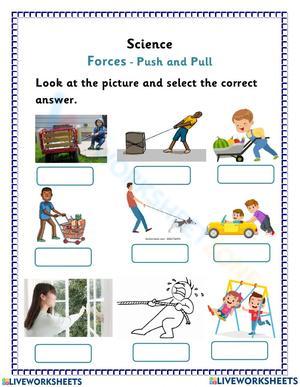
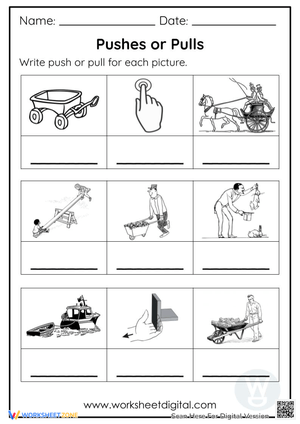
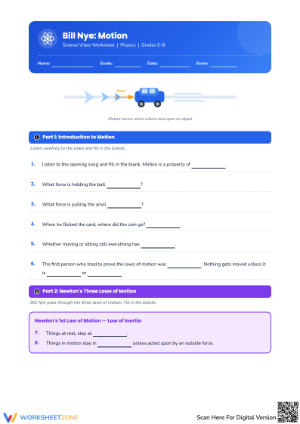
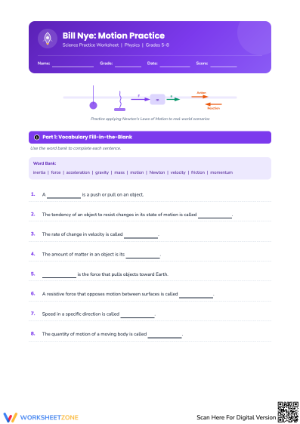
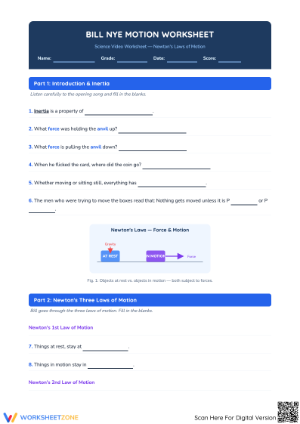
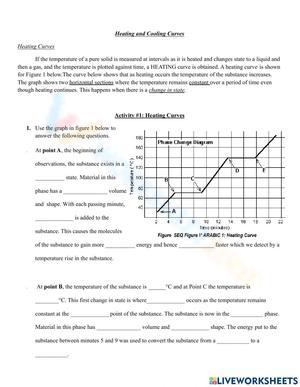
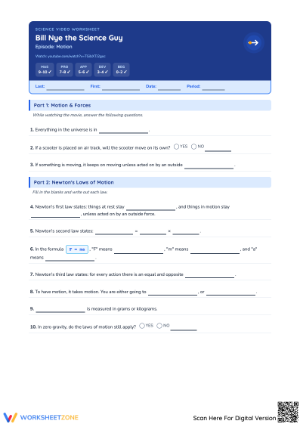
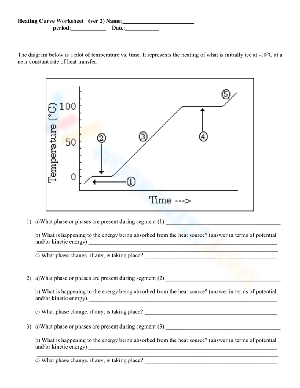
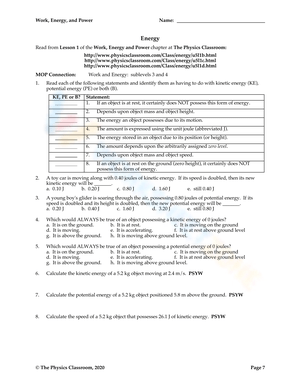
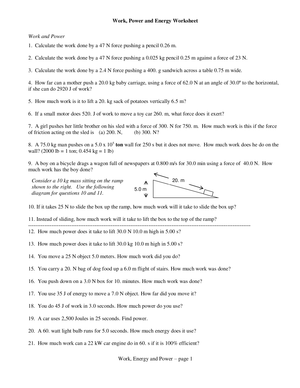
These 9th grade forces motion and machines printable worksheets resources give physical science teachers what they actually need: targeted practice on Newton's laws, kinematics, and simple machines that students can work through independently, in pairs, or as structured class review. Each worksheet addresses a discrete skill — not a grab-bag of loosely related problems — so teachers can place one at exactly the right moment in a unit rather than assigning a stack and hoping the right practice lands.
The Specific Skills Targeted
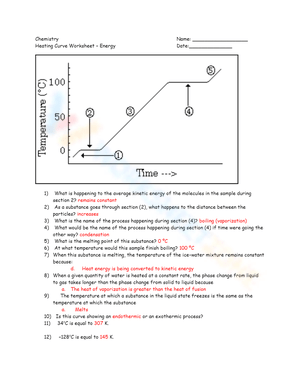
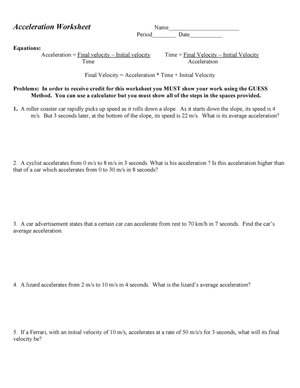
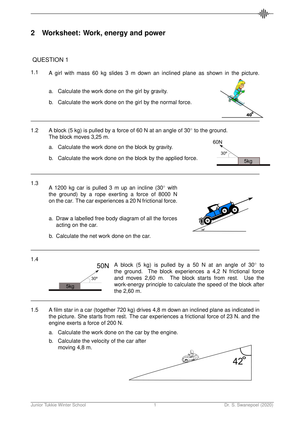
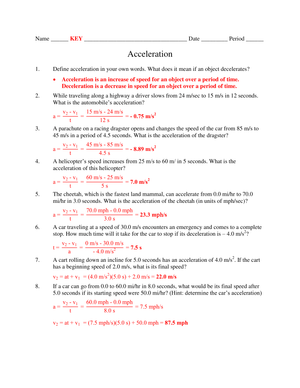
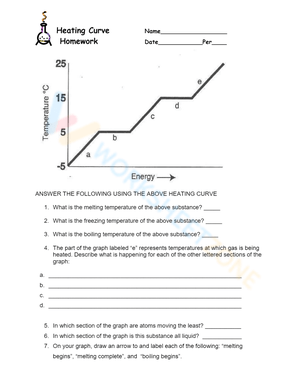
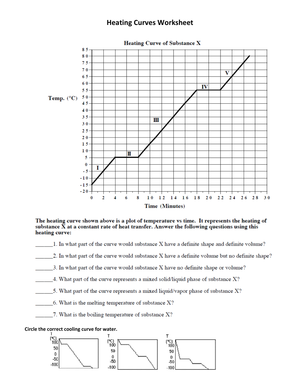
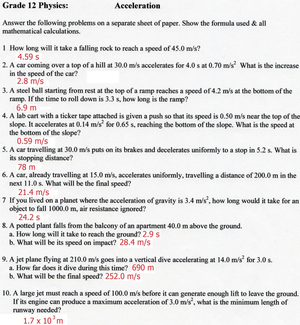
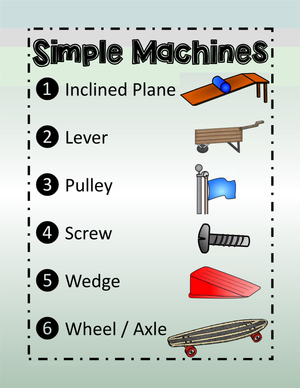
Three content strands run through the set. The first covers Newton's three laws, with problem types that push students past surface-level recall. Students identify which law governs a described scenario, construct free-body diagrams with labeled force vectors, and solve algebraically for net force, mass, or acceleration. The second strand addresses kinematics: calculating average speed and velocity, distinguishing scalar from vector quantities, and interpreting position-time and velocity-time graphs. Students mark slope calculations directly on each graph, which makes the connection between mathematical slope and physical acceleration concrete rather than something they accept on faith. The third strand covers simple machines — lever, pulley, wheel and axle, inclined plane, wedge, and screw — where students calculate ideal and actual mechanical advantage, work through efficiency problems, and analyze labeled pulley diagrams by counting supporting rope segments to determine mechanical advantage without a formula lookup.
Frequent Student Errors Worth Watching For
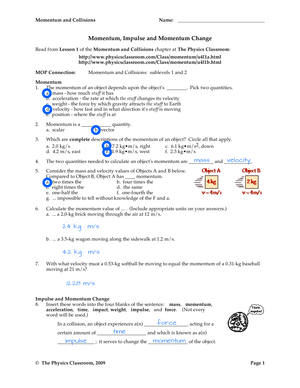
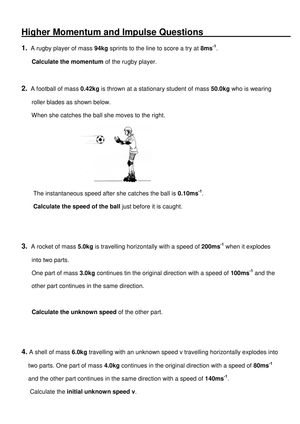
Newton's second law produces one error that shows up in virtually every class: students substitute weight (in Newtons) for mass (in kilograms) when they set up F = ma. A student who correctly uses W = mg to find weight will then immediately plug that Newton value back into the acceleration equation — doubling the gravitational effect without realizing it. The error is hard to catch on a test because the algebra looks clean; catching it during worksheet practice, when students are expected to show unit labels, is where the correction actually sticks.
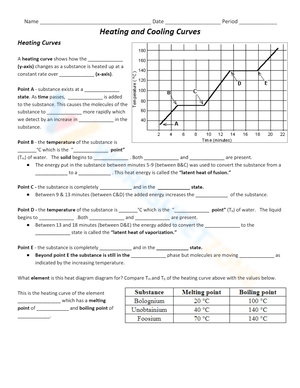
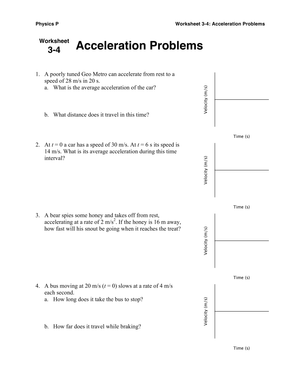
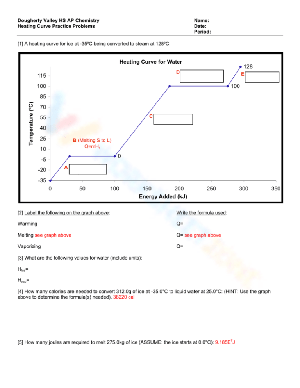
Velocity-time graphs generate a distinct and persistent misconception. Students read the y-value at a specific time and call it acceleration, rather than computing the slope between two points. When a graph shows a velocity of 12 m/s at t = 3 s, students write "acceleration = 12 m/s" — they haven't calculated a rate of change at all, just reported the height of the graph. The kinematics worksheets require students to label their slope calculations explicitly, which makes the error visible in the written work before it migrates to a quiz.
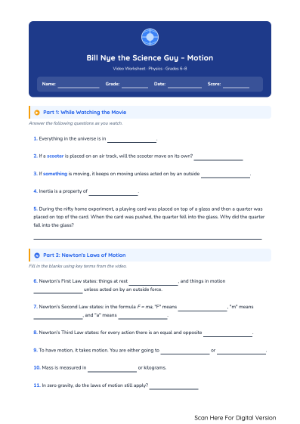
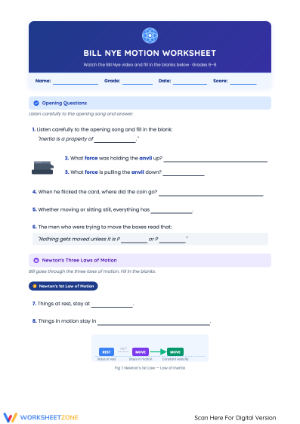
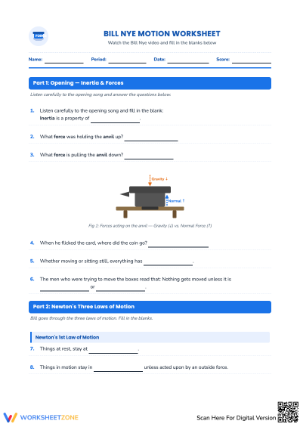
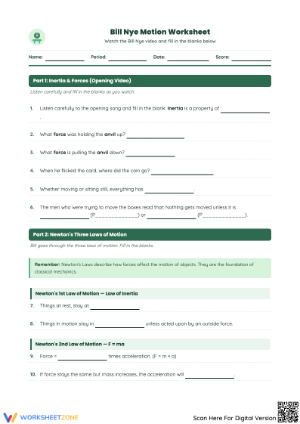
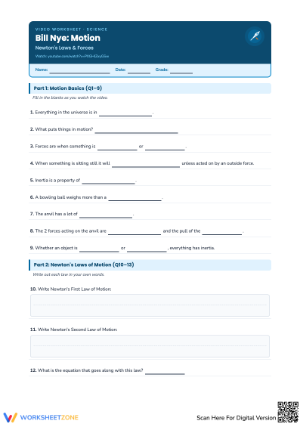
On Newton's third law, many freshmen believe that action-reaction pairs cancel each other, which leads them to conclude that nothing should ever accelerate. The word "equal" in "equal and opposite" sounds like equilibrium to a 14-year-old, and that misreading is durable. These worksheets address it by requiring students to identify which object each force in an action-reaction pair acts upon — a step that makes it structurally impossible to treat the two forces as acting on the same body.
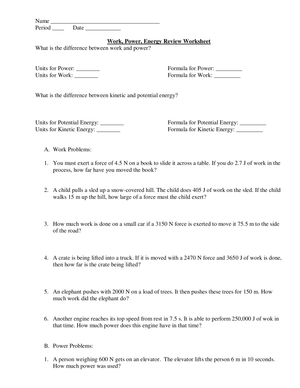
Simple machines bring their own arithmetic trap. Students who can recite "mechanical advantage equals output force over input force" will still invert the ratio when the problem is set up so the output force is smaller than the input — which shouldn't yield a mechanical advantage greater than one, but does in their calculation. Requiring students to label input and output before writing any numbers reduces this error significantly.
Building These Worksheets Into the Week Without Losing Instructional Time
The 9th grade forces motion and machines printable worksheets set works best when matched to a specific moment in a lesson sequence rather than distributed as bulk practice. A strong placement for the free-body diagram worksheets is the class period after introducing Newton's first and second laws — before students attempt algebraic problem-solving. Students who draw the diagram first make far fewer sign errors when they set up equations, because the direction of each force is already committed to paper before a single number appears.
The kinematics graphing worksheets run particularly well as Monday morning warm-ups. Graphing is the skill that fades fastest over a two-day weekend gap, and ten minutes of graph interpretation at the start of the week costs less time than reteaching it mid-unit. The simple machines efficiency worksheets, which require multi-step calculation, fit better in a full practice block — the fifteen or twenty minutes at the end of class when direct instruction is finished and students need applied work to consolidate what they heard.
Exit-ticket use is worth building in deliberately. One worksheet collected at the door gives a clean read on which students have internalized the concept and which are still making procedural errors. The data from that quick check should drive how you open the next class — whether that's a worked example at the board, a rapid peer correction activity, or moving forward with confidence because the class is ready.
Standard Alignment
These worksheets align with NGSS HS-PS2-1, which requires students to analyze data to support the claim that Newton's second law of motion describes the mathematical relationship among the net force on a macroscopic object, its mass, and its acceleration. In classroom terms, this standard is what makes F = ma problem sets non-negotiable: students need enough quantitative repetition that the relationship stops being a formula they recall and becomes one they reason from. The simple machines and mechanical advantage content connects to HS-PS3-1 and the broader work and energy strand — particularly when students compare ideal mechanical advantage to actual mechanical advantage and account for energy lost to friction as the reason those two values diverge.
Differentiating the Worksheets Across Ability Levels
For students still building algebra fluency, the F = ma worksheets work better when paired with a formula reference card. The instructional goal at this stage is reasoning about forces — not testing whether a student can retrieve an equation under pressure. Removing that barrier lets struggling students access the physics thinking and still reveal their conceptual understanding, which is where the diagnostic information actually lives.
Advanced students benefit from extension problems that require formula rearrangement under less-obvious conditions: solving for mass when net force and acceleration are both given as expressions rather than clean integers, or determining the ramp angle needed to produce a specified mechanical advantage. The graphing worksheets extend naturally by asking students to write the kinematic equation for a specific motion segment and justify it using the graph's slope — a task that bridges the graphical and algebraic representations in a way that on-level problems do not demand.
For students who need a different entry point into motion graphs, pairing the worksheet with a brief physical demonstration — one student walking at constant speed across the room, then accelerating — before asking the class to sketch the corresponding graph gives them a perceptual anchor. The worksheet alone asks students to reason abstractly about motion they cannot see; the sixty-second demonstration changes that.
Frequently Asked Questions
Are these worksheets appropriate for an on-level 9th grade physical science class, or are they aimed at honors?
The set works for on-level physical science. The problem types reflect what a standard mechanics unit covers — Newton's laws, basic kinematics, and simple machines — without requiring calculus or pre-calculus reasoning. The algebraic demands stay within what most 9th graders have seen in middle school math, so the challenge is conceptual and procedural rather than a math-readiness issue.
My students freeze as soon as they see a word problem. What helps?
Require a physics sketch before any numbers appear on paper. Students draw the object, label the forces with directional arrows, and write down what quantity they are solving for. This step converts a paragraph of text into a visual setup and reduces the cognitive load of parsing language and doing algebra at the same time. Most setup errors disappear once this habit is consistent — students who skip the sketch are the ones who consistently misread what the problem is asking.
Can I use these for formative assessment rather than graded practice?
Yes, and that's often the better use. Each worksheet targets a narrow enough skill that it functions as formative feedback rather than a summative measure. Students who work through an additional 9th grade forces motion and machines printable worksheets exercise before a unit test are doing spaced retrieval practice on exactly the skills the assessment covers — which is more useful than a general study session the night before.
How do I help students who confuse mass and weight?
The Newton's second law worksheets include problems that require students to convert between weight (in Newtons) and mass (in kilograms) before solving — which forces the computational version of understanding the distinction. A reliable problem type is asking students to calculate their weight on the Moon using g = 1.62 m/s² and then on Earth using g = 9.8 m/s², and to confirm their mass stays constant across both calculations. Students who can narrate why the numbers change — and why one number does not — have moved past the surface confusion.
Where do these fit if I teach forces and motion across a full semester rather than a compressed unit?
The set distributes across a longer course without any awkward sequencing. Use the kinematics worksheets during the motion-without-forces portion of the course, introduce the Newton's law worksheets once forces enter the picture, and save the simple machines and mechanical advantage work for the energy and work strand later in the semester. Distributing the practice this way means the 9th grade forces motion and machines printable worksheets materials serve a spaced retrieval function — students revisit related ideas after a meaningful interval rather than massing all the practice into a single week.












 Interactive Worksheet Maker
 Quiz Maker
 Word Search Maker
 Crossword Puzzle Maker
 Word Scramble Generator
 Sentence Scramble Generator
 Handwriting Worksheet Generator
 Name Tracing Generator
 Fill In The Blank Generator




 BACK TOSCHOOL