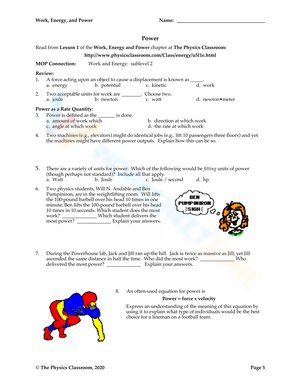
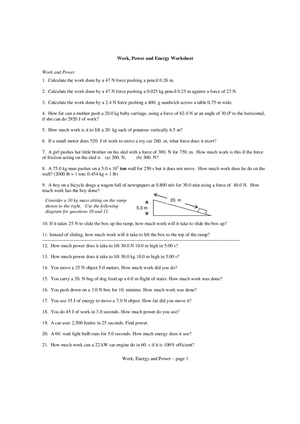
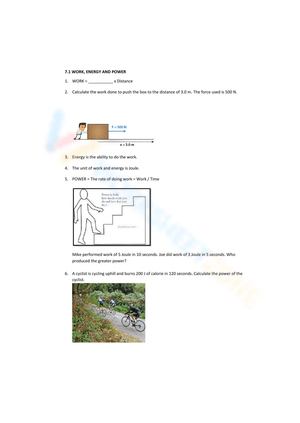
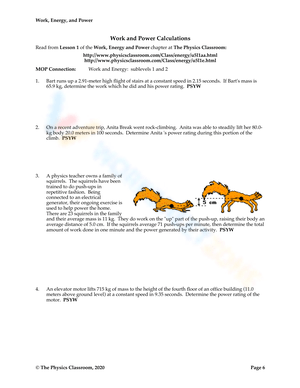
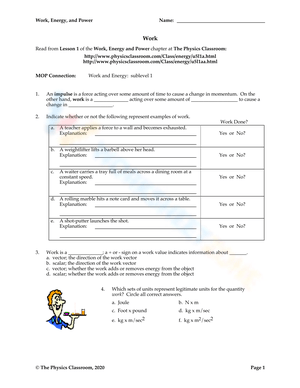
These work power and energy worksheets for 9th grade target a unit that trips students up in two distinct ways—once on the definitions, and again when calculation skills and conceptual understanding have to work together at the same time. The printable set moves through formula application, unit reasoning, and scenario-based questions in a sequence that mirrors how a typical unit unfolds in class: definitions first, then calculation practice, then problems where students have to decide which idea is even relevant.
Student Mistakes These Worksheets Help Teachers Catch
The hardest idea to teach in this unit isn't the formula—it's the physics definition of work itself. Ninth graders will consistently say that someone carrying a heavy box across a room is doing work, because from an everyday standpoint that's accurate. From a physics standpoint, if the applied force is vertical but the displacement is horizontal, work done by that force is zero. That gap between ordinary language and technical definition doesn't close after one explanation. Worksheets that present a series of illustrated scenarios—lifting, pushing horizontally, carrying at constant height—and ask students to mark each as positive work, negative work, or zero work give students the repeated exposure needed to stop relying on intuition and start applying the actual definition.
The second common breakdown happens with power. Students frequently compute P = W/t correctly but then describe the higher-powered machine as having "done more work." The problem held work constant—power describes the rate, not the quantity. The correct calculation appears in their work; the wrong interpretation appears in their explanation. Worksheets that require a written sentence explaining what a higher power value actually tells you—rather than only solving for the number—make that gap visible while there's still time to address it.
Unit tracking is the third consistent problem. A student who works through W = Fd and writes 480 without a label will stall on the following problem, which asks them to use that value in P = W/t. They can recite that power is measured in watts, but they haven't registered the unit chain: newtons times meters gives joules, joules divided by seconds gives watts. Requiring unit labels at every substitution step—not just on the final answer line—surfaces this problem immediately rather than at the test.
The Specific Skills Targeted
Each worksheet in the set addresses one or more of the following:
- Applying W = Fd to calculate work from force and distance values, with close attention to the direction of force relative to motion
- Using P = W/t to compare situations where identical tasks are completed in different amounts of time
- Calculating kinetic energy using KE = ½mv² and gravitational potential energy using GPE = mgh
- Identifying conditions under which work equals zero even when force is clearly present
- Showing full substitution steps with units at each stage before arriving at a final answer
- Answering short written-response items that require explanation or comparison, not just a number
That last item carries more weight than it might appear. A student can complete eight calculation problems correctly and still struggle to answer: "Two workers lift identical loads to the same height. Worker A finishes in half the time. Who did more work? Who had more power? Explain." The answer to the first part—they did equal work—surprises more students than it should. The explanation items in this set are placed after calculation practice so students encounter that type of question before the test does.
How to Build These Worksheets Into a Unit Sequence
The work power and energy worksheets for 9th grade in this set are organized by focus—formula application, unit reasoning, or conceptual comparison—so teachers can pull the right worksheet for a given lesson without working through the full collection first.
Early in the unit, a worksheet focused on positive/negative/zero work scenarios works well as a 10-minute paired activity immediately after the initial definition lesson. Students who process the formula quickly often assume they've grasped the concept; these scenario-based exercises reveal the difference between the two. Mid-unit, after students have seen both work and power, a comparison worksheet—same work, different times—makes a strong partner task for the last 15 minutes of class because students have to put the distinction into words, not just numbers. By the review phase, worksheets that present work, power, and energy problems together without labeling which concept each one targets require students to select the right formula themselves. That is a substantially better preparation for a unit test than reviewing each topic in its own isolated block.
These worksheets also make reliable sub plans. Each one is self-contained, with enough example structure that students can proceed independently and clear enough directions that a substitute needs no setup time. A two-worksheet sub assignment—one focused on work calculations, one on mixed review—rarely results in off-task classes.
Standard Alignment
The content in these worksheets aligns with NGSS HS-PS3-1, which requires students to create mathematical representations of energy transfer in a system, and HS-PS3-2, which addresses how macroscopic energy can be understood as a combination of kinetic and potential forms. In most 9th grade course sequences, these performance expectations arrive in the first semester, typically after a unit on forces and motion. That sequence matters: students who already have working definitions of force and displacement experience the introduction of work as a natural extension of prior learning rather than a fresh conceptual leap.
At the algebra level, the formula work in these worksheets connects to Common Core HSA-CED.A.1, which asks students to create equations from real-world contexts. Rearranging W = Fd to solve for force, or P = W/t to solve for time, is that standard applied in a science setting—a connection worth naming explicitly to students who treat math class and science class as unrelated.
Adjusting These Worksheets for a Range of Learners
For students still building algebra fluency, start with the direct-substitution worksheets where all variable values are provided and the task is to apply the formula, track units, and write the answer with the correct label. Students who can recite W = Fd but struggle to rearrange it to solve for force or distance should not be asked to do both things at once. Keeping initial practice at the formula-application level preserves the focus on the science content rather than the algebra.
For students ready for extension, the comparison and explanation items in this set require genuine reasoning. Finishing a power calculation worksheet quickly isn't the stopping point—these students can move directly to a prompt that gives two machines with identical work output but different completion times and asks which is more powerful and why. That combination of calculation and written justification is closer to what AP Physics 1 free-response questions actually require than any additional substitution problem would be.
Teachers looking for work power and energy worksheets for 9th grade to use across a mixed-readiness class will find the most flexibility in this set by sorting worksheets according to cognitive demand rather than topic alone. One stack for direct substitution, one for unit reasoning, one for explanation tasks—that organization makes it possible to assign targeted follow-up practice after a formative check rather than simply handing back the same worksheet students already completed.
Frequently Asked Questions
Do these worksheets include answer keys?
Each worksheet comes with a corresponding answer key showing worked solutions with unit labels at every step. For multi-step problems this is particularly useful, because a correct formula choice with an arithmetic error looks different from a wrong formula selection—both produce incorrect final answers, but the right instructional response is different for each.
What prior knowledge do students need before starting these worksheets?
Students should be familiar with force and displacement from a prior kinematics or forces unit and should be able to work with a two-variable equation. The direct-substitution worksheets are accessible to students still developing that algebra skill; the multi-step and comparison worksheets assume students can rearrange a formula independently.
Can these worksheets be assigned for homework without prior classroom introduction?
The calculation-focused worksheets work well for homework once students have received direct instruction on the relevant formula. The conceptual and comparison items are better used as class activities first, where students can discuss and check their reasoning before working independently. Sending explanation items home without prior modeling tends to produce more guessing than actual thinking.
How do the mixed-review worksheets differ from the topic-focused ones?
The topic-focused worksheets build fluency within a single concept. The mixed-review worksheets place work, power, and energy problems in the same set without signaling which concept each one targets—students have to identify the right approach themselves. That mirrors actual assessment conditions more closely than any single-topic review. If you are comparing this set against other work power and energy worksheets for 9th grade resources available online, the presence of that mixed-review component is one of the most meaningful differences to look for.












 Interactive Worksheet Maker
 Quiz Maker
 Word Search Maker
 Crossword Puzzle Maker
 Word Scramble Generator
 Sentence Scramble Generator
 Handwriting Worksheet Generator
 Name Tracing Generator
 Fill In The Blank Generator




 BACK TOSCHOOL