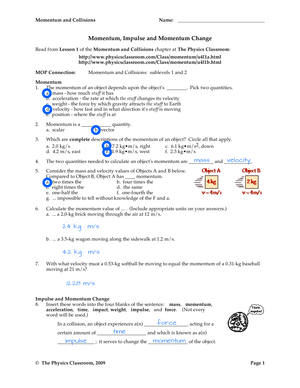
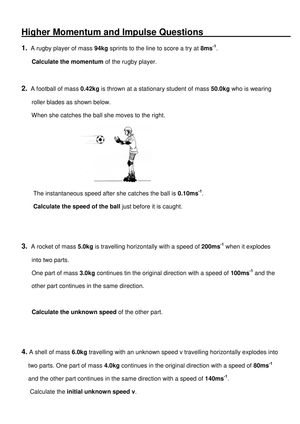
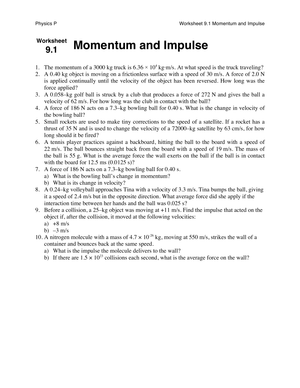
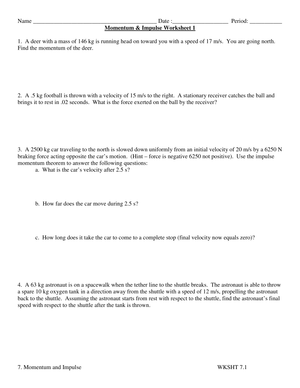
9th Grade Momentum and Impulse worksheets
These 9th grade momentum and impulse worksheets resources give physics teachers a ready set of problem-solving practice for one of the most conceptually layered units in introductory physical science. Each worksheet targets a specific layer of the momentum-impulse relationship — from foundational p = mv calculations through the full Impulse-Momentum Theorem — rather than compressing the whole unit into one undifferentiated bank of equations. The set addresses the error patterns and conceptual gaps that reliably appear in student work, including direction sign errors, unit conversion failures, and the struggle to move between symbolic manipulation and physical reasoning.
Skills Across the Set
The worksheets move through the momentum-impulse sequence in a deliberate order. Early worksheets build fluency with p = mv, requiring students to identify mass in kilograms, velocity in meters per second, and the direction of motion before writing a single number — because the vector nature of momentum is where most 9th graders first go wrong. A second cluster introduces impulse via J = FΔt and includes Force-Time graphing exercises where students calculate impulse by finding the area under the curve. This graphing skill matters beyond physics: the same concept reappears in AP Calculus and AP Physics C.
Later worksheets work with the full Impulse-Momentum Theorem, FΔt = m(vf − vi). Problems require students to solve for different unknowns — average force during a collision, the contact time needed to bring a vehicle to rest, the final velocity after a known impulse — so algebraic rearrangement gets practiced alongside physical reasoning. The set closes with applied scenarios drawn from car safety engineering and sports biomechanics, where students explain why a longer contact time produces a smaller average force rather than just calculating it.
Error Patterns That Show Up Across Every Class
The directional sign issue is the most consistent source of lost points in this unit, even among students who understand the concept. A student calculating the average braking force on a 1,500 kg car decelerating from 20 m/s to rest might correctly compute Δp = 1,500(0 − 20) = −30,000 kg·m/s, then report the braking force as +1,500 N because they dropped the negative when dividing by time. The error is not algebraic confusion — the student can do the algebra. The failure is treating direction as a bookkeeping detail rather than a physical property of the answer. The worksheets in this set include a direction-labeling step before each calculation precisely to interrupt that habit.
Unit conversion is the other predictable stumbling block. Textbook problems frequently give mass in grams and speed in km/h, and students who sail through the conceptual questions will often leave those units unchanged, producing answers off by factors of 1,000 or 3.6. These worksheets require students to show unit conversions as explicit steps before they write the momentum equation, which prevents the error structurally rather than just marking it wrong after the fact.
Standard Alignment
The 9th grade momentum and impulse worksheets set addresses NGSS HS-PS2-2, which requires students to use mathematical representations to support the claim that the total momentum of a system is conserved when there is no net force on it. In classroom terms, meeting this standard means students must do more than substitute numbers into FΔt = Δp — they need to interpret what their answer means in the given physical situation, explain why a collision outcome makes sense, and connect the equation to observable phenomena. The application-level worksheets push students toward that interpretive layer, making them useful for summative assessment preparation as well as daily practice.
Getting the Most From These Worksheets in Your Lesson Sequence
The most effective sequencing puts the p = mv worksheets right after an initial demonstration — a cart collision on a track, or a slow-motion clip of a bowling ball hitting pins — before the formula gets formally introduced. Students who have just watched a heavy cart dominate a lighter one already have an intuition about mass and speed that the worksheet can anchor into mathematics. Saving the impulse worksheets for after the PhET Collision Lab simulation means students work with Force-Time graphs while the visual relationship between force, time, and momentum change is still fresh from the screen.
The 9th grade momentum and impulse worksheets that work through the Impulse-Momentum Theorem are most productive as a pre-lab requirement before a crash-test or egg drop activity. Students who calculate the predicted impact force and minimum stopping time before they build their containers carry a real physical question into the lab: did the contact time I designed actually meet the threshold? That predictive accountability changes what the activity teaches. Teachers who skip the calculation step often run a fun activity that students can't explain when asked.
Adjusting the Set for a Range of Learners
For students still developing algebra fluency, the Impulse-Momentum Theorem worksheets become more accessible when the rearranged forms — F = Δp/Δt and Δt = Δp/F — are printed alongside the standard form. This reduces the cognitive weight of the algebra step so students can concentrate on identifying what they're solving for and interpreting the answer physically. The two students who benefit most from this adjustment are usually not the lowest performers — they're the ones who understand the physics but lose confidence the moment an equation needs rearranging.
Students who move through the standard problem sets quickly find genuine challenge in the Force-Time graph worksheets that use non-constant force curves. Estimating the area under a curved line by treating it as a series of trapezoids is not a busywork extension — it is a real mathematical task that previews integration for students heading into AP Physics or precalculus. The 9th grade momentum and impulse worksheets in this set include one advanced graphing problem of that type, so no separate material needs to be prepared for those students.
Frequently Asked Questions
What is the difference between inertia and momentum for a 9th grader?
Inertia depends only on mass and describes resistance to any change in motion, whether an object is stationary or moving. Momentum adds velocity to the picture — it only exists when an object is actually moving. A parked delivery truck has enormous inertia but zero momentum. A tennis ball traveling at 150 km/h has relatively small inertia but real momentum. Students who confuse the two tend to conflate "hard to set in motion" with "hard to stop," which are related but not identical. The distinction becomes clearer when students solve problems where two objects share the same mass but move at different speeds, or carry the same speed but differ in mass.
Why do airbags reduce injury, explained using the Impulse-Momentum Theorem?
In a collision, the change in momentum is fixed by the vehicle's mass and the change in velocity — airbags cannot alter either of those values. What airbags change is the time interval over which that momentum change occurs. Because FΔt = Δp, holding Δp constant and increasing Δt forces F to decrease proportionally. Increasing contact time from roughly 0.02 seconds to 0.2 seconds reduces the force on the passenger by a factor of ten. This is the calculation students work through in the applied worksheets, and the result consistently surprises them.
What units should students use for momentum and impulse?
Momentum is reported in kilogram-meters per second (kg·m/s). Impulse is reported in Newton-seconds (N·s). These are dimensionally equivalent — one Newton equals one kilogram-meter per second squared, so one N·s equals one kg·m/s. The convention is to report final momentum in kg·m/s and impulse in N·s, even though the numbers are interchangeable. Students can use this equivalence as a self-check: if the unit on their impulse answer doesn't match the unit of their momentum change, something went wrong in the calculation.
Why is kinetic energy not conserved in most collisions when total momentum is?
Total momentum is conserved in any isolated system because the internal forces during a collision are equal and opposite — Newton's Third Law guarantees those forces cancel when summed across both objects. Kinetic energy carries no such protection; it converts into heat, sound, or the energy used to permanently deform material (a bent bumper, a cracked helmet, a dented door panel). Only in a perfectly elastic collision does kinetic energy remain constant. Students notice this concretely when they compare elastic and inelastic problems side by side on the same worksheet — the momentum equations balance cleanly while the kinetic energy values do not.
Clear All