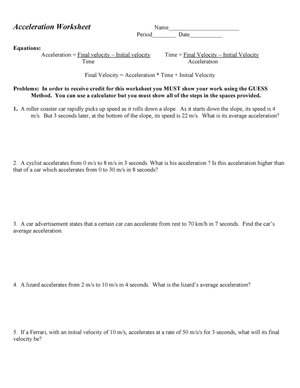
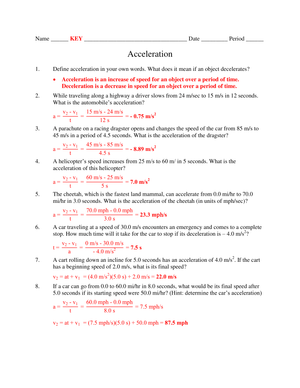
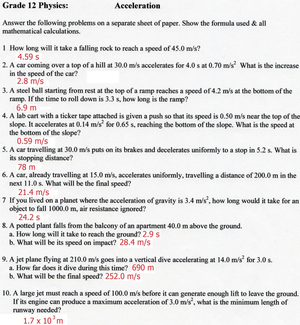
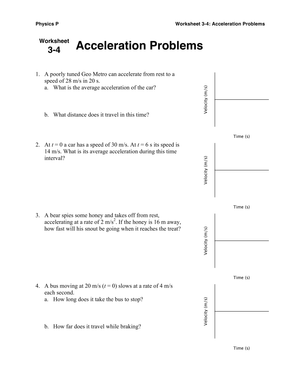
These acceleration printable worksheets for 9th grade give physics teachers a focused set of standalone practice resources that move students from the basic formula through velocity-time graph analysis and into multi-step sign problems — all within introductory kinematics. Each worksheet targets a specific skill, so teachers can assign exactly what a class or individual student needs rather than working through an undifferentiated block of problems.
The Specific Skills Each Worksheet Targets
The variety built into acceleration printable worksheets for 9th grade reflects the multiple cognitive moves the topic demands — formula manipulation, graph interpretation, unit analysis, and algebraic rearrangement all operate differently, and treating them as one undifferentiated skill leaves gaps in what students can actually do independently.
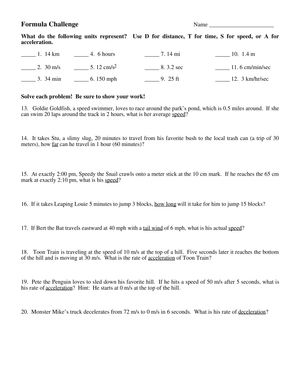
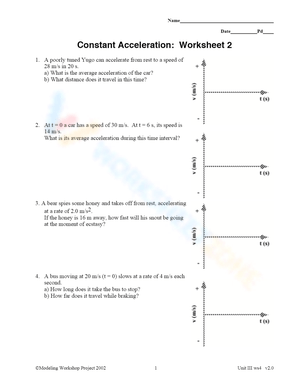
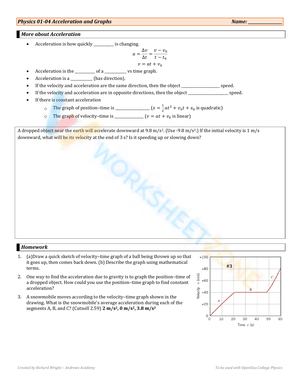
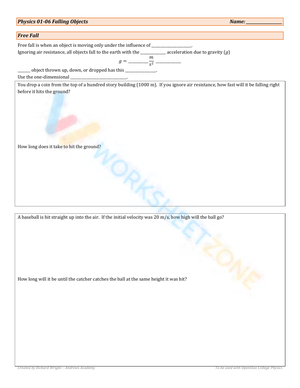
The foundational worksheets ask students to apply a = Δv / t to short word problems: identify initial velocity, final velocity, and elapsed time, then solve for the unknown. A second group shifts entirely to velocity-time graphs. Students calculate the slope of a plotted line, label intervals of positive acceleration, negative acceleration, and constant velocity, and explain in writing what a flat horizontal segment physically represents. A third type introduces algebraic rearrangement — given acceleration and final velocity, solve for initial velocity; or given initial velocity and elapsed time, find displacement using the kinematic equations. The fourth format is error analysis: each worksheet presents a completed solution with a deliberate mistake embedded. Students mark the error, explain why it is wrong, and produce the correct answer. That format is underused in most ninth-grade classrooms and surfaces misconceptions that a straightforward calculation problem never would.
All four types require units at every step. When a student writes m/s for acceleration instead of m/s², the unit itself flags the error before the teacher ever looks at the numbers.
Frequent Student Errors Worth Watching For and Correcting
The most persistent error in ninth-grade kinematics is collapsing velocity and acceleration into one idea. Students read a problem about a car traveling at 90 km/h and assume that high speed implies rapid acceleration. Several worksheets in the set are written specifically to break that assumption — scenarios feature objects at low constant speed alongside objects at rest that are accelerating sharply, and students must classify each one. Without that direct contrast, students keep the misconception even after they can solve the formula correctly.
Sign convention is the second major trouble spot. The shorthand "negative acceleration means slowing down" is only accurate when the object is moving in the positive direction, and students who memorize the rule without understanding it get blindsided. Ask a student who just correctly identified braking as negative acceleration to analyze a ball thrown upward at the moment of release, and the sign suddenly feels backwards. The worksheets address this by requiring students to write out their coordinate system before calculating — a small step that catches a surprising number of inconsistencies. The check-your-work section at the bottom of each worksheet prompts students to verify that their sign choices hold across all variables in the problem.
A subtler problem involves what m/s² actually means. Students accept the unit without processing it. They label it correctly at the top of the page and then treat acceleration as velocity-per-meter in their arithmetic. A few directed questions — "What is the velocity after 1 second? After 2 seconds? After 3 seconds?" — force the concept to land in a way the formula alone does not, and these appear deliberately in the graphing worksheets where the pattern becomes visible on the line.
How to Work These Worksheets Into Your Lesson Plans
The formula-based worksheets run well as the first eight to ten minutes of a period when students have just come off a demonstration or direct instruction. They are still in receiving mode, and a short set of guided calculations keeps the thinking active without demanding the independent synthesis they are not ready for yet. The graphing worksheets work better in pairs. Two students talking through why a slope is negative — connecting the math to what the object is physically doing — produce stronger understanding than one student staring at the line alone. The conversation is the instruction.
The error-analysis worksheets belong later in the unit, not at the beginning. They ask students to hold the correct process in mind while reading someone else's flawed work, which is a higher cognitive demand than solving a fresh problem. Assigning one after students have completed basic calculations on their own gives teachers a clear window into whether understanding is procedural or conceptual — whether students are following a memorized sequence of steps or actually know why the steps work. The two produce very different error-analysis results.
These acceleration printable worksheets for 9th grade also function as efficient exit tickets during the last few minutes of class. A single calculation — "A skateboard rolls from rest and reaches 6 m/s in 4 seconds; find its acceleration and include units" — takes under three minutes and tells you immediately which students have internalized the formula and which are still uncertain about what goes in the denominator.
Standard Alignment
These worksheets align with NGSS HS-PS2-1, which asks students to analyze data to support the claim that Newton's second law describes the mathematical relationship among net force, mass, and acceleration. That standard sits downstream of the calculation skills these worksheets build. Students who cannot isolate acceleration as a variable — or who misread the slope of a velocity-time graph — will work through HS-PS2-1 mechanically rather than analytically. Fluency with the acceleration formula is the prerequisite, not the endpoint, and these worksheets treat it that way.
The graphing worksheets also address the NGSS science and engineering practice of analyzing and interpreting data — specifically, extracting quantitative information from a visual representation and connecting it to a physical phenomenon. That practice appears across physical science performance expectations at the high school level, so time spent on graph interpretation in kinematics pays forward into later units on force, energy, and waves.
Differentiating These Worksheets Across Student Levels
Students who are still shaky on algebra benefit from tackling the formula-application worksheets before any rearrangement problems. Adding a fully worked example at the top of each worksheet — one problem solved in full with units labeled at every step — gives those students a reference point they can return to without needing to raise a hand. That removes the social friction some students feel around asking basic questions in front of peers and keeps the class moving through the period without repeated interruptions.
Students who move through basic calculations quickly find enough complexity in the error-analysis and rearrangement worksheets. A further extension: ask those students to write their own word problem using a specific acceleration value, then exchange with a partner and solve. That task requires genuine command of all four variables in the kinematic equations — not just the procedural steps for plugging numbers in — and the writing component surfaces gaps that the calculation alone would not.
These acceleration printable worksheets for 9th grade can also support students with IEPs or 504 plans when teachers reduce the number of problems per worksheet and permit calculator use on the computational sections. The error-analysis and graph-interpretation questions can then be assigned at full volume as the on-grade-level conceptual work, while the arithmetic-heavy problems are adjusted in quantity. The two task types are separable, which gives teachers flexibility without eliminating rigor for students who need modified workloads.
Frequently Asked Questions
What is the difference between positive and negative acceleration?
Positive acceleration means velocity is increasing in the direction defined as positive. Negative acceleration means velocity is decreasing in that direction — or increasing in the opposite direction. The shortcut "negative acceleration means slowing down" only holds when the object is moving in the positive direction. A ball rolling backward and picking up speed has negative acceleration even though its speed is increasing. Setting up a coordinate system before solving eliminates most of the confusion around this.
How do you calculate acceleration from a velocity-time graph?
Acceleration equals the slope of the line on a velocity-time graph. Select two distinct points on the line, find the change in velocity (Δv), and divide by the elapsed time between those points (Δt). A steep upward slope represents large positive acceleration. A line angling downward represents negative acceleration. A flat horizontal line means zero acceleration — the object is moving at constant velocity, with no change in speed or direction.
Can an object be moving fast and have zero acceleration?
Yes. A commercial aircraft cruising at 850 km/h in a straight line at constant speed has zero acceleration because its velocity is not changing. Acceleration measures the rate of change of velocity, not velocity itself. This is one of the most commonly misunderstood points in ninth-grade physics, which is why several worksheets in the set pair high-speed constant-velocity scenarios directly alongside objects that are accelerating from rest — students must identify which situation shows acceleration and which does not.
Why does circular motion at constant speed count as acceleration?
Velocity is a vector quantity that carries both magnitude and direction. In circular motion, an object's direction changes continuously even if its speed remains constant. Because direction changes, velocity changes — and any change in velocity over time meets the definition of acceleration. The force responsible for this (centripetal force) points toward the center of the circle, which is why the resulting acceleration also points inward rather than along the direction of travel.












 Interactive Worksheet Maker
 Quiz Maker
 Word Search Maker
 Crossword Puzzle Maker
 Word Scramble Generator
 Sentence Scramble Generator
 Handwriting Worksheet Generator
 Name Tracing Generator
 Fill In The Blank Generator




 BACK TOSCHOOL