9th Grade Factor Quadratic Expressions Worksheets
These 9th grade factor quadratic expressions printable worksheets give algebra teachers a sequenced set of practice resources that moves students from extracting a greatest common factor through trinomial factoring and into special product patterns. Each worksheet targets a single factoring type, which keeps cognitive load focused rather than scattering student attention across every case at once. The set fits naturally into an Algebra 1 unit without requiring teachers to build the progression from scratch.
The Factoring Types Covered, and Why the Order Matters
Factoring quadratic expressions breaks into four categories that build on one another. Presenting them out of sequence is one of the fastest ways to lose students, so the worksheets follow this order deliberately.
- Greatest Common Factor first: Every factoring problem starts here — including problems where the GCF is one. Students who skip this step arrive at larger coefficients in the remaining trinomial and then struggle unnecessarily. Making GCF extraction a required first step, even when trivial, locks in the habit before it actually matters.
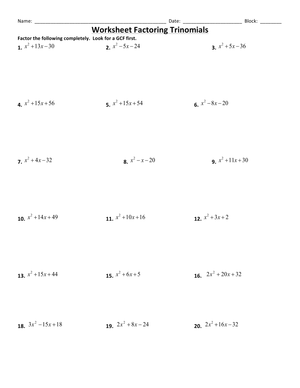
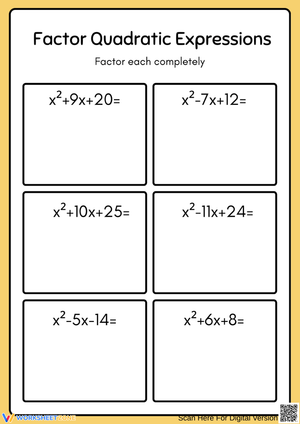
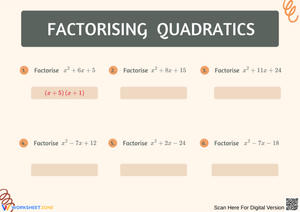
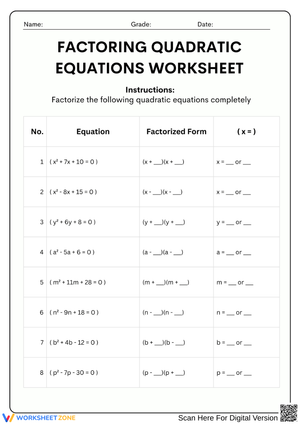
- Trinomials with a leading coefficient equal to 1: The form x^2 + bx + c asks students to find two integers that multiply to c and sum to b. This is a number-sense problem dressed in algebraic notation. The worksheets use a range of integer values, including negatives, so students do not assume the factor pairs are always positive.
- Trinomials with a leading coefficient greater than 1: This is where many students stall. Each worksheet in this section presents the AC method and the box method alongside each other for the first few problems, then removes that parallel structure so students choose their own approach on the remaining problems.
- Special products — difference of squares and perfect square trinomials: These patterns reward recognition over calculation. The worksheets include identification tasks before the factoring tasks, so students build the habit of noticing the pattern rather than defaulting to trial and error every time.
Errors Worth Anticipating Before You Hand These Out
The most consistent mistake across 9th grade factoring work is sign confusion in trinomials where c is negative. Students understand that one factor must be positive and one negative to produce a negative product, but they guess at placement rather than testing both options. The error surfaces like this: a student factors x^2 + 2x − 15 correctly as (x + 5)(x − 3), but then writes (x + 5)(x + 3) for x^2 − 2x − 15 without checking whether the middle term comes out right. These worksheets include a verification step in the answer space — students multiply the binomials back out before moving on, which interrupts that guessing pattern.
The second persistent problem is incomplete factoring. A student pulls a GCF of 2 from 2x^2 + 8x + 6, writes 2(x^2 + 4x + 3), and stops. The remaining trinomial is still factorable, but the student treats simpler as done. This error is especially predictable when the GCF is large. Several worksheets in the set flag these problems with a prompt — "can this expression factor further?" — that interrupts the assumption without giving away the next step.
Building These Worksheets Into Your Algebra 1 Lesson Plans
The approach that works best is assigning one worksheet per factoring type on the day you introduce that type, then returning to mixed-review worksheets every two or three days throughout the unit. Spaced retrieval matters here because students who practiced GCF factoring on Monday will frequently misapply it to a trinomial problem on Friday without the review touchpoint. The mixed-review worksheets work especially well as the first ten minutes of class on Monday morning — not as a quiz, but as a reset that surfaces which method each student retained over the weekend.
Error analysis tasks embedded in several worksheets also fit well in that slot. Asking a student to explain in writing where shown work went wrong is a more demanding task than re-solving the problem from scratch, and it pays off in the quality of their own self-monitoring. One practical note: when using box method worksheets, having students work on graph paper eliminates a persistent source of arithmetic error. The box method is a visual organizer, and students who draw it freehand frequently misalign partial products — an issue that has nothing to do with whether they understand factoring.
Standard Alignment
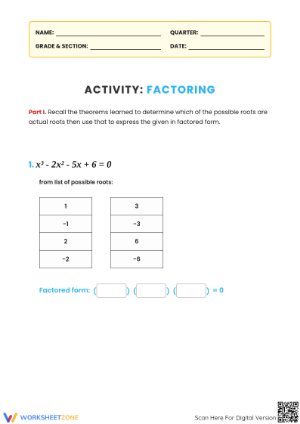
These worksheets address CCSS.MATH.CONTENT.HSA-SSE.B.3a, which requires students to factor a quadratic expression to reveal the zeros of the function it defines. In classroom terms, this standard sits at the intersection of algebraic structure and function behavior — students are not merely rewriting expressions but connecting the factored form to the x-intercepts of a parabola. Teachers using these worksheets to meet this standard should pair them with graphing tasks so students see that (x − 3)(x + 5) = 0 means the parabola crosses the x-axis at 3 and −5, not just that the algebra worked out. Factoring without that graphical anchor often stays procedural through the end of the unit.
Adjusting These Worksheets for a Range of Learners
For students still working on integer fluency, the trinomial worksheets become significantly more manageable when you provide a printed multiplication chart and require them to use it actively rather than relying on recall. That is not the same thing as lowering the algebraic expectation — it separates arithmetic retrieval from algebraic reasoning so you can assess the latter independently. When assigning these 9th grade factor quadratic expressions printable worksheets for homework, flagging the GCF-first problems for students who need additional support at home gives them a reasonable entry point that builds confidence before the harder types.
For students who move through the standard problems quickly, the set includes challenge problems that require two factoring methods within a single expression — for example, a four-term polynomial where grouping leads directly into a difference of squares. These problems also appear in area model contexts: a quadratic expression representing a rectangular area, where the factored form reveals the dimensions. Students who need extension work in mathematical communication benefit from writing out in prose why the Zero Product Property allows the factored form to solve the related equation, then presenting that explanation to a partner.
Frequently Asked Questions
Which factoring method holds up best for trinomials where the leading coefficient is greater than 1?
Both the AC method and the box method work consistently for this case. The box method tends to be more reliable for students who make arithmetic errors in multi-step procedures because the visual layout forces each partial product into a specific cell, making the work easier to trace back when something goes wrong. The AC method is faster once internalized and requires no drawing. These worksheets present both methods; students work through enough problems with each to make a real choice rather than defaulting to whichever one the teacher modeled most recently.
How do these worksheets connect factoring to solving quadratic equations?
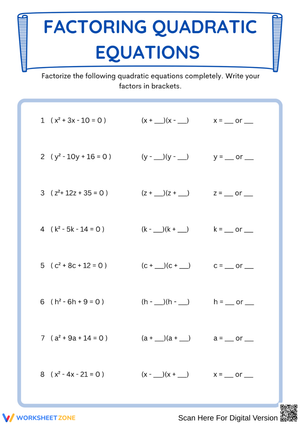
Several worksheets include a final column that asks students to set the factored expression equal to zero and state the solutions — not as a full equation-solving unit, but as a preview. Students who see that (x + 4)(x − 7) immediately tells them where the equation equals zero have a concrete reason to care whether they factored correctly, which changes the quality of the practice. That connection also makes the transition into the solving unit shorter, because students arrive already holding the logic of the Zero Product Property.
Can these worksheets function as formative assessment tools?
Using the 9th grade factor quadratic expressions printable worksheets as exit tasks — one per class session during the factoring unit — gives a running record of each student's progression across factoring types without requiring separate quiz preparation. Because each worksheet covers a narrow skill, a completed set tells you specifically where a student's understanding breaks down. A student who handles GCF problems correctly but stalls on a = 1 trinomials gives you a diagnostic reading that a cumulative chapter test would bury.
What should I do when a student keeps making sign errors no matter how many problems they attempt?
Pull back to integer operations briefly. Students who cannot quickly determine which sign combination produces a given sum and product do not have a factoring problem — they have a signed-number fluency gap that factoring is exposing. A short round of integer pair exercises done on a mini-whiteboard (find two integers that multiply to −12 and sum to 1) usually reveals whether the student can reason through sign logic at all outside the algebraic context. Once they can do that reliably, the factoring errors typically resolve. These 9th grade factor quadratic expressions printable worksheets include a small integer-pair warm-up in the header of each trinomial worksheet specifically to address this gap at the point of use.
Clear All