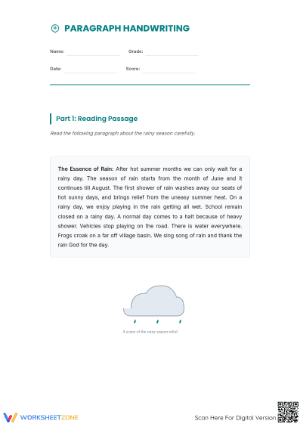
These handwriting printable worksheets for 9th grade fill a gap that secondary teachers run into constantly: there are plenty of K–5 penmanship resources and almost nothing that respects what a high school freshman is actually studying. Each worksheet draws on content already in the 9th-grade academic world—passages from The Odyssey and Romeo and Juliet, SAT vocabulary used in sentences, excerpts from the U.S. Constitution and other primary sources—so the handwriting drill carries academic weight alongside the motor practice. The set addresses both print and cursive legibility, with stamina-building passages long enough to simulate the sustained output demands of a timed essay.
Skills and Content Across the Set
The worksheets work through the specific legibility problems that appear most often in 9th-grade student writing. Letter formation exercises target the clusters that most commonly collapse under writing speed: in cursive, the connectors between letter pairs like o–u, b–r, and v–e; in print, the capital letters students inconsistently mix with cursive in their hybrid writing. Word spacing gets its own exercises because many students who form individual letters correctly still run words together once they pick up pace.
Beyond letter-level work, the set covers:
- Literary copywork — multi-sentence passages from texts already on the 9th-grade reading list, so copying serves double duty as close-reading exposure and builds familiarity with complex sentence structures
- SAT and ACT vocabulary drills — students write each word inside a sentence rather than copying it in isolation, which reinforces meaning alongside letter formation
- Historical document transcription — constitutional passages and foundational primary sources in cursive, which also build the reading fluency needed for AP U.S. History or AP Government coursework
- Signature development — a structured sequence that walks students through designing a consistent cursive signature, with practice lines for both speed and precision versions
- Timed writing benchmarks — one-minute copy exercises that produce a baseline sample teachers can compare directly to each student's untimed work
Legibility Failures Worth Knowing Before You Teach This Set
The error pattern that shows up most consistently in 9th-grade writing is not poor letter formation in isolation—it's letter formation that deteriorates under speed. A student can produce a clean lowercase a when copying a single word slowly, then write something that reads as a u or even ci when the same letter appears mid-sentence at normal note-taking pace. The breakdown typically occurs at the same two or three letter transitions for each student, and identifying those specifically is more useful than prescribing general penmanship review across the whole alphabet.
Spatial problems form the second major cluster. Students whose baseline alignment collapses—letters drifting above and below the line within the same word—often have adequate grip and adequate formation skills, but they've never been asked to write continuously for more than a few minutes at a stretch. By 9th grade, the habit is ingrained. The longer copywork passages in these worksheets address this through subtle baseline guides rather than the heavy-ruled lines that remind students of second grade. A related issue: word spacing that's fine at slow speed but compresses into illegibility by the third line of a paragraph. The timed exercises surface this pattern quickly.
One more error worth naming explicitly: many 9th graders write in a hybrid of print and cursive that's individually readable but inconsistent enough to slow their own output. They switch systems mid-word, drop connectors between letters they're uncertain about, and abandon cursive entirely whenever they hit a capital. The signature development worksheets address this directly—designing one coherent, connected sequence forces students to commit to their letter forms rather than switching between systems to avoid the hard ones.
How to Build These Worksheets Into Your High School Week
Ten to fifteen minutes of focused, frequent practice produces more improvement than a single forty-minute weekly block. These worksheets work well as bell-ringers on Monday and Wednesday—short enough to complete before attendance and morning announcements, long enough to accumulate real practice across a semester. After a heavy testing session, a short copywork worksheet also functions as a genuine cool-down: it's quiet, low-stakes, and asks students' brains to do a different kind of task before the dismissal bell.
The timed benchmark exercises serve a specific diagnostic function. Have students write a short paragraph at their normal relaxed pace, then immediately complete a one-minute timed copy of a different passage. Comparing the two samples shows exactly where letter formation degrades under pressure—that's where the targeted drill should focus. Using handwriting printable worksheets for 9th grade as diagnostic instruments rather than generic practice changes how students experience the work. When they can see the measurable gap between their relaxed writing and their rushed writing, the motivation to close that gap is self-generated rather than teacher-imposed.
Framing matters at this age. Calling this "penmanship practice" will lose the room before you distribute anything. Frame it as writing stamina, professional communication, or test preparation—all of which are accurate descriptions of what these exercises build. The signature worksheets open themselves: every student understands why they need a reliable signature before they get a driver's license or open a checking account.
Adjusting Each Worksheet for the Range of Writers in Your Room
Students who are already writing legibly at a functional pace can move directly to the timed stamina exercises and the longer literary passages. For them, the goal isn't letter formation—it's sustained speed without legibility collapse, and the benchmark comparison makes that progress measurable and visible.
Students with significantly weaker letter formation need more structured entry points. The cursive connector exercises, which isolate two- and three-letter sequences rather than full words, give those students lower-pressure practice before they attempt the longer copywork passages. Print-only students who have never developed cursive beyond basic tracing can use the constitutional transcription worksheet alongside the signature sequence. Together, those two worksheets introduce enough functional cursive to read primary sources and sign documents without turning the unit into a full cursive instruction course from scratch.
For students with dysgraphia or fine motor delays, the handwriting printable worksheets for 9th grade work best alongside explicit instruction on grip, posture, and arm movement—not as independent seatwork. The timed benchmarks remain useful for these students, but the goal shifts: reducing fatigue and maintaining minimum legibility rather than building raw speed. Observing whether students are writing from the fingers or from the arm makes a real difference in how quickly they fatigue on the longer passages.
Frequently Asked Questions
Is cursive instruction actually worth the time in a 9th-grade English class?
A full cursive instruction unit is rarely necessary at this level, but targeted cursive practice is. High schoolers need cursive for three specific purposes: reading historical primary sources, signing legal documents, and taking notes faster than disconnected print allows. Connected cursive letters move faster once automated, which matters during AP lectures. The cursive worksheets in this set address all three purposes without requiring a teacher to rebuild a handwriting curriculum from the ground up.
My students use laptops for nearly everything. Why prioritize handwriting now?
Because standardized assessments still require it. The SAT essay option, AP free-response sections, and most state writing assessments ask students to produce extended handwritten text under time pressure. A student who hasn't written continuously for more than five minutes in months will fatigue quickly, and their essay quality suffers—not because they lack content knowledge, but because the physical act of writing becomes the bottleneck. Brief, consistent practice before test season removes that bottleneck before it costs them points.
How do I handle students who feel embarrassed about their handwriting?
Reframe the work before distributing anything. Tell students these exercises target writing stamina and speed—both measurable and improvable—not the aesthetic beauty of their penmanship. The benchmark comparison helps because it makes the exercise feel analytical rather than evaluative. Most 9th graders respond well when they're analyzing their own data instead of being told their handwriting looks bad. Presenting the timed vs. untimed samples side by side and asking students to identify where the breakdown happens shifts ownership of the diagnosis to them.
Do these worksheets work for students who have never had formal cursive instruction?
Yes, with a clear starting point. Students with no cursive background should begin with the signature development sequence and the connector exercises before attempting the longer copywork passages. The handwriting printable worksheets for 9th grade in this set assume print fluency but not prior cursive training—the constitutional transcription worksheet and the signature sequence introduce cursive letter forms gradually enough that students without a foundation can work through them without needing a separate introductory unit first.












 Interactive Worksheet Maker
 Quiz Maker
 Word Search Maker
 Crossword Puzzle Maker
 Word Scramble Generator
 Sentence Scramble Generator
 Handwriting Worksheet Generator
 Name Tracing Generator
 Fill In The Blank Generator