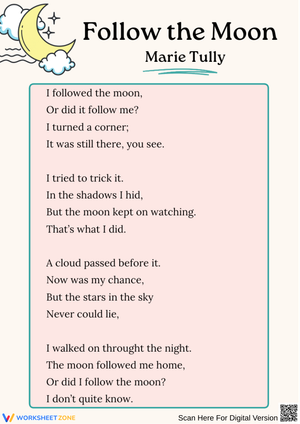
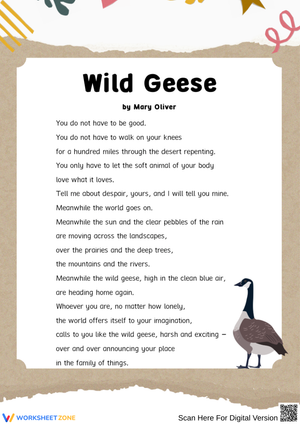
These poetry printable worksheets for 9th grade give ELA teachers a ready set of materials for the two things a freshman poetry unit actually requires: close reading analysis and original composition practice. The set moves through figurative language identification, structural analysis, tone and mood distinction, and cross-text thematic comparison. Most worksheets include answer keys with suggested responses for subjective questions and definitive answers for structural identification tasks.
What Students Actually Work Through
Ninth grade is the first year most students are expected to do more than name a device — they need to explain what it does. That shift from identification to analysis is where these worksheets spend most of their energy. Each worksheet asks students to locate a device, quote the relevant lines, and then write a sentence or two explaining how that device contributes to tone, theme, or the speaker's emotional position. The format pushes students past the "I found a metaphor" response into the kind of explanatory writing ELA teachers actually need to see by the end of a unit.
The set covers the device categories ninth graders encounter most on state assessments and in Common Core-aligned units:
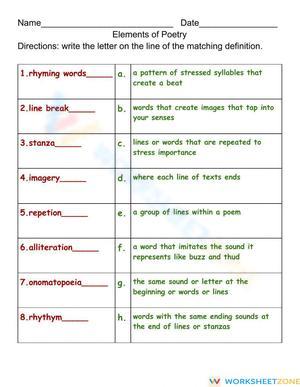
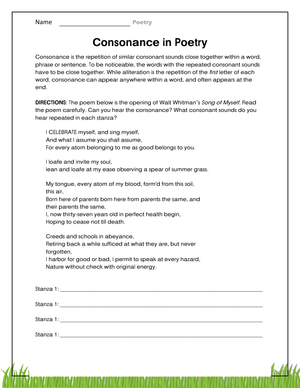
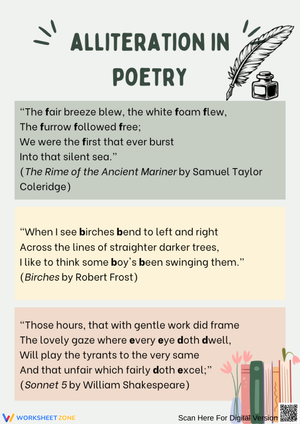
- Sound devices — alliteration, assonance, consonance, and onomatopoeia worksheets that move from single-device identification toward tasks that ask students to notice how several devices working together produce rhythm and tone simultaneously
- Extended metaphors and personification — exercises that ask students to track a central comparison across multiple stanzas and explain what it adds to the poem's argument, not just what it means in isolation
- Paradox and hyperbole — worksheets that distinguish these from simpler exaggeration and ask students to explain why a poet might use deliberate contradiction or overstatement at a specific moment in the text
Structure analysis worksheets run throughout the set. Students map rhyme schemes using standard letter notation, count syllables to identify iambic pentameter, and mark caesuras and enjambments in free verse. The poetry printable worksheets for 9th grade on Shakespearean sonnet structure include an annotation exercise where students track how the argument develops across three quatrains before arriving at the volta in the couplet — a task that makes the formal logic of the form visible in a way that lecture alone rarely accomplishes.
Student Errors Worth Anticipating Before You Hand These Out
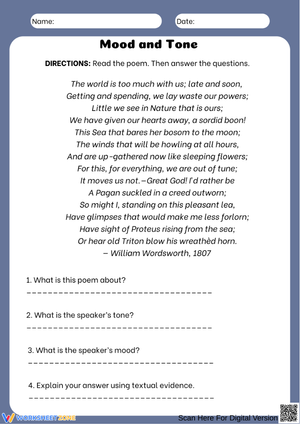
The tone-mood distinction trips up ninth graders every year. Students consistently conflate the two, writing that "the tone is sad" when they mean the mood. The reframe that works most reliably: tone is what the speaker seems to feel or think; mood is what the reader experiences in response. A poem can carry a cool, detached tone and still produce a devastating mood — Sylvia Plath does this in "Metaphors," where the speaker describes pregnancy with clinical flatness that makes the emotional weight land harder, not lighter. Once students have that distinction, the worksheets that ask them to annotate separately for tone and mood become considerably more productive.
A second consistent error involves enjambment. Students who were taught to pause at every line break in middle school bring that habit into ninth grade and misread rhythm as a result. The enjambment worksheets address this directly: students read the same lines aloud twice — first stopping at every line break, then following the syntax across the line — and describe what changes between the two readings. It is a short exercise that corrects a deeply ingrained reading habit most ninth graders don't know they have.
The speaker-versus-author confusion shows up in written analysis more than any other error. Students have spent years in persuasive writing units thinking about the author's purpose, so they default to treating every poetic speaker as autobiographical. Several worksheets include brief contextual notes alongside the poem text, and the guided questions ask students to describe the speaker's situation before they are permitted to make any claim about the author's intent — a deliberate sequencing choice that keeps analysis grounded in the text rather than in assumption.
Fitting These Worksheets Into the Week Without Losing Momentum
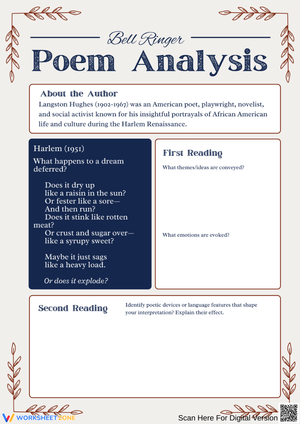
The shorter analysis worksheets are the most natural fit for bell-ringers. A single stanza with three annotation tasks takes about six minutes — enough time to settle a class, establish an analytical frame for the lesson, and give a quick visual check of where individual students are before instruction begins. The tone-and-mood worksheets work especially well this way at the start of a thematic unit, before students have encountered the anchor text.
The poetry printable worksheets for 9th grade on cross-text thematic comparison work better as mid-unit collaborative tasks than as independent work. Pair students, assign each pair two poems that share a theme — conflict and identity, or nature and mortality — and let the graphic organizer on the worksheet structure their conversation before they write. Comparison is genuinely difficult for ninth graders who are still building a mental library of texts to draw from, and talking through the organizer first reduces that difficulty without removing the analytical demand.
Creative writing prompt worksheets fit the last fifteen minutes of a Friday period better than they fit a Monday. By Friday, students have encountered enough in the week to have something to imitate or push against. The peer review checklist worksheets are worth running at least once during any writing unit: having students read a classmate's draft against a specific checklist produces more useful revision than open-ended peer feedback does at this age.
Standard Alignment
These worksheets address CCSS.ELA-LITERACY.RL.9-10.4, which asks students to determine the meaning of words and phrases as they are used in a text — including figurative and connotative meanings — and to analyze the cumulative impact of specific word choices on meaning and tone. They also address CCSS.ELA-LITERACY.RL.9-10.5, which requires students to analyze how an author's structural choices create specific effects on meaning and aesthetic impact. In classroom terms, RL.9-10.4 is the standard behind every figurative language and tone-and-mood worksheet in the set; RL.9-10.5 is what the structure analysis and sonnet annotation worksheets are working toward. Both standards appear on most state English assessments at the ninth-grade level, so the practice carries direct standardized test relevance as well.
Adjusting the Set for a Range of Readers
For students who struggle with unfamiliar vocabulary, the figurative language worksheets become more accessible when paired with a short reference card — four to six definitions covering only the devices on that specific worksheet. A full literary terms glossary creates cognitive overload for these students; a narrow card targeting exactly what they need keeps attention on the analytical task rather than on vocabulary management.
Advanced students move through single-poem identification tasks quickly, and the right extension is the cross-text comparison worksheets rather than more of the same. Comparing how Robert Frost's "The Road Not Taken" and Langston Hughes's "A Dream Deferred" each handle the theme of paths left unchosen requires the same structural knowledge but demands synthesis at a substantially higher level. The comparison graphic organizers in the set handle that extension without requiring additional prep time or a separate resource.
Frequently Asked Questions
Do these worksheets come with answer keys?
Most do. Structural identification tasks — rhyme scheme notation, syllable counts, device labeling — have definitive keys. Analytical writing questions come with suggested responses that show the reasoning a strong answer demonstrates, which also makes them useful for grading calibration when multiple teachers are running the same unit.
Can individual worksheets be assigned as homework?
The shorter bell-ringer and single-poem annotation worksheets translate to homework assignments without much adjustment. The cross-text comparison and peer review worksheets are built for in-class collaborative use and lose some of their value when assigned independently — they rely on discussion to surface differences students are unlikely to notice working alone.
How are the worksheets organized — by device, by form, or by theme?
The poetry printable worksheets for 9th grade are grouped by skill: figurative language, structural analysis, tone and mood, and comparative reading. Within each skill group, the worksheets move from more directed tasks toward more open-ended analytical writing. Teachers can work through a group sequentially or pull individual worksheets to match the specific text they are teaching that week.
Are these worksheets appropriate for honors or accelerated sections?
The core analysis worksheets align with standard ninth-grade expectations, but the extended metaphor tracking exercises and cross-text comparison worksheets are rigorous enough for honors sections. Accelerated students can use them as timed close-reading practice, moving through what a standard class treats as a full-period activity in twenty minutes or less.












 Interactive Worksheet Maker
 Quiz Maker
 Word Search Maker
 Crossword Puzzle Maker
 Word Scramble Generator
 Sentence Scramble Generator
 Handwriting Worksheet Generator
 Name Tracing Generator
 Fill In The Blank Generator