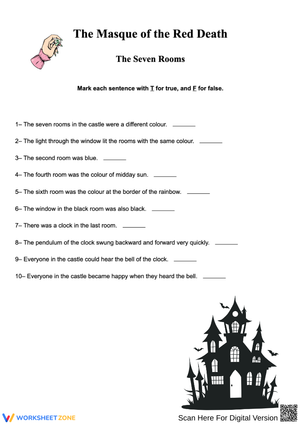
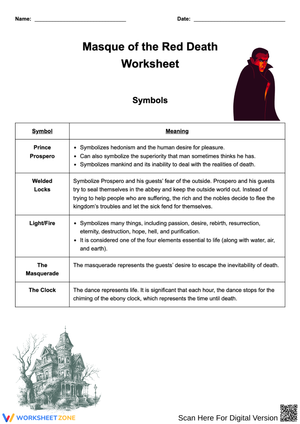
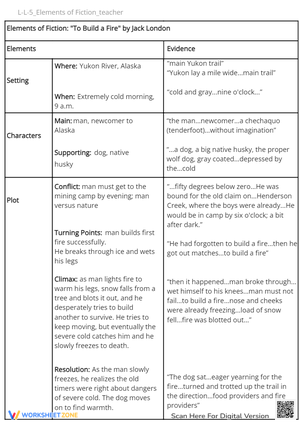
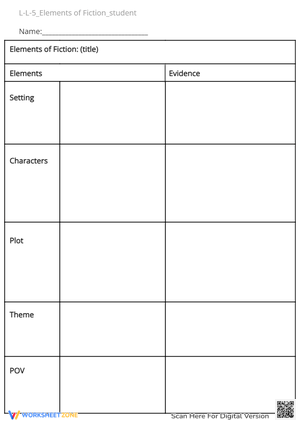
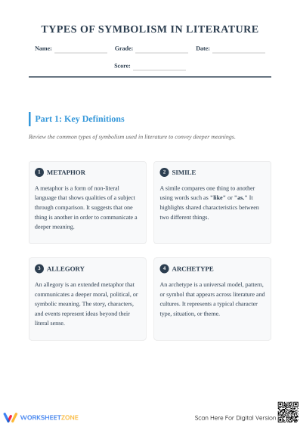
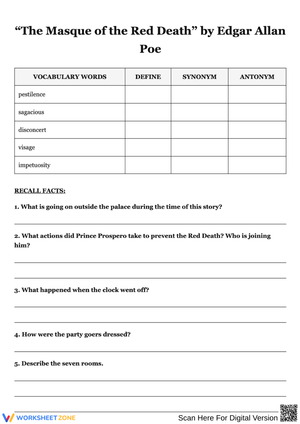
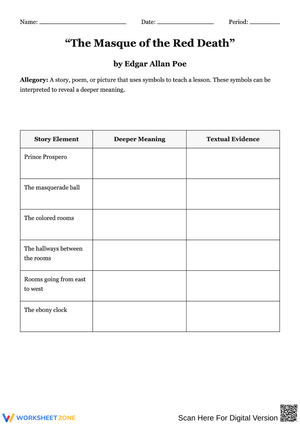
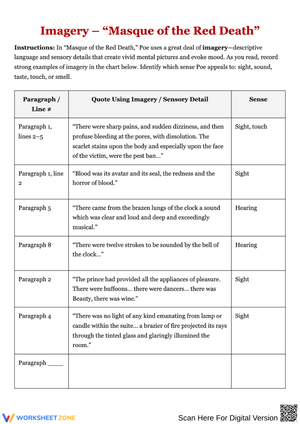
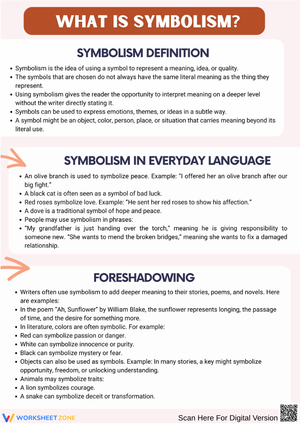
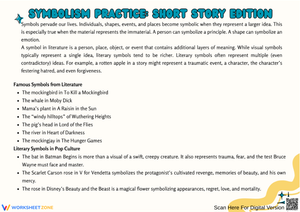
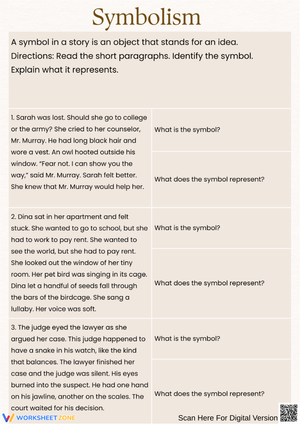
These 9th grade symbolism worksheets resources help teachers address one of the hardest transitions in secondary ELA — the moment students have to stop reporting what happened in a text and start explaining what it means. Each worksheet moves students through the same core interpretive process: identify a symbol, ground it in direct textual evidence, and articulate what abstract idea that symbol carries within the specific narrative context.
What Students Practice
The skills these worksheets build cluster around three moves that 9th graders rarely arrive knowing how to perform. First, students distinguish between a literal detail and a symbolic one — a process that requires them to ask what an author is doing with a particular image rather than just noting it exists. Second, they anchor claims in evidence, selecting specific lines or passages where the symbol appears and carrying those quotations into their written analysis. Third, they explain symbolic meaning in relation to theme or character development, not in isolation. Writing that a green light represents hope is far less sophisticated than writing that Fitzgerald's green light represents a particular American hope that stays beautiful precisely because it remains just out of reach — and the task structure of each worksheet pushes students toward that second kind of thinking.
Worksheet formats in this 9th grade symbolism worksheets collection include graphic organizers with columns for the symbol, selected quotations, and an explanation of how the symbol develops a theme; text-dependent question sequences built around short passages; and comparison tasks that ask students to track how the same symbol shifts in meaning as a text progresses. Some worksheets focus on a single symbol traced through an entire short story; others ask students to examine several symbols from one scene and consider how they reinforce each other.
What Goes Wrong When Students Analyze Symbols
The most persistent error at this level is what might be called "labeling without grounding" — a student writes "the raven represents death" and stops there, treating the identification of the symbol as the analysis itself. These worksheets counter that pattern by requiring students to select a quotation from the text before writing anything interpretive. Without that requirement built into the task, most 9th graders move directly to the conclusion.
A second pattern appears when students conflate a symbol with a theme. They write that the mockingbird in Lee's novel "is the theme of innocence" rather than recognizing that the bird is a concrete object pointing toward that theme. Students who conflate the two produce circular analysis: the symbol represents innocence because innocence is what it represents. Worksheets that ask students to explain which specific quality of the symbol — its fragility, its silence, its harmlessness — connects it to an abstract idea interrupt that circular reasoning before it calcifies.
A third error shows up specifically with text-specific symbols as opposed to universal ones. Students who correctly identify that a dove signals peace will still struggle with the scarlet ibis in Hurst's story, because that symbol only becomes legible after close reading. Several worksheets address this by building in a step where students describe the symbol as a purely literal object before attempting any interpretation — removing the pressure to leap immediately to abstraction.
Where These Worksheets Fit in a Short Story Unit
Graphic organizer worksheets work well as mid-reading check-ins — assign one when students are about halfway through a short story, before any class discussion of symbolism. What students write on those organizers before discussion is more diagnostic than what they say in seminar after three classmates have already named the symbol and shaped everyone else's thinking. That pre-discussion snapshot shows where the class actually is, not where the strongest voices have led it.
Text-dependent question sets fit naturally at the start of a class period while students are finishing a reading, or as the anchor task during paired work, where one partner selects textual evidence and the other drafts the explanation — a division that produces sharper conversation about the text than open-ended discussion alone. Comparison worksheets, which ask students to examine how two authors use the same symbol to different effect, are best held until students have completed at least two texts; they function well as the culminating task before a formal essay assignment.
Standard Alignment
These worksheets address RL.9-10.4, which requires students to determine the meaning of words and phrases as they appear in a text — including figurative and connotative meanings — and to analyze the cumulative impact of specific word choices on meaning and tone. Symbolism belongs inside that standard because interpreting what an author intends a concrete image to carry requires exactly the figurative and connotative reading RL.9-10.4 targets. The evidence-recording sections on each worksheet also address RL.9-10.1, which asks students to cite strong textual evidence when drawing inferences from a text. Teachers who use these worksheets as preparation for a literary analysis essay address both standards within the same assignment cycle.
Adapting the Work for Stronger and Struggling Readers
Students who arrive in 9th grade with stronger analytical preparation can move quickly through the identification and evidence columns and spend most of their energy on the interpretive explanation. For those students, add a second layer of demand: ask them to track whether the symbol's meaning stays fixed across the text or shifts, and write one sentence explaining what that development reveals about the author's larger argument. That question surfaces quickly which students genuinely understand symbolic development and which have simply memorized what the symbol "means" from a prior class discussion.
Students who struggle with abstract thinking benefit from working with universal symbols before text-specific ones. An approach that holds up in practice: open the unit with a brief activity asking students to write about a personal object — a worn pair of running shoes, a cracked trophy — and explain two things it might mean to whoever owned it. Moving from the concrete personal to the concrete textual is more reliable for students who freeze when asked directly what an author intended. The 9th grade symbolism worksheets set includes graphic organizer formats that provide the structured support these students need without reducing the interpretive demand.
Frequently Asked Questions
Which texts work best alongside these worksheets?
Short stories are the most practical first pairing because a symbol appears and resolves within a manageable reading window. The Scarlet Ibis by James Hurst is particularly strong — the central symbol is visually concrete, emotionally resonant, and directly connected to a named character, all of which makes the relationship between literal and symbolic layers easier to see. The Necklace by de Maupassant and Poe's The Cask of Amontillado both work well for comparison tasks, since students can examine how different authors use physical objects to carry symbolic weight across structurally similar stories.
How do these worksheets address the difference between a symbol and a motif?
Several worksheets in the set draw the distinction directly. A symbol is a concrete element — object, character, setting detail — carrying an abstract meaning in context. A motif is a recurring pattern of images or language that accumulates meaning as a text progresses. The most useful classroom explanation is usually that a symbol is the thing itself, while a motif is what happens when that thing appears again and again in a deliberate pattern. One worksheet asks students to track a single image from its first mention through its last, noting changes in how it is described — that tracking exercise makes the relationship between the two concepts visible in a way that defining them in isolation does not.
Can these worksheets prepare students for standardized test questions on symbolism?
A 9th grade symbolism worksheets built around evidence-based analysis maps well onto the inference and figurative-meaning questions that appear on state ELA assessments and the SAT Reading section. Those tests rarely ask students to name a symbol outright; they ask what a specific detail suggests or contributes to the meaning of a passage — which is exactly the interpretive move these worksheets practice repeatedly. Students who have worked through multiple evidence-recording exercises tend to approach those questions with a more deliberate process rather than choosing based on first impression.
How should I assess symbolism analysis at this grade level?
Completed worksheets serve as process documentation — they show the steps of the analysis, not just the conclusion, which is where most errors become visible. For a quick formative check, ask students to name one symbol from the day's reading and cite one textual detail that supports that identification; the quality of the evidence they choose tells you a great deal about whether the interpretive work is actually happening. For summative work, a paragraph-length response asking students to explain how a specific symbol develops a major theme is more telling than a multiple-choice identification task, and it mirrors the analytical writing 9th graders produce on standardized assessments and in later ELA coursework.












 Interactive Worksheet Maker
 Quiz Maker
 Word Search Maker
 Crossword Puzzle Maker
 Word Scramble Generator
 Sentence Scramble Generator
 Handwriting Worksheet Generator
 Name Tracing Generator
 Fill In The Blank Generator