Relative Dating Worksheet Ideas That Help 8th Grade Students Read Earth History Evidence
These relative dating worksheets for 8th grade shift the work from recalling geological timelines to reading actual evidence — which is exactly what eighth graders need before they can write a defensible claim about Earth history. Each worksheet sets students in front of a stratigraphy diagram and asks them to sort faults, igneous intrusions, sedimentary layers, and fossil clues into a sequence they must justify. The task is deliberate: sequence first, written explanation second.
What Students Actually Do in Each Worksheet
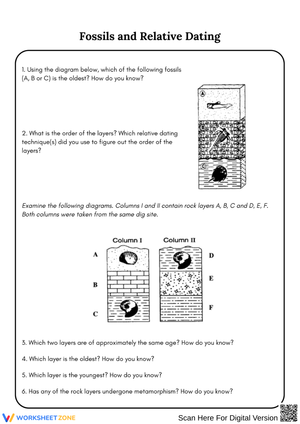
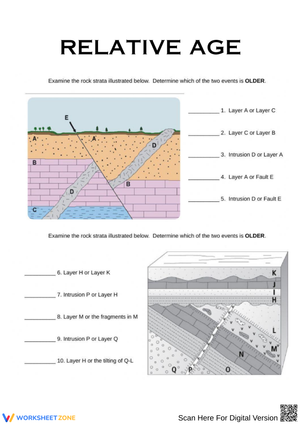
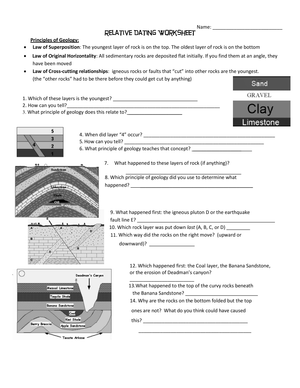
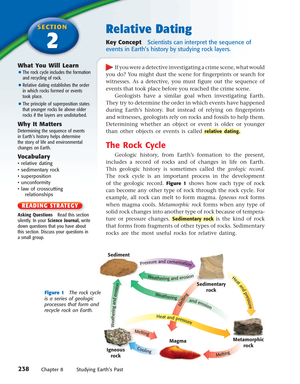
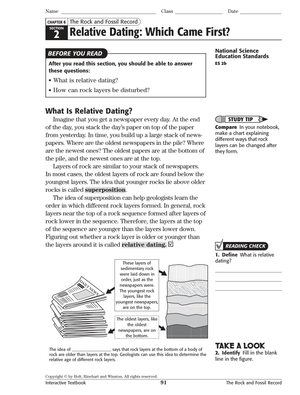
Three principles carry most of the reasoning weight in relative dating practice: superposition, cross-cutting relationships, and fossil succession. A well-built worksheet cycles students through all three in a single diagram rather than isolating them in separate tasks. That matters because the real challenge appears when the principles have to work together — when a student must order sedimentary layers using superposition and then revise that sequence after identifying a fault cutting through one of those layers.
- Label each rock layer or geological event visible in the diagram
- Circle or annotate any cross-cutting feature — fault, intrusion, unconformity
- Note fossil evidence that appears in one layer but not in adjacent ones
- Write a sequenced list of events from oldest to youngest
- Provide a short written justification naming the specific principle used at each step
That justification step is what separates a genuine comprehension check from a completion task. A student who writes "Layer A is oldest because it is at the bottom" is applying superposition correctly. A student who writes the same answer without noticing that a fault cuts through Layer A before reaching Layer D has missed the cross-cutting inference entirely — and that gap shows up only when the worksheet asks for reasoning, not just ranking.
Frequent Student Errors Worth Watching For
The most persistent error in relative dating work is not vocabulary confusion — it is over-applying one principle and ignoring the others. Students who internalize superposition will sometimes apply it mechanically even when a later event disrupts the original sequence. In practice, this looks like a student who correctly ranks layers 1 through 5 from bottom to top, then places the fault as the second-oldest event because it appears "below" the top layers visually. The fault's position in the image misleads them; they miss the inferential step that any cross-cutting feature is younger than every layer it cuts through, regardless of where it sits on the page.
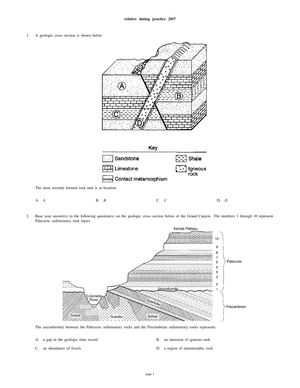
A second pattern appears with unconformities. Many students treat a gap in the rock record as simply "a missing layer" rather than evidence of a significant period of erosion or nondeposition. That distinction is worth addressing before students reach any worksheet that includes an unconformity, and then reinforcing with a prompt that asks specifically what the gap represents rather than just where it falls in the sequence.
Standard Alignment
MS-ESS1-4 from the Next Generation Science Standards asks middle school students to construct a scientific explanation based on rock strata and the fossil record to support the inference that biological evolution has occurred over Earth's history. Relative dating sits at the foundation of that standard: before students can explain how fossils mark biological change across time, they need to sequence the layers those fossils come from. Classrooms that treat stratigraphy as a standalone exercise tend to struggle when students reach the evidence-based writing that MS-ESS1-4 actually requires, because the sequencing logic was never built into durable understanding.
These worksheets build the prerequisite move — inferring sequence from observable features — so that the explanation writing students encounter later has concrete geologic reasoning to draw on rather than vague recall.
Smart Ways to Work These Worksheets Into Your Week
Using relative dating worksheets for 8th grade as a formative mid-unit check — rather than saving them for end-of-unit review — gives you the opportunity to intervene before gaps harden into test errors. A diagram with a single focus question ("Which layer is oldest, and what feature proves it?") takes eight minutes as a bell ringer and immediately shows who retained the concept from the previous day. Used in a station rotation during a rocks-and-fossils lesson, each worksheet anchors one principle: station one handles superposition, station two targets cross-cutting relationships, and station three introduces fossil succession. Students rotate through all three in a single class period and leave with a more connected picture than a sequential lecture produces in the same time.
The same resources work as exit tickets when trimmed to one diagram and one written justification. If eighteen students out of twenty-six write that a fault is older than the layers it cuts, you have clear reteach data before the quiz — not after. That kind of fast formative feedback is what makes the format worth returning to across the unit.
What Belongs in a Well-Built Worksheet
Diagram quality determines whether students practice reasoning or practice guessing. A readable cross-section with clearly separated layers, distinct shading for each rock type, and a single well-placed cross-cutting feature gives students enough to work with. Crowded cross-sections with six simultaneous events and overlapping labels produce confusion, particularly for students encountering geologic diagrams for the first time. The answer format matters too — a worksheet that only asks students to circle the oldest layer gives you completion data, not comprehension data. At minimum, one item on each worksheet should ask students to write a sentence explaining which principle led them to their answer.
Including a prompt that distinguishes relative from absolute dating is worth the space, even if it is brief: "Can this diagram tell you how many years ago Layer 3 was deposited? Why or why not?" Students who answer yes reveal a confusion that needs direct attention before they move into radiometric dating or any lesson that asks for numeric age estimates. The American Museum of Natural History's resource Different Techniques for Dating Fossils makes this distinction clearly and pairs well with worksheet discussion if students need a reference point.
Adapting These Worksheets Across Readiness Levels
Students who need additional support do better with diagrams that show three or four clearly horizontal layers and one unmistakable cross-cutting feature — no unconformities, no stacked intrusions, no folds. Adding sentence frames directly on the worksheet ("The fault is younger than ___ because ___") reduces the writing load while keeping the cognitive work focused on evidence rather than blank-page anxiety. The goal is not to simplify the concept — it is to remove barriers that are unrelated to the actual learning target.
On-level students handle diagrams with five or six events, including an unconformity and at least one intrusion. Asking them to note which principle they used beside each step in their sequence turns the worksheet into a vocabulary-in-context exercise as well as a reasoning check. For students working above grade level, one additional prompt does significant work: "Explain why this diagram can tell you the order of these events but not how long ago each one occurred." That question pushes thinking toward the conceptual distinction between relative and absolute dating that will carry into high school Earth science — and it asks students to explain a boundary on what evidence can do, which is genuinely sophisticated scientific thinking.
Frequently Asked Questions
What is the difference between relative dating and absolute dating, and when should I introduce the distinction?
Relative dating establishes sequence — which event came first, second, or last — without producing a numerical age. Absolute dating methods, including radiometric techniques, give age estimates in years. In an 8th grade unit, relative dating usually comes first because it relies on observable features in a diagram and does not require any understanding of isotope decay. Introducing the distinction early, while students are still practicing stratigraphy, prevents the recurring misconception that every dating question should end with a number.
How do I know whether a student understands the concept or is just reading the diagram visually?
Require a written justification for at least one item on each worksheet. A student who guesses correctly will write something vague ("it looks older" or "it's near the bottom"). A student who understands will name the principle and connect it to a specific feature in the diagram — "Layer 1 is oldest because it sits below an undisturbed sequence, which means it was deposited before the layers above it." That written sentence is your fastest diagnostic read, and it gives you something to quote back to students during reteach.
Are these worksheets appropriate for students who have not yet covered fossils in depth?
Most relative dating worksheets for 8th grade work fine before a deep fossil unit because the fossil component in stratigraphy practice is narrow: students only need to recognize that certain fossil types appear in one layer but not adjacent ones, suggesting those layers are from different time periods. They do not need to identify species, understand evolutionary biology, or know geologic period names. A brief introduction to index fossils — what they are and why they appear in specific rock layers — is enough to make the diagram tasks accessible early in a unit.
What should I look for when selecting a PDF set for my class?
Check that the diagrams are clearly labeled, that the set includes at least one cross-cutting feature, and that answer formats require some form of written justification rather than just letter or number responses. Relative dating worksheets for 8th grade that ask students only to rank layers without explaining why produce completion grades, not comprehension evidence. Also look for at least one prompt that addresses the relative-versus-absolute dating distinction, since that boundary is a consistent source of confusion and worth addressing before students encounter radiometric methods.
Clear All