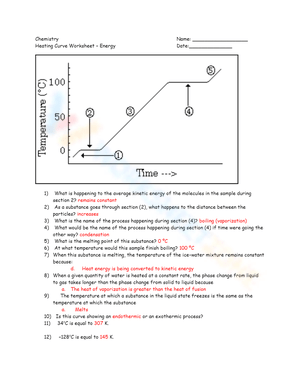
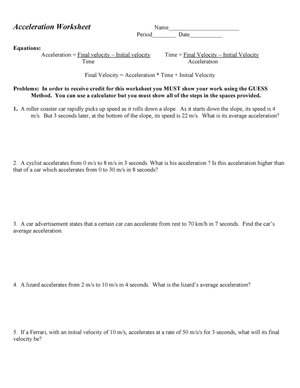
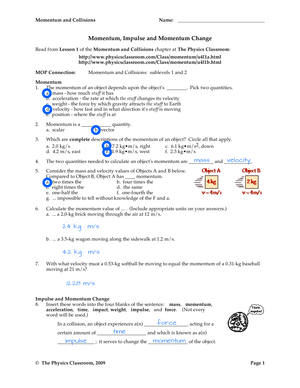
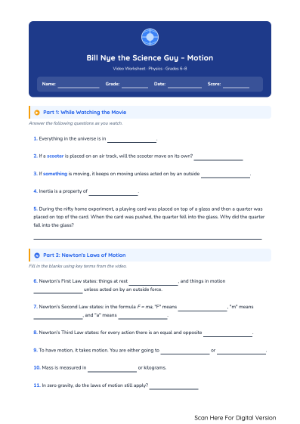
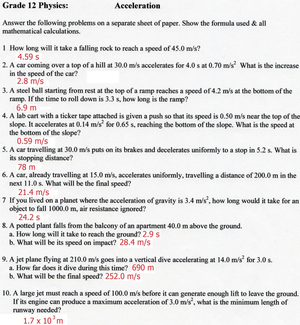
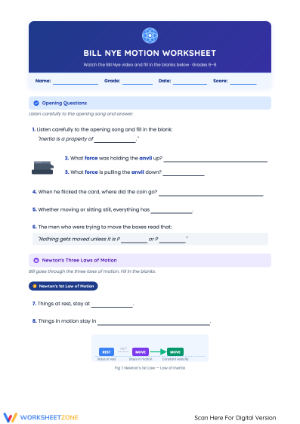
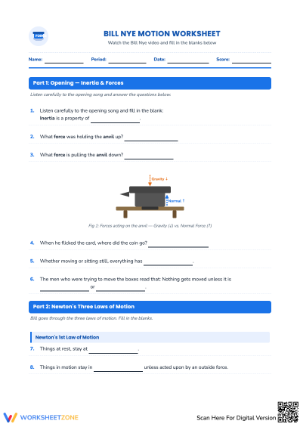
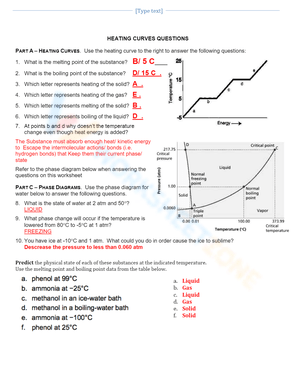
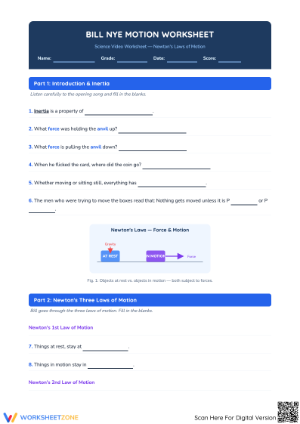
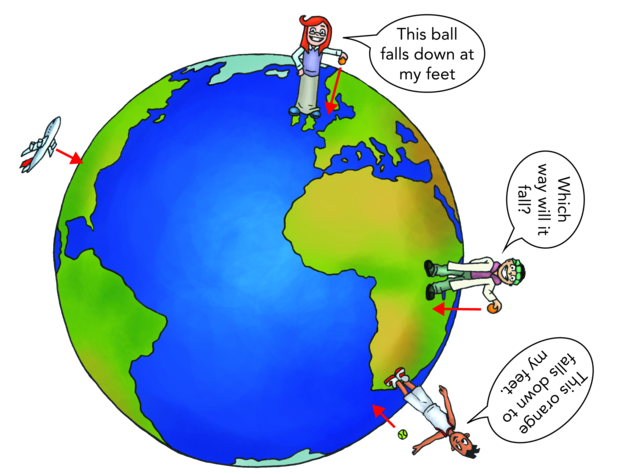
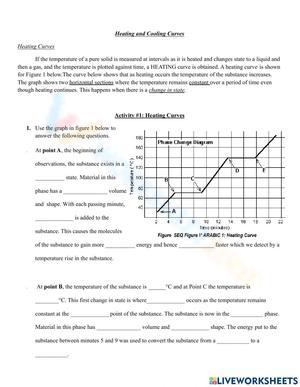
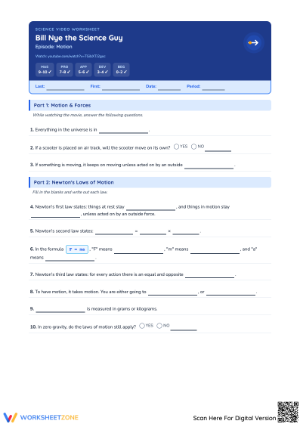
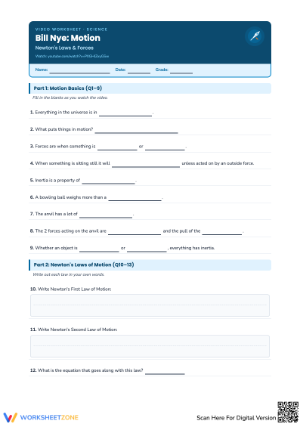
These forces motion and machines worksheets for 8th grade give science teachers a printable set built around one goal: keeping students reasoning about force and motion at every step, from basic push-and-pull diagrams through net force calculations, collision scenarios, and all six classic simple machines. The resources fit multiple classroom routines without extra technology or rebuild time between uses.
The Specific Skills Each Worksheet Targets
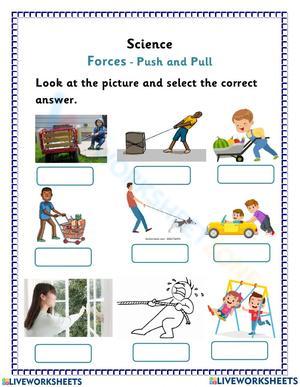
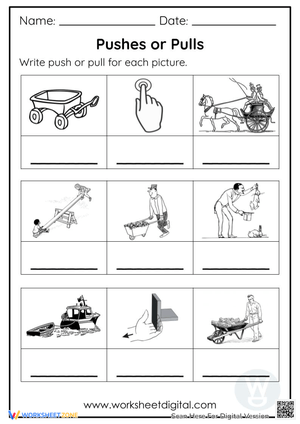
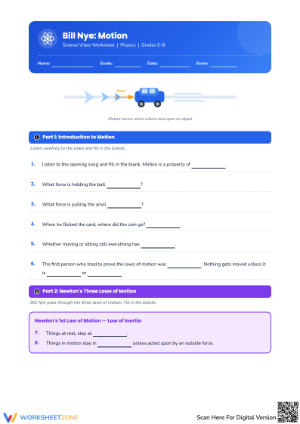
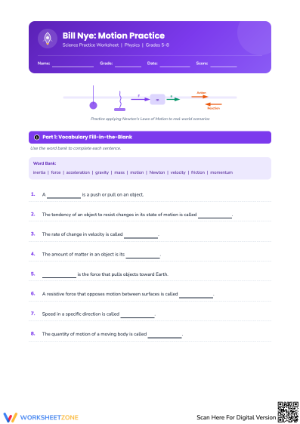
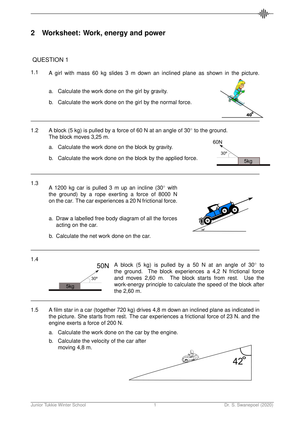
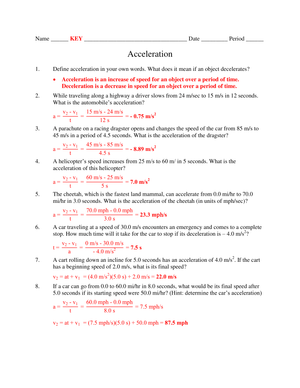
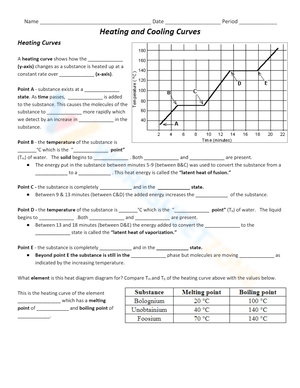
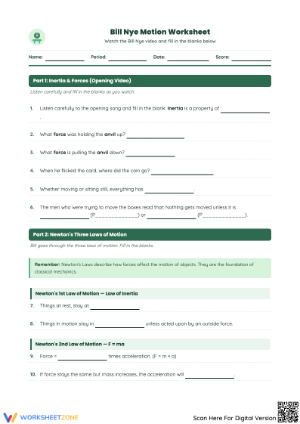
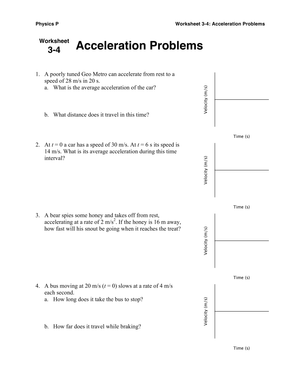
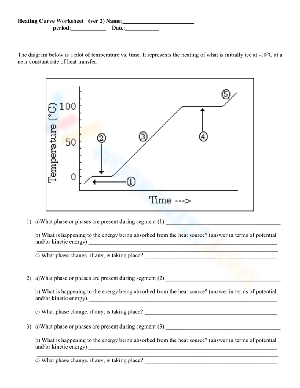
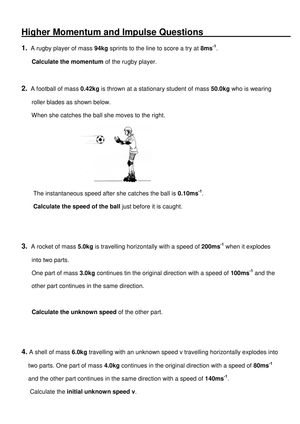
The set moves through force and motion content in a teachable sequence. Early worksheets ask students to identify pushes and pulls, draw force arrows on diagrams, and decide whether the forces on an object are balanced or unbalanced. From there, the focus shifts to net force — students combine forces acting in the same direction and subtract opposing ones, then predict what happens to an object's speed or direction. Those net force skills carry directly into collision scenarios, where students explain why a moving object slows, stops, or changes course after contact.
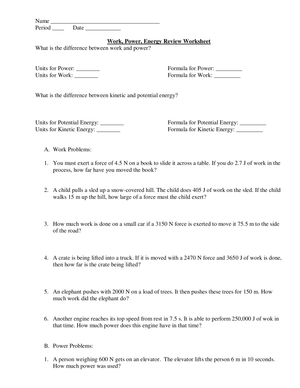
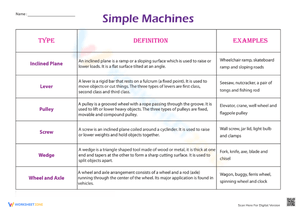
Machines arrive later in the sequence, where they belong. Each worksheet covering simple machines — lever, wheel and axle, pulley, inclined plane, wedge, and screw — keeps the force vocabulary intact. Students are not just identifying machine types; they are explaining how each tool changes the direction, distance, or amount of effort needed. Compound machine worksheets raise the demand by asking students to identify two or more simple machines operating together inside a familiar object such as a pair of scissors or a hand drill.
Task formats vary deliberately across the set:
- Force diagram labeling — reveals whether students can read and annotate visual representations of motion scenarios
- Short written explanations — shows whether students can connect a cause (net force direction) to an effect (change in motion)
- Sorting and matching tasks — reinforces machine vocabulary without reducing the activity to pure recall
- Applied scenarios — asks students to interpret a real situation, such as a cart on a ramp or a pulley lifting a load, and justify their prediction in writing
Student Errors Worth Watching For Before You Grade
The most persistent mistake in force and motion work is conflating "balanced forces" with "no forces." Students see a book resting on a desk and write "zero forces" because nothing is moving — they interpret stillness as an absence of force rather than equilibrium. Force diagram worksheets surface this directly. When students draw both gravity and the normal force on the same stationary object and see that the arrows cancel, most of them correct the misconception before the class discussion even begins.
Net force direction errors look different from pure calculation mistakes, and that distinction matters when reviewing student work. A student might correctly compute that 10 N left and 4 N right produces a net force of 6 N, then record the answer without a direction label — or label it "right" because that was the last direction mentioned in the problem. Written explanation prompts catch this error more reliably than numerical answers alone, which is why short-response items appear throughout the set rather than only at the end.
In the machines section, watch for the idea that a pulley or inclined plane "creates more force." Students frequently write that a ramp adds force to the situation. The more precise explanation — that an inclined plane spreads the same amount of work across a greater distance, so the effort needed at any given point is less — requires repeated exposure to stick. Worksheet prompts that ask students to compare two scenarios (lifting a box straight up versus pushing it up a ramp) give that correction a concrete place to land, and students who have written out that comparison are much faster to self-correct during review.
How to Work These Worksheets Into a Force and Motion Unit
The most effective approach treats the set as a short unit arc rather than a pile of stand-alone activities. On the first day of the sequence, use a balanced-versus-unbalanced forces worksheet as a bell ringer, then return to it during guided practice to correct the first round of responses — that immediate feedback loop works better than collecting and returning work a day later. On day two, net force and motion prediction worksheets hold up well as partner tasks because students can argue through direction before committing an answer. By day three, machine worksheets give a concrete application that re-engages students who checked out during more abstract force discussions.
Station rotations work cleanly when each station uses one worksheet with a single narrow task. One table handles force diagram labeling. A second asks for written one-sentence motion predictions. A third has students sort tools by simple machine type. A fourth presents a short challenge: compare a fixed pulley to a movable pulley and explain which one reduces effort. That structure gives students movement and variety while giving the teacher a clear checkpoint at each table rather than one large stack to sort through afterward.
For sub plans, the diagram-heavy worksheets with explicit visual cues work best — students can start independently without the teacher needing to set context. For the last eight minutes before dismissal, a two-item exit card pulled directly from a worksheet keeps the closing routine short. forces motion and machines worksheets for 8th grade with varied formats handle all of these situations without requiring the teacher to build new materials for each routine.
Standard Alignment
The content connects most directly to MS-PS2-1 and MS-PS2-2 from the NGSS Motion and Stability: Forces and Interactions strand. MS-PS2-2 anchors most of the force and motion worksheets — students demonstrate reasoning about how the sum of forces and an object's mass determine its change in motion, which is exactly what net force and collision worksheets ask them to show in written form. MS-PS2-1 becomes relevant when collision scenarios ask students to explain force pairs between two objects in contact.
In planning terms, this means the force and motion worksheets belong in the middle of an MS-PS2 unit — after students have worked through qualitative motion observations and before any formal lab report requiring controlled variables. The machine worksheets serve best at the end of the strand, after students can already explain net force with confidence. Teachers who introduce machines at the beginning of the unit consistently find that students treat them as a memorization list rather than a force application — the sequencing matters more than most planning guides acknowledge.
Adjusting the Worksheets for a Range of Learners
For students who need a more structured entry point, the diagram-labeling worksheets give the lowest floor — students annotate existing visuals rather than generating explanations from scratch. Pairing those with a classroom force-direction reference card (up, down, left, right with sample arrows) reduces working memory load enough for students to focus on whether forces are balanced rather than spending effort on spatial orientation. The short written-response items can be temporarily replaced with sentence frames: "The net force acts toward ___, so the object will ___."
For students ready to move past grade-level expectations, compound machine worksheets provide the right extension. Ask them to identify every simple machine embedded in a bicycle — most will find the wheel and axle and the gears but miss the screws and the lever action of the brakes. A follow-up prompt asking them to redesign one component to reduce effort draws on the same force reasoning without just adding more repetition. This keeps advanced students inside the unit's conceptual framework rather than redirecting them to unrelated enrichment tasks.
Teachers sometimes ask whether forces motion and machines worksheets for 8th grade can serve a 7th grade class that is moving quickly through physical science. The answer depends on prior exposure. If those students have already worked with force arrow diagrams and can define net force, the introductory worksheets function as review and the net force worksheets work as new instruction. If the class has no prior force vocabulary, start with the labeling tasks and build from there before moving to the short-response items.
Frequently Asked Questions
What topics should an 8th grade forces, motion, and machines worksheet set cover?
The core content includes balanced and unbalanced forces, net force outcomes in one dimension, mass as a factor in motion, collision scenarios, and all six simple machines: lever, wheel and axle, pulley, inclined plane, wedge, and screw. A well-sequenced set adds compound machine examples at the end so students apply the same force vocabulary to multi-part tools rather than treating machines as a separate memorization task.
How do these worksheets fit into a station rotation?
Assign one worksheet per station with a single focused task — force diagrams at one table, written motion predictions at another, machine sorting at a third. Keeping each station narrow makes it practical to scan student responses quickly for misconceptions before the class rotates. A challenge station comparing two machine types works well as the fourth stop for groups that move faster than expected.
Are simple machines appropriate content for a force and motion unit, or do they belong in a separate unit?
They fit best as an applied extension of force ideas, not a disconnected memorization unit. When students have already explained net force and balanced forces, machine examples give them a way to see those same concepts operating in tools they already know. Treating machines as a standalone chapter tends to produce students who can name the six types but cannot explain why any of them reduces effort — which is the central idea the unit is trying to build.
How do these worksheets support NGSS-aligned instruction?
The forces motion and machines worksheets for 8th grade in this set support MS-PS2-1 and MS-PS2-2 when the questions ask students to reason through motion changes rather than recall definitions. Tasks that have students interpret a force diagram, identify what changes when net force changes direction, and defend a motion prediction in writing are the ones that align to those performance expectations — not tasks that stop at naming terms.












 Interactive Worksheet Maker
 Quiz Maker
 Word Search Maker
 Crossword Puzzle Maker
 Word Scramble Generator
 Sentence Scramble Generator
 Handwriting Worksheet Generator
 Name Tracing Generator
 Fill In The Blank Generator




 BACK TOSCHOOL