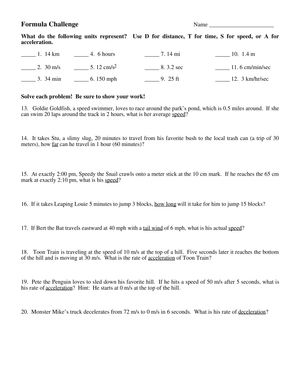
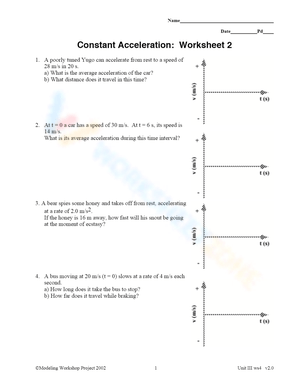
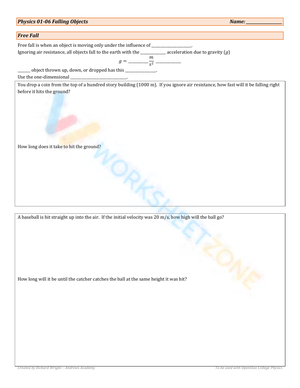
These acceleration worksheets for 8th grade address the moment in a motion unit when students need to shift from informal language — "it's going faster," "it slowed down" — into precise quantitative reasoning about velocity, time, and rate of change. Each worksheet fits a specific lesson slot: warm-up, guided practice, station rotation, or exit ticket. No single worksheet tries to cover the whole topic at once, which is what makes the set easy to use across a unit without it feeling repetitive.
What Students Practice in Each Worksheet
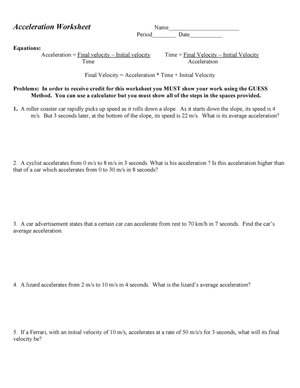
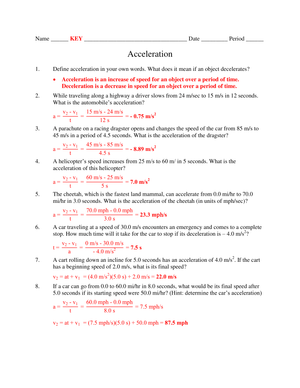
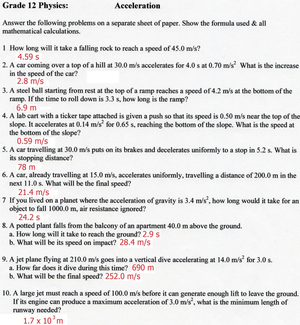
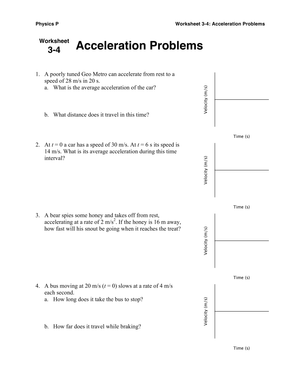
Students work across four task types. They identify whether a described motion qualifies as acceleration — which includes speeding up, slowing down, and changing direction, and students regularly miss the last two. They solve direct substitution problems using a = Δv/t, with numbers chosen to keep the focus on conceptual reasoning rather than arithmetic. They read motion tables and decide what the data shows before committing to a numerical answer. And they interpret velocity-time graphs, marking where acceleration is positive, where it turns negative, and where velocity holds constant.
The variety is deliberate. When every problem follows the same plug-and-chug routine, students can perform adequately without understanding why velocity changes — and that gap surfaces fast when a graph question appears on the unit test.
Student Errors to Watch For in Acceleration Work
The most persistent error at grade 8 is treating acceleration as interchangeable with speed. A student will calculate that a = 3 m/s², then write in the explanation line that "the object is moving at 3 meters per second" — collapsing the result back into a speed value. That isn't a careless slip; it means the student completed the arithmetic without connecting the formula to what acceleration actually describes. Catching it in the explanation line, not just the number box, is where the instructional value sits.
A second pattern involves subtraction order. When a problem gives an initial velocity of 12 m/s and a final velocity of 4 m/s, many students compute (12 − 4)/t, treat the positive result as correct, and move on — missing that the object was decelerating. Some students do get a negative value, then flip the subtraction because a negative acceleration seems like a mistake. Including problems where negative acceleration is explicitly the right answer helps students treat deceleration as a legitimate outcome rather than a sign they went wrong.
The third issue is units. Students often record m/s instead of m/s², which signals they haven't internalized that acceleration measures a change in velocity over time — not simply a rate of motion. A unit-analysis step built into the problem format catches this before it settles into a habit.
Standard Alignment
NGSS MS-PS2-2 (Motion and Stability: Forces and Interactions) expects middle school students to plan investigations showing that changes in an object's motion depend on the sum of forces and the mass of the object. Acceleration is the quantitative thread that holds that standard together — students cannot meaningfully reason about how force and mass affect motion until they can calculate and interpret Δv/t from real data.
Instructionally, these worksheets sit in the middle of that standards sequence: after students have observed and described motion qualitatively, and before they move into designing their own investigations. That placement gives students the formula fluency they need before they're asked to build arguments from evidence — instead of pausing mid-investigation to revisit what acceleration actually means.
How to Weave These Worksheets Into the Unit
In a launch lesson, a couple of concept questions and one simple substitution problem work well immediately after a demonstration — a cart rolling down a ramp, a ball tossed and caught. Students annotate what changed in the motion before connecting it to the formula, which keeps the math from feeling disconnected from the physical event. Mid-unit, the acceleration worksheets for 8th grade work well as independent practice while the teacher circulates or pulls a small reteach group; the mix of problem types means students aren't all working on the same item simultaneously, which makes it easier to move around the room and identify who needs a conversation before the period ends.
Near the assessment, the same worksheets shift into spiral review — pairing acceleration items with net force or motion graph questions to check whether the concept holds across contexts. A 45-minute class handles this sequence comfortably: five minutes of shared vocabulary review, ten minutes of teacher-modeled examples, fifteen minutes of partner or independent practice, ten minutes of whole-class discussion on one or two problems, and five minutes for an exit ticket. That structure keeps the practice visible and prevents students from sitting inside a long silent work block with no feedback until the following day.
Fitting These Worksheets to Different Learner Levels
For students who need more support, reduce the item count, print units directly beside each blank, and pair the first problem on each worksheet with a completed worked example showing every step — the velocity subtraction, the division by time, and the unit label. A sentence frame like "The velocity changed from ___ m/s to ___ m/s in ___ seconds, so the acceleration is ___" keeps attention on the reasoning rather than on how to begin. This approach is especially useful for students who can talk through the motion orally but freeze when faced with a blank formula.
For students ready for more depth, comparison prompts shift the task from computing to interpreting. Asking which of two objects experienced greater acceleration — and why — requires analysis, not just arithmetic. Asking students to write a claim about what a flat line on a velocity-time graph means in terms of force makes the connection to Newton's laws explicit without piling on more formula work.
- Support tier: fewer items, units visible beside each blank, worked example alongside the first problem.
- Core tier: full mixed practice — calculation, scenario interpretation, and graph reading.
- Enrichment tier: comparison questions, written explanation prompts, and force-and-mass connections beyond the basic formula.
The acceleration worksheets for 8th grade in this set handle all three tiers without separate materials — teachers select the items and decide which support structures fit each group on a given day.
Frequently Asked Questions
What should students know before working on these worksheets?
Students need a working distinction between speed and velocity, basic familiarity with units like m/s and m/s², and the understanding that acceleration describes a change in velocity over time — not just "moving fast." A quick five-minute vocabulary sort before the first worksheet prevents the most common errors from appearing on the first problem.
Where do these worksheets fit in a forces and motion sequence?
They fit best after velocity has been introduced qualitatively and before students move into net force analysis or investigation design. That placement gives students formula fluency before they start reasoning about what forces do to mass — so the investigation doesn't stall mid-way while students try to recall what acceleration means.
Can these worksheets serve as formative assessment tools?
Short mixed sets from the acceleration worksheets for 8th grade — one vocabulary item, one calculation, and one interpretation prompt — work well as exit tickets. Longer sets with graph and table items give a fuller formative picture by revealing whether students hold the concept across formats or only in one narrow problem type. Answer keys make turnaround fast enough to adjust the next day's plan before students arrive.
How should teachers handle student resistance to negative acceleration values?
Name it directly and early. Tell students that a negative result isn't a mistake — it tells them the direction of the velocity change. Once students see a deceleration problem with a worked answer that comes out negative and is labeled as correct, the resistance largely drops. Leaving it until a student flags a negative value on their own creates confusion that takes longer to untangle than a thirty-second explanation at the start.












 Interactive Worksheet Maker
 Quiz Maker
 Word Search Maker
 Crossword Puzzle Maker
 Word Scramble Generator
 Sentence Scramble Generator
 Handwriting Worksheet Generator
 Name Tracing Generator
 Fill In The Blank Generator




 BACK TOSCHOOL