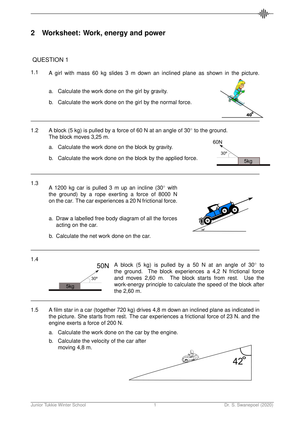
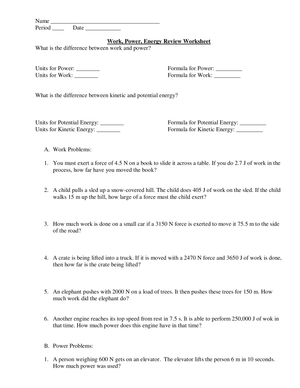
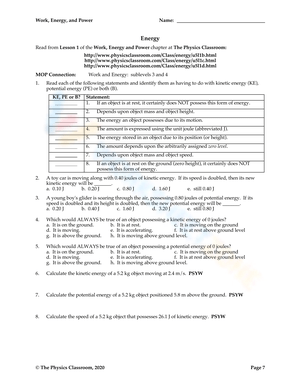
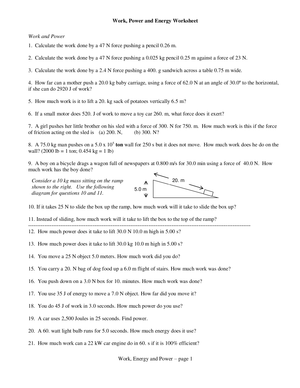
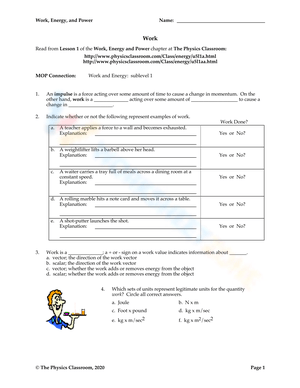
These 8th grade work power and energy printable worksheets give physical science teachers a direct path from formula introduction to application, covering work calculations, power comparisons, kinetic and potential energy distinctions, and simple machine analysis in a format students can complete without a device or elaborate classroom set-up. The set works across warm-ups, guided practice, independent review, and pre-assessment depending on how you build the lesson sequence.
The Specific Skills Each Worksheet Targets
The core difficulty in this unit is that students can execute a calculation procedure without understanding what the result means physically. A student who solves W = F × d correctly may still believe that pushing hard against a locker counts as doing work, because effort was applied. Each worksheet isolates a skill sharply enough that you can assign one for targeted reteach without pulling students through material they have already handled.
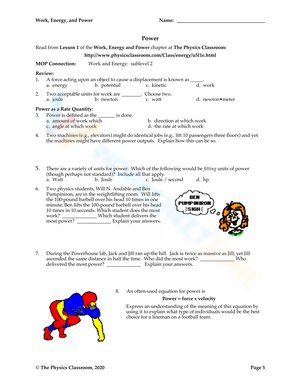
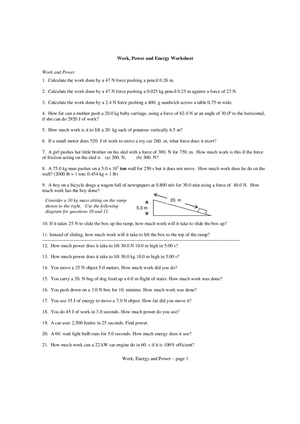
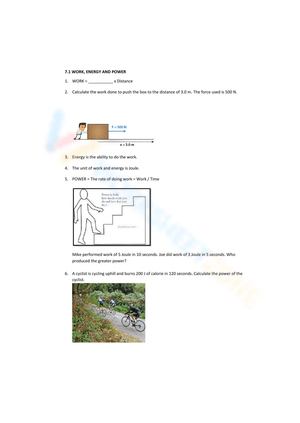
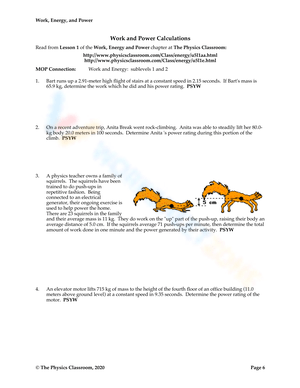
- Work and power formula fluency: solving W = F × d and P = W ÷ t problems with given values, attending carefully to units at every step.
- When work is or is not being done: short scenarios asking students to identify zero-work situations and explain why displacement in the direction of force matters.
- Kinetic and potential energy: comparing energy forms in motion-based scenarios and identifying when a transfer is taking place.
- Simple machine relationships: calculating mechanical advantage and explaining how ramps, levers, and pulleys trade force for distance without changing the total task.
- Force and motion connections: relating changes in an object's speed or direction to the net forces acting on it and its mass.
- Vocabulary in context: using terms such as joule, watt, mechanical advantage, and energy transfer accurately in short written responses.
That last category carries more diagnostic weight than it might seem. When students write sentences using physics vocabulary, the gaps in their understanding become visible in a way that circled answers never reveal. A student who writes "the box had more energy because it was higher up" has the right instinct but imprecise framing — and a worksheet that calls for a sentence gives the teacher something concrete to address.
Mistakes Students Make That These Worksheets Help You Catch
The most stubborn misconception in this unit is treating force as equivalent to work. Students who hold a heavy object without moving it feel as though they are doing real work — and in everyday language, they are. The scientific definition requires displacement in the direction of the applied force, and that constraint lands hard for eighth graders who trust their physical experience over a formula. A student may correctly state "no movement means no work" on a quiz and then immediately answer that a person straining against an immovable wall is doing work on it. The formula says one thing; their muscles say another.
Confusing work with power is a separate and equally persistent problem. Students who can calculate both correctly under straightforward conditions often have no model for why completing the same task in less time changes the power without changing the work done. They treat P = W ÷ t as a variation of W = F × d rather than as a distinct quantity with its own meaning. Problems that hold work constant and vary time — asking students to calculate power for both scenarios and then compare — surface this gap more clearly than asking students to recite definitions.
Unit analysis is a third area worth monitoring. Students drop units from answers or write joules where watts belong, sometimes within the same problem. Worksheets that include a labeled column or blank for units on every calculation step tend to produce cleaner work than those that leave unit recording optional. The habit forms through repetition, not reminder.
Standard Alignment
NGSS MS-PS3-5 (Energy) asks students to construct arguments supporting the claim that when the kinetic energy of an object changes, energy is transferred to or from that object. NGSS MS-PS2-2 (Motion and Stability: Forces and Interactions) asks for evidence that changes in an object's motion depend on the net force acting on it and its mass. These two performance expectations connect naturally in this unit: many situations that call for a work or power calculation — a cart accelerating down a ramp, a pulley lifting a load, a bike speeding up on a descent — also require students to reason about energy transfer and the forces producing the motion.
Worksheets that pair short written justifications with numerical answers address both standards at once rather than isolating them. A student who calculates the work done on a rolling cart and then writes a sentence explaining why the cart accelerated is doing exactly the reasoning MS-PS3-5 and MS-PS2-2 describe. That pairing is worth building into several worksheets across the set, not only the end-of-unit review.
How to Work These Worksheets Into Your Week
The most effective use of a short computation worksheet is the first eight minutes of class after a concept has been introduced — not as a recap of yesterday's notes, but as the moment when students find out whether those notes actually make sense. Assign two or three work or power problems, give students five minutes to work independently, and spend three minutes correcting as a class before the lesson continues. That sequence surfaces confusion early enough to address before it compounds.
For guided practice, begin with one problem worked aloud — naming each step explicitly: identifying known values, selecting the formula, substituting, solving, and checking units. Then release students to the next two problems with a partner before moving to independent work. This reduces the cognitive load of managing both the calculation procedure and the underlying physical concept simultaneously, which is especially useful the first time students encounter power as a rate rather than an amount.
Station rotations work well here because the topic lends itself to physical objects. At one station, students use a ruler and a small object to estimate force and distance and then calculate work. At another, they complete a section comparing kinetic and potential energy scenarios. A third station might hold a simple lever or ramp for students to observe before connecting the experience to mechanical advantage problems on a paired worksheet. The 8th grade work power and energy printable worksheets in this set fit comfortably into that kind of structure because each worksheet has a focused enough scope that it does not overwhelm a ten-minute station block.
Before a unit test, mixed review worksheets are most effective as a homework assignment rather than an in-class task. Students who complete the review at home and mark questions they could not answer arrive the next day with a specific question — which makes whole-class review far more productive than an open-ended "what do you want to go over?"
Why Simple Machine Problems Are Worth the Space
Simple machines often get treated as an add-on in this unit — brief and optional, assigned after students have finished formula practice. That framing misses what simple machine problems actually do. Ramps, levers, and pulleys give students a concrete situation where the relationship between force and distance becomes visible rather than symbolic. A student who sees that a ramp reduces the force needed to lift an object while increasing the distance traveled already understands mechanical advantage in its most useful sense: less force times more distance accomplishes the same total task as more force times less distance.
A worksheet format that proves consistently effective places two nearly identical problems side by side: lift a 20 N box straight up two meters, then move that same box up a ramp to the same height using a smaller force over a longer distance. The numbers differ, but students who calculate both find that the work done is equal. Asking them to write one sentence about what the comparison reveals often produces the first moment in the unit where the formula stops feeling arbitrary. Students who have only practiced straight-lift problems tend to say a machine "makes it easier" without understanding why the total task is unchanged — the side-by-side problem makes that tradeoff explicit without requiring a lengthy teacher explanation.
Adjusting the Set for a Range of Learners
For students who need additional support, the most practical adjustment is reducing the number of steps required before the formula appears. Give those students the equation written out, the known values labeled, and one blank to solve — rather than a word problem requiring them to extract information, select the formula, substitute, and solve in sequence. Once they handle that more guided version consistently, move them to problems where one value is unlabeled and they must identify it before proceeding.
Pairing 8th grade work power and energy printable worksheets with short extension prompts is a low-effort way to challenge students who are ready for more. Ask those students to compare two scenarios rather than solve one, or to explain what would happen to the power output if the same amount of work were completed in half the time. These prompts mirror the multi-step reasoning that appears on standardized assessments and in high school physics — they extend the work without requiring a different resource entirely.
Students who are still building reading fluency may struggle with word problems not because of the physics content but because of sentence complexity. Letting those students read problems aloud with a partner before solving independently separates the language barrier from the science barrier. Treating both as a single problem tends to obscure which gap actually needs closing.
Frequently Asked Questions
What grade level are these worksheets written for?
The set targets grade 8 physical science, aligned to the middle school NGSS performance expectations for energy and forces. The reading level and formula complexity suit eighth graders who have received initial instruction on the topic and need repeated practice before a quiz or unit assessment.
Can sections of these worksheets serve as exit tickets or short quizzes?
Yes. Two or three problems from a focused worksheet work well as exit tickets at the end of a lesson. A full worksheet covering formula practice, scenario analysis, and one written explanation functions as a short quiz, typically requiring fifteen to twenty minutes of class time.
Do the worksheets include answer keys?
Each worksheet comes with a corresponding answer key. Keys include both the numerical answer and the correct unit label, which matters in this unit because students frequently arrive at the right number while writing the wrong unit — or no unit at all.
How do these worksheets support preparation for standardized assessments?
The 8th grade work power and energy printable worksheets in this set address the physical science concepts that appear most often on middle school standardized assessments — energy transfer, force and motion relationships, and simple machine calculations. Mixed review worksheets that combine vocabulary, computation, and short written explanation give students practice with the range of question formats they encounter on those tests, not only the straight plug-and-solve problems that dominate most textbook practice sets.












 Interactive Worksheet Maker
 Quiz Maker
 Word Search Maker
 Crossword Puzzle Maker
 Word Scramble Generator
 Sentence Scramble Generator
 Handwriting Worksheet Generator
 Name Tracing Generator
 Fill In The Blank Generator




 BACK TOSCHOOL