


























Views
Downloads

Introduction to Waves Worksheet | Grade 8 Essential
Paste this activity's link or code into your existing LMS (Google Classroom, Canvas, Teams, Schoology, Moodle, etc.).
Students can open and work on the activity right away, with no student login required.
You'll still be able to track student progress and results from your teacher account.
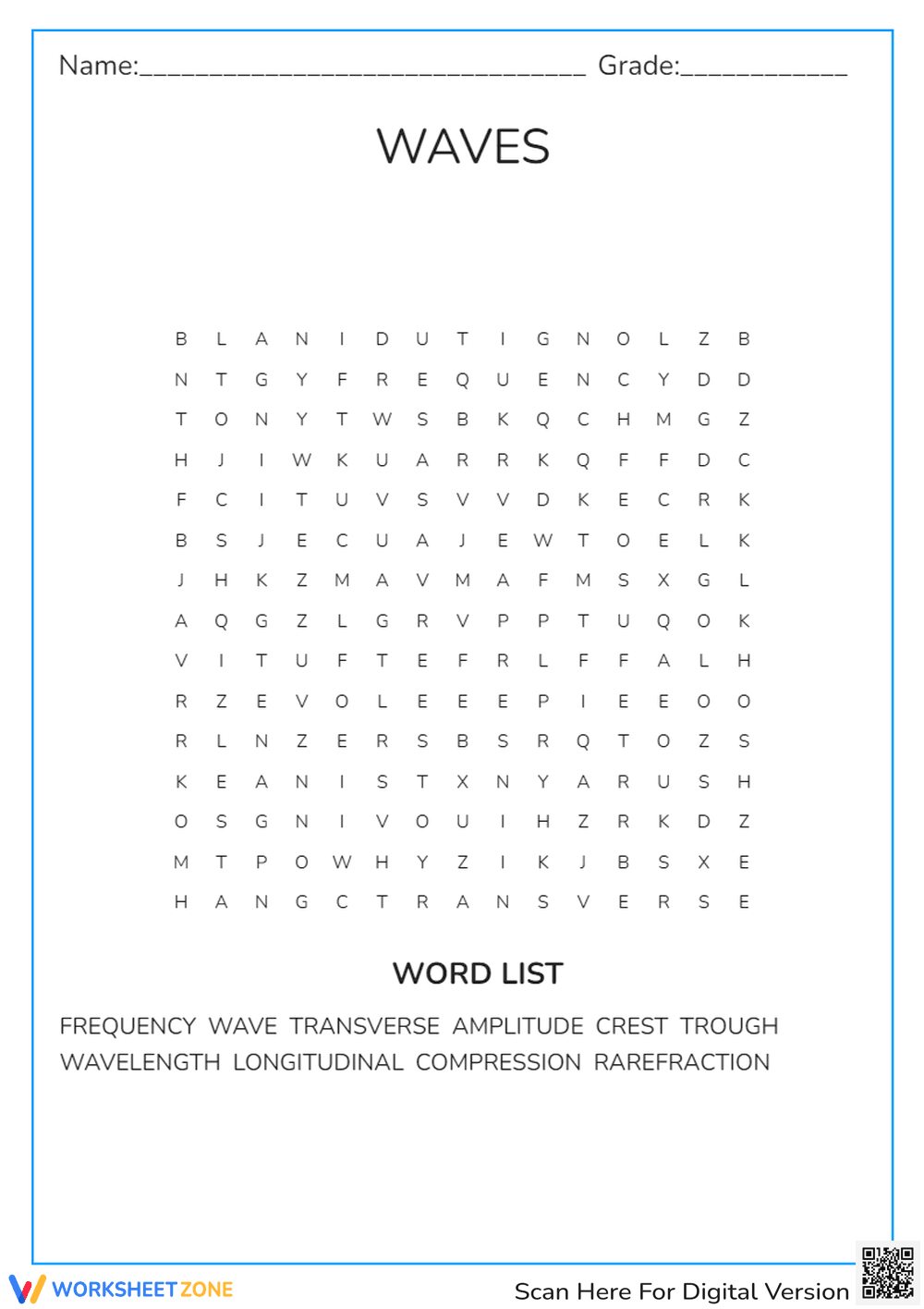
This Grade 8 science worksheet provides a focused vocabulary reinforcement activity for students beginning their unit on physical science and wave properties. By identifying key terminology within a structured word search, learners solidify their recognition of essential concepts like frequency, amplitude, and wave types. This activity serves as an ideal introductory tool to build academic language before complex mathematical modeling.
At a Glance
- Grade: 8 · Subject: Science
- Standard:
MS-PS4-1— Use models to describe wave properties including frequency, amplitude, and wavelength.- Skill Focus: Scientific Vocabulary Acquisition
- Format: 1 page · 10 problems · Answer key included · PDF
- Best For: Bell-ringers, sub plans, or vocabulary warm-ups
- Time: 10–15 minutes
The worksheet features a 10-word vocabulary list containing the most critical terms for middle school wave units. The layout includes a clear word bank and a dense letter grid to challenge student observation skills. This single-page PDF is designed for high-contrast printing and includes terms such as transverse, longitudinal, compression, and rarefaction, ensuring students are familiar with both mechanical and electromagnetic wave descriptions.
Zero-Prep Workflow
- Step 1: Print the single-page PDF for your entire class (30 seconds).
- Step 2: Distribute to students as a bell-ringer or transition activity during your physics unit (1 minute).
- Step 3: Review the definitions of the 10 terms as a whole class once the search is complete to check for understanding (5 minutes).
Total teacher preparation time is under 2 minutes, making it an excellent resource for emergency sub plans or unexpected schedule shifts.
Standards Alignment
This resource aligns with MS-PS4-1: "Use mathematical representations to describe a simple model for waves that includes how the amplitude of a wave is related to the energy in a wave." While the standard focuses on modeling, vocabulary mastery is the prerequisite for understanding the variables in those models. Both standard codes can be copied directly into lesson plans, IEP goals, or district curriculum mapping tools.
How to Use It
Use this worksheet as a formative assessment during the "Engage" or "Explain" phase of a 5E lesson cycle. It is particularly effective for identifying students who may struggle with the spelling or recognition of technical terms like "rarefaction." Expected completion time is 10–15 minutes, depending on student familiarity with the word list. It can also serve as a quiet individual activity following a hands-on lab with slinkies or ripple tanks.
Who It's For
This activity is designed for Grade 8 science students but is also highly effective for English Language Learners (ELL) and students requiring Tier 2 vocabulary support. It pairs naturally with a visual anchor chart showing wave diagrams or a direct instruction lesson on the electromagnetic spectrum. It provides a low-stakes way for students to interact with complex scientific text.
The "Introduction to Waves" worksheet supports the acquisition of technical domain-specific vocabulary required by the MS-PS4-1 standard. Research from RAND AIRS 2024 indicates that structured vocabulary exposure in middle school science significantly improves long-term retention of complex physical science concepts. By isolating 10 core terms such as frequency, wavelength, and amplitude, the worksheet reduces cognitive load during the initial stages of the learning cycle. This allows students to build the mental schema necessary for later mathematical applications and wave modeling. The use of word searches as a low-stakes retrieval practice tool aligns with evidence-based strategies for reinforcing orthographic mapping of scientific terms. Educators can utilize this resource to ensure all learners, including those with diverse linguistic backgrounds, have a baseline familiarity with the language of physics before moving into higher-order analysis of wave behavior and energy transfer.


