8th Grade Geologic Time Worksheets
These 8th grade geologic time worksheets give science teachers a structured entry point into one of the curriculum's genuinely hard concepts — deep time. The problem isn't that students lack interest; it's that 4.6 billion years has no cognitive anchor in lived experience. Each worksheet moves students through the geologic time scale, relative and absolute dating, and index fossil correlation with focused, skill-specific practice that builds toward the kind of integrative reasoning the NGSS Earth and Space Science standards require.
The Specific Skills Targeted
Each worksheet isolates a distinct competency rather than mixing unrelated tasks on the same exercise. The set covers:
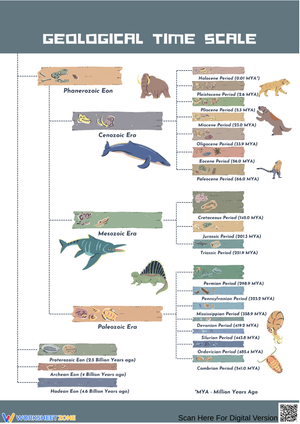
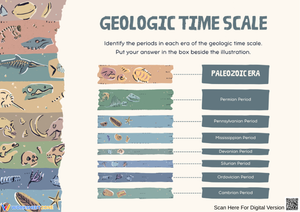
- Reading and labeling the geologic time scale — students place eons, eras, periods, and epochs in correct sequence and identify dominant life forms in each major division
- Applying the Law of Superposition — students examine rock outcrop diagrams and rank layers from oldest to youngest, including disrupted sequences involving faults and intrusions
- Cross-cutting relationships — students identify which geologic features — dikes, faults, unconformities — postdate the surrounding rock and explain their reasoning in writing
- Half-life calculations — students use parent-to-daughter isotope ratios to calculate absolute ages, working with Carbon-14 for recent organic material and Uranium-238 for ancient igneous rock
- Index fossil correlation — students match rock layers across two or three site columns using shared fossil assemblages, building a unified sequence from incomplete local records
Later tasks in the 8th grade geologic time worksheets ask students to combine relative and absolute dating evidence rather than practicing each method in isolation — which is where the deeper conceptual work actually happens and where gaps in understanding become visible.
Common Misconceptions to Watch For and Correct
The most persistent error in the half-life tasks is a specific one: students who understand the concept still write the half-life value itself as the sample's age the moment they see the parent isotope at 50%. A student who knows Carbon-14 has a half-life of 5,730 years will record "5,730 years" without stopping to ask how many half-lives have elapsed. The calculation tasks here require students to show the elapsed-half-life step explicitly before producing a final age, which surfaces this shortcut early enough to address it before the unit assessment.
A different error shows up in the rock outcrop diagrams. Students who handle superposition correctly in a clean, undisturbed column consistently freeze when a fault cuts through the layers — they keep applying "oldest at bottom" to a disrupted sequence instead of switching to cross-cutting relationship logic. The diagrams in this set deliberately include faults, intrusions, and unconformities precisely because those disruptions force students to reason through the sequence rather than pattern-match to a familiar column shape.
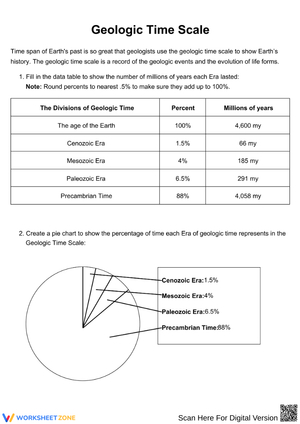
On the geologic time scale itself, most eighth graders can recite the major eons in order after some rehearsal, but they underestimate the Precambrian's proportion almost universally. They expect the major divisions to be roughly equal in length. When a scaled timeline task reveals that the Precambrian occupies close to 90% of the total, the surprise is genuine — and it creates a productive moment to discuss why the fossil record looks the way it does.
Standard Alignment
NGSS MS-ESS1-4 asks students to construct a scientific explanation based on rock strata evidence for how the geologic time scale is used to organize Earth's 4.6-billion-year history. The tasks here map directly to that standard's three-dimensional structure: relative dating exercises address the evidence-gathering dimension, half-life calculations address the quantitative reasoning dimension, and index fossil correlation addresses the cross-site synthesis the standard implies. Teachers using these resources as formative assessments can trace specific task types back to specific dimensions of MS-ESS1-4 without retrofitting the standard onto material that wasn't built for it.
Fitting These Worksheets Into the Week's Lesson Flow
The 8th grade geologic time worksheets on relative dating work best as second-day activities — give students direct instruction on the principles one day, then use the diagram tasks the next. Running them during the same class as initial instruction tends to produce rote copying rather than genuine reasoning. Ten minutes of independent work followed by a whole-class debrief, where students defend their layer-ordering choices to each other, is consistently more productive than a longer silent work period.
For half-life calculations, the transition from the visual decay curve to the arithmetic trips students when both happen on the same day. Introducing the decay curve on Monday and returning to the calculation worksheet on Wednesday or Thursday uses spaced retrieval to advantage: the gap surfaces weaknesses that same-day practice conceals. The students who appeared confident on Monday but struggle on Wednesday are exactly the students who needed that spacing.
The index fossil correlation worksheet pairs well with a short inquiry extension. Give student groups descriptions of rock cores from three fictional sites and ask them to reconstruct the regional geological history from the fossil evidence alone. When groups reach different conclusions and have to argue from the data, the reasoning consolidates in a way that individual worksheet completion alone does not produce.
Adjusting the Worksheets for Different Student Levels
These 8th grade geologic time worksheets allow teachers to shift the entry point without building entirely separate materials from scratch. For students who struggle with the rock outcrop diagrams, providing a clean labeled reference column before they attempt the disrupted versions gives them a working model to reason from. Students who have the relative dating principles firm can move directly to the disrupted diagrams and multi-site correlation tasks, which require holding several principles in mind simultaneously.
The half-life calculation tasks begin with clean ratios — 50%, 25%, 12.5% — where the number of elapsed half-lives is a whole number and the arithmetic is transparent. For students ready for a harder challenge, non-round ratios require interpolating between half-lives, which is closer to what actual radiometric dating involves and extends the math into more demanding territory without changing the underlying conceptual framework.
For the geologic time scale tasks specifically, students who are overwhelmed by the full hierarchy of names and dates benefit from a reduced-scope version focusing on the three Phanerozoic eras and the life forms that define each one. Students who are ready to go further can work with the complete scale — including major epochs and extinction events — and answer interpretive questions about cause and consequence rather than sequence recall alone.
Frequently Asked Questions
What is the difference between an era and a period in the geologic time scale?
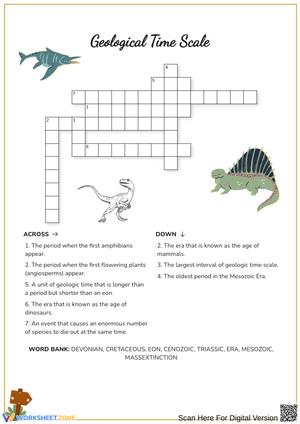
An era is a broad division of geologic time defined by major shifts in life forms or Earth's crust. Periods are subdivisions within an era, marked by more specific biological or geological events. The Mesozoic Era breaks into the Triassic, Jurassic, and Cretaceous periods — each associated with distinct fossil assemblages and geological conditions. The boundaries fall where they do largely because mass extinctions register as abrupt shifts in fossil types, making them the clearest natural dividing lines available in the rock record.
How do index fossils help match rock layers from different locations?
An index fossil comes from an organism that lived during a short, well-defined time window and was geographically widespread. When the same index fossil appears in rock layers at two distant sites, scientists infer those layers are roughly contemporaneous. The key constraint is the short-lived requirement: an organism that persisted for 300 million years is nearly useless for correlation because its presence barely narrows the possible time range. Students sometimes apply index fossil logic to long-ranging species; the correlation tasks here ask them to distinguish between index fossils and persistent marker fossils before proceeding.
Why does the Law of Superposition sometimes fail to apply?
Superposition holds for undisturbed sedimentary sequences. Tectonic forces can fold, tilt, and even overturn entire sequences, leaving the originally youngest layer now sitting at the bottom. Geologists use sedimentary structures — graded bedding, cross-bedding, ripple marks — to determine the original "up" direction when layers have been overturned. The rock outcrop diagrams in this set flag faults and intrusions visually and ask students to apply cross-cutting relationship reasoning to re-establish the correct sequence, rather than treating superposition as a rule that always holds.
Which isotopes are covered, and how do teachers explain when to use each one?
The set uses Carbon-14 and Uranium-238 as the two main examples. Carbon-14 is appropriate for organic material up to roughly 50,000 years old; beyond that, too little parent isotope remains for a reliable measurement. Uranium-238, with a half-life of about 4.5 billion years, is used for ancient igneous and metamorphic rock. A useful classroom framing: Carbon-14 works for things that were once alive; uranium-lead methods work for rocks that crystallized from magma. Students who try to date dinosaur bone using Carbon-14 are reasoning correctly about the method but misapplying the timescale — acknowledging the logic before correcting the error lands better than simply marking it wrong.
Why does the Precambrian take up so much more of Earth's history than the other divisions?
The Precambrian spans roughly 4 billion years — about 88% of Earth's total history. It encompasses the planet's formation, the cooling of the crust, the development of the atmosphere and oceans, and the slow emergence of single-celled and then simple multicellular life. Because most Precambrian organisms lacked hard parts, the fossil record for this interval is thin compared to what followed, which is part of why the Precambrian has fewer named subdivisions than the Phanerozoic. Students tend to assume that fewer named periods means less happened. That assumption is exactly backward.
Clear All