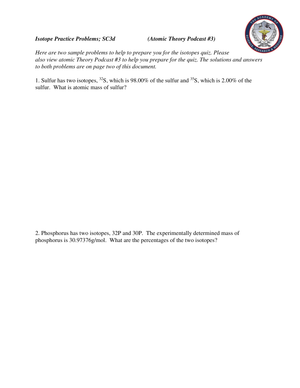
These 8th grade isotope practice printable worksheets give teachers a set of standalone resources for the piece of atomic structure that trips up most 8th graders: the discovery that atoms of the same element can carry different masses. Each worksheet isolates a specific skill—isotopic notation, neutron calculation, weighted average reasoning, or the distinction between isotopes and ions—so teachers can assign exactly what a class needs rather than moving through a fixed sequence.
The Specific Skills Each Worksheet Targets
The set covers the core competencies students need during a Grade 8 atomic structure unit:
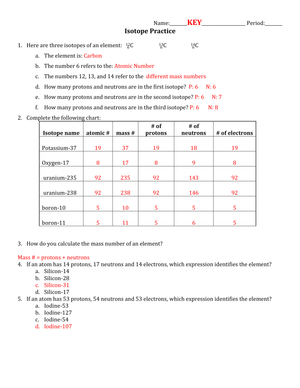
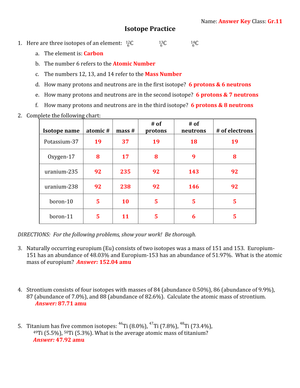
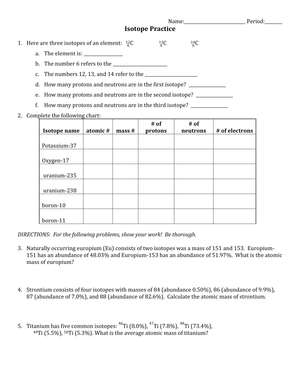
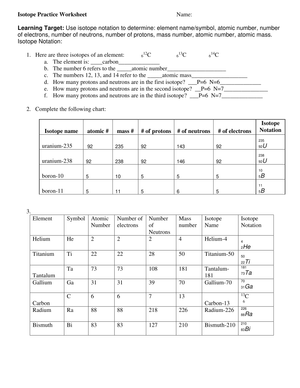
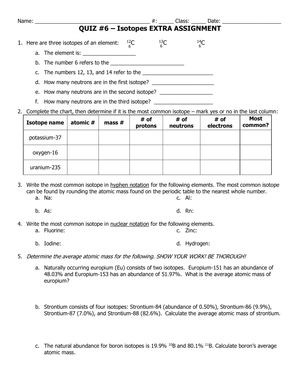
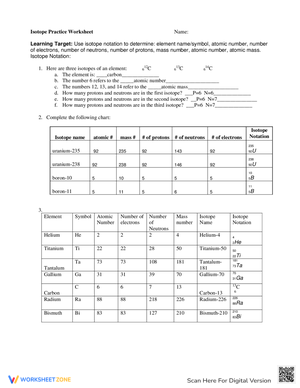
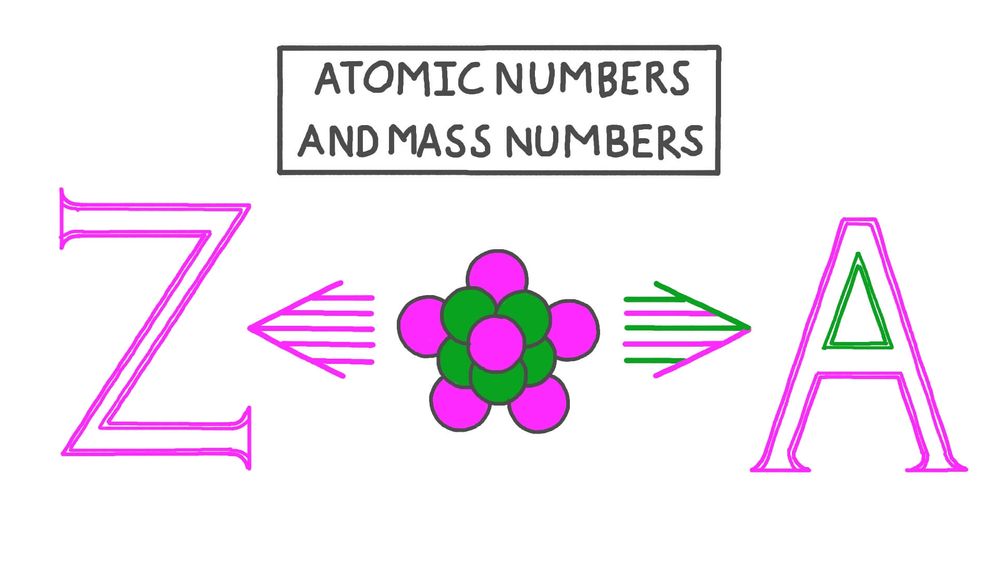
- Reading and writing isotopic notation in symbol form (mass number as the superscript, atomic number as the subscript) and in hyphen notation such as Carbon-14
- Calculating neutron count by subtracting the atomic number from the mass number
- Explaining why atomic masses on the periodic table are decimal values rather than whole numbers
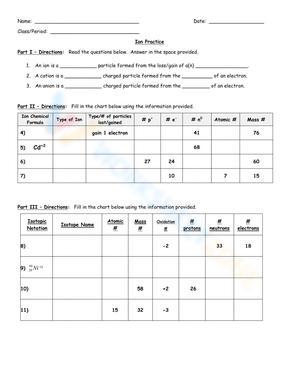
- Distinguishing isotopes from ions by identifying which subatomic particle is changing in each scenario
- Connecting named isotopes—Carbon-14, Cobalt-60, Uranium-235—to their real-world uses in radiocarbon dating, cancer treatment, and nuclear energy
The isotope-versus-ion comparison deserves its own worksheet rather than a single item buried in a broader review. Students who can explain the distinction verbally still routinely misclassify ions as isotopes on assessments, because a superscript charge symbol looks identical to a mass number at first glance. A worksheet that asks for protons, neutrons, electrons, and charge in the same table forces students to identify which particle is actually changing—and that tracking habit transfers directly to later work in chemical bonding.
The Errors That Show Up Most in Student Isotope Work
The most reliable calculation error is subtracting in the wrong direction. Students know subtraction is involved but write atomic number minus mass number rather than the reverse. Working Chlorine-35, a student running the formula correctly gets 18 neutrons; flip the subtraction and you get a negative number—which many students record without pausing. They don't recognize a negative neutron count as impossible, which tells you the formula is memorized rather than understood. A column on the worksheet that asks students to confirm their answer is a positive whole number before moving on catches this early, before the reversal hardens into habit.
The other consistent misconception involves the decimal values on the periodic table. When students encounter Carbon-12 and Carbon-14 together on 8th grade isotope practice printable worksheets, they notice that neither mass number matches the periodic table value of 12.011—and many conclude the table is slightly wrong. That confusion is actually a productive entry point: 12.011 is a weighted average across all naturally occurring carbon isotopes, not a rounding error. Students who arrive at that question through their own work retain the explanation far better than students who receive it as a cold lecture opener.
Fitting These Worksheets Into a Unit Sequence
Bell-ringers work consistently here. Write one isotopic symbol on the board before students arrive. In the first five minutes of class, students open the relevant worksheet, complete the subatomic particle breakdown, and compare with a neighbor before whole-class review. Circulating during those five minutes gives you immediate formative data—you can see within two rows whether the wrong-direction subtraction error is widespread or isolated to a handful of students.
Exit tickets close the loop on the back end. Three minutes before dismissal, give students one unfamiliar isotope symbol—something not used in that day's lesson—and ask them to identify protons, neutrons, and electrons. They write the answer and hand the worksheet in on the way out. A quick sort into two piles tells you whether the class is ready to move on or needs another repetition cycle the following morning.
Mid-unit, an Isotope Hunt adds movement while maintaining rigor. Post isotopic symbols around the room and have students carry the 8th grade isotope practice printable worksheets as their recording sheet, filling in particle counts at each station. Students naturally compare answers with whoever arrives at the same symbol at the same time, and disagreements push them back to the formula rather than waiting for teacher input. This format works best on day three or four of the unit, when students understand the mechanics but haven't locked them in through enough repetition.
For students who keep reversing the subtraction, two highlighter colors help considerably: one for the atomic number, one for the mass number. Color forces students to locate and label both values before calculating anything, interrupting the impulse to subtract whichever number appears first. Students who adopt this approach during the first week tend to self-correct faster than those who work without it.
Standard Alignment
NGSS MS-PS1-1 anchors this content, asking students to develop models of atoms that account for observable patterns in the periodic table, including mass patterns. In classroom terms, this standard moves students beyond the general awareness that atoms contain protons, neutrons, and electrons—a concept most have carried since Grade 5—toward explaining why two carbon atoms can have different masses. The neutron calculation and isotopic notation work these worksheets address sits squarely in that progression. Districts that map science content to math standards often connect isotope calculation to CCSS.MATH.6.EE.A.2, since students are substituting known values into a literal expression and evaluating the result.
How to Modify Each Worksheet for Mixed-Ability Groups
Students still finding their footing with the periodic table get more from 8th grade isotope practice printable worksheets when open-table access is permitted and the task is narrowed to neutron calculation alone. That removes the element-identification step, cutting the number of things students have to hold in working memory at once. Once neutron calculation is consistent, add the identification step back in. Keeping the steps separate at first prevents the kind of overload that causes students to make errors in work they actually understand.
For students who have already mastered the core calculation, pull real isotope abundance data for hydrogen—protium at approximately 99.98%, deuterium at roughly 0.015%, and tritium in trace amounts—and have them compute a weighted average by hand before checking it against hydrogen's periodic table value of 1.008. Students who work through that calculation arrive at the decimal themselves, which answers the "why isn't it a whole number?" question better than any direct explanation. The same students can investigate why Uranium-235 sustains a chain reaction while Uranium-238 does not, extending the isotope concept into nuclear chemistry without requiring a separate unit.
Frequently Asked Questions
How do you find the number of neutrons in an isotope?
Subtract the atomic number from the mass number. The atomic number tells you the number of protons; the mass number tells you protons and neutrons combined. For Carbon-14, that calculation is 14 minus 6, which gives 8 neutrons. In standard isotopic notation, the atomic number always appears as the subscript—the lower-left number—which is the value to subtract.
What is the difference between an isotope and an ion?
An isotope has a different number of neutrons compared to the most common form of that element, which changes its mass but not its charge or chemical behavior. An ion has gained or lost electrons, which changes its charge but not its mass. A practical sorting rule for Grade 8 students: if the mass number changes, look at neutrons. If a charge is listed, look at electrons. The two concepts affect different particles and produce different effects.
Why does the periodic table show atomic masses as decimals?
The value on the periodic table is a weighted average of all naturally occurring isotopes of that element, with each isotope weighted by its abundance in nature. Because most elements have at least two stable isotopes present in different proportions, the average rarely falls on a whole number. The mass number for any specific atom is always a whole number—the decimal only appears when averaging across the full range of naturally occurring versions of that element.
Do isotopes of the same element behave differently in chemical reactions?
In ordinary chemical reactions, isotopes of the same element behave essentially the same way, because chemical behavior depends on electron configuration and isotopes carry identical electron arrangements. The differences between isotopes are physical—primarily mass and nuclear stability. Uranium-235 and Uranium-238 behave differently in nuclear reactions, but in a standard chemical context they are nearly indistinguishable. That boundary between chemical and nuclear behavior is an important distinction as students move further into chemistry.












 Interactive Worksheet Maker
 Quiz Maker
 Word Search Maker
 Crossword Puzzle Maker
 Word Scramble Generator
 Sentence Scramble Generator
 Handwriting Worksheet Generator
 Name Tracing Generator
 Fill In The Blank Generator