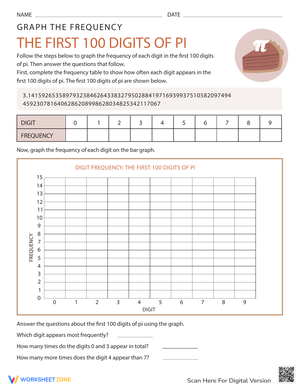
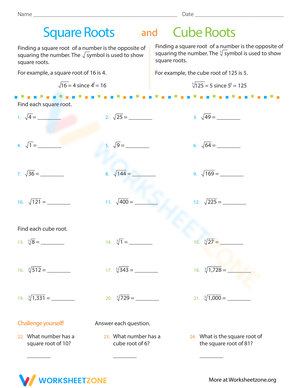
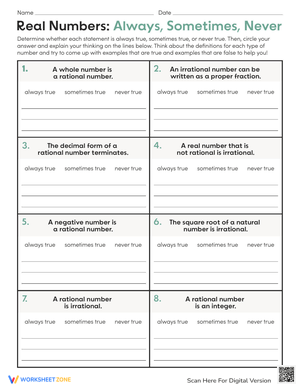
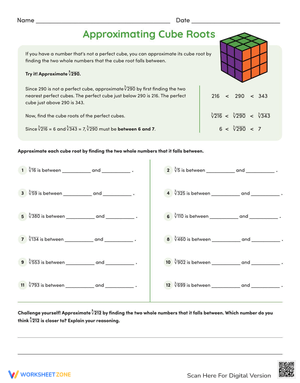
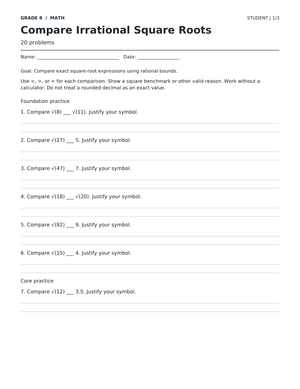
These 8th grade irrational numbers worksheets resources give math teachers what this concept genuinely requires: printable, structured practice that moves students from basic classification toward confident estimation and comparison on the real number line. The gap between "rational vs. irrational" as a vocabulary distinction and actually placing √27 between 5 and 6 is wider than most unit plans account for — and this set closes that gap through well-ordered, repeated exposure to the same skills in different formats.
What Each Worksheet Asks Students to Do
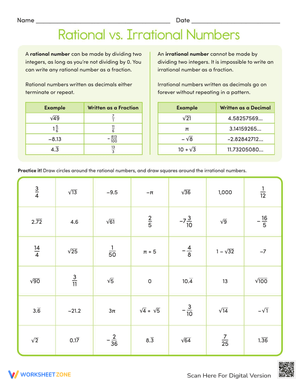
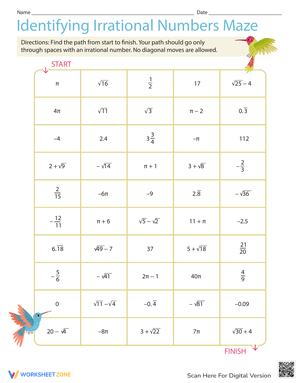
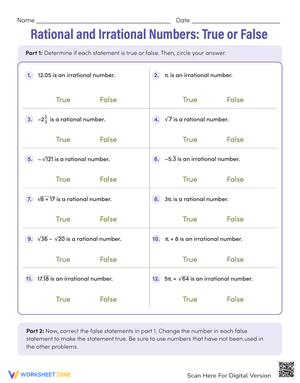
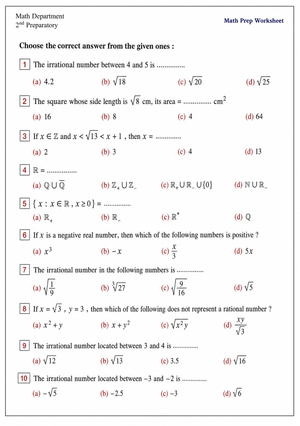
The set covers the full arc of 8th-grade irrational number reasoning. Students begin by classifying numbers across mixed representations — not just obvious cases like simple radicals, but sets that include repeating decimals, integers, terminating decimals, and constants like pi alongside square roots of non-perfect squares. That variety matters because students who only see radicals during classification practice often miss the underlying logic entirely.
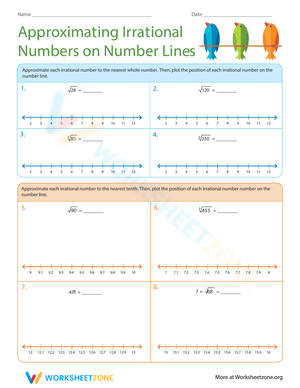
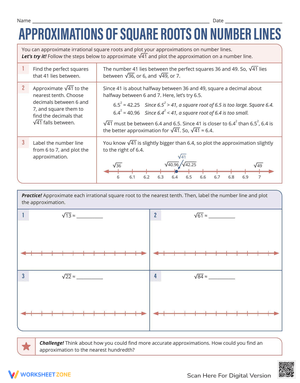
From there, each worksheet moves into estimation. Students identify the two consecutive integers a given irrational value falls between, then refine their thinking to tenths when the task demands it. Number line placement follows — students mark values like √11 or √30 on a given scale, which forces them to commit to a position rather than just name a range. The final worksheets address ordering: students arrange mixed lists of decimals, fractions, integers, and radicals from least to greatest.
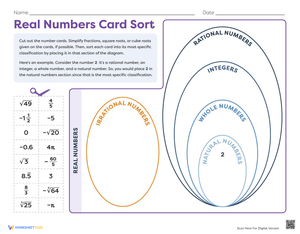
- Classify numbers as rational or irrational across mixed number types
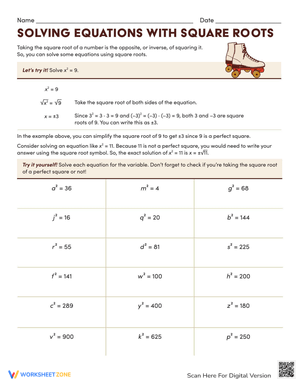
- Distinguish perfect square roots (rational) from non-perfect square roots (irrational)
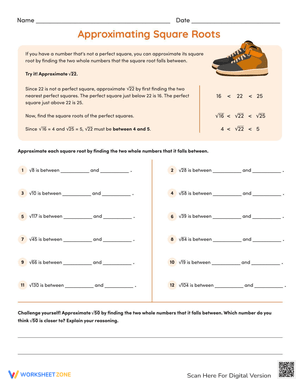
- Estimate irrational values between consecutive integers using perfect square benchmarks
- Place values like √7, √15, and √50 on scaled number lines
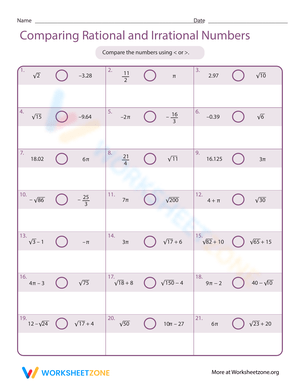
- Compare and order rational and irrational numbers in combined sets
- Write brief justifications using decimal behavior or radical reasoning
Student Mistakes Worth Anticipating Before the Lesson Starts
Three errors show up consistently in student work on this topic, and knowing them in advance changes how you sequence the worksheets.
The most common is assuming that any square root is irrational. Students who correctly identify √50 as irrational will often mark √49 the same way — not because they missed the definition, but because they haven't internalized that perfect squares have exact integer roots. A classification task that includes enough perfect square roots forces that distinction repeatedly. One or two examples won't stick; six or seven will.
A second error involves long decimals. Students who understand that "nonterminating, nonrepeating" describes irrationals will sometimes classify a decimal like 0.142857142857... as irrational simply because it looks unfamiliar. Without direct exposure to repeating decimal notation — the overbar or an explicitly stated pattern — they read "strange-looking" as "nonrepeating." Worksheets that display actual repeating notation correct this faster than re-explaining the definition.
The third error is more conceptual: students treat irrational numbers as category labels rather than actual quantities. They can say "pi is irrational" but freeze when asked why √10 lands closer to 3.2 than to 3.5 on a number line. Error-analysis questions — where students identify what's wrong with a sample classification or placement — push past surface-level labeling faster than additional straightforward practice alone.
How to Build These Worksheets Into Your Lesson Plans
For initial instruction, use the classification worksheet as a whole-class warm-up after introducing the vocabulary, then move into the estimation worksheet for guided practice. The number line worksheet works well as the independent practice component — students have seen the reasoning modeled but now have to commit to their own placements without prompting. That gradual release within a single lesson keeps the cognitive demand appropriate without overwhelming students who are still anchoring their perfect square knowledge.
For the reteach block — those 15 minutes after a quick formative check reveals that a third of the class is still marking √36 as irrational — start with a quick oral anchor: "Name every perfect square up to 144." Then assign just the classification portion of the mixed-review worksheet before moving on. Keeping the reteach narrow prevents the kind of cognitive overload that happens when students are asked to estimate and place values before they've stabilized the definition. The ordering worksheet, on the other hand, works well as a Friday review task: it requires holding multiple irrational values in mind simultaneously and comparing them, which is a cleaner end-of-week indicator than a repeated classification drill. These 8th grade irrational numbers worksheets sets also adapt easily to math centers — one station for classification card-sort work, one for number line placement, and one for written justification tasks, all running from the same skill progression.
Standard Alignment
The worksheets align to CCSS 8.NS.A.1 and 8.NS.A.2. Standard 8.NS.A.1 requires students to understand informally that every number has a decimal expansion, and to distinguish between rational decimals (those that terminate or repeat) and irrational ones (those that do neither). The classification and written-justification tasks in the set address this directly, asking students to identify the decimal behavior behind a given number rather than just memorize which examples are irrational. Standard 8.NS.A.2 focuses specifically on approximating irrational numbers on a number line — the estimation and placement worksheets target this standard, asking students to use perfect square benchmarks to locate values and compare their size to nearby rational numbers. Both standards appear early in the Grade 8 year, typically in the first number sense unit before the class moves into expressions and equations, so these resources fit naturally at the front of the course.
Adjusting the Work for a Range of Learners
Students who are still unsure which numbers are perfect squares need a reference strip before attempting estimation tasks. Including a list of perfect squares from 1 to 225 alongside the estimation worksheet isn't giving the answer away — it redirects cognitive effort toward the reasoning that matters at this stage. Sentence frames help struggling writers produce usable evidence, too: "This number is irrational because its decimal expansion..." gets a student to the argument faster than an open-ended prompt does. These are low-cost adjustments that keep the mathematical demand intact.
Students who have the basics and need something harder respond well to ordering tasks that ban calculators and require decimal estimation to the tenths place. Asking them to arrange four values — something like √3, 1.7, √5, and 2.1 — in order from least to greatest, with written justification for each placement, combines estimation, decimal comparison, and reasoning in a way that stays within Grade 8 standards but demands real fluency. These 8th grade irrational numbers worksheets resources support that kind of tiered assignment because each worksheet targets one clear skill, making it straightforward to pull the right one for each group without rebuilding the lesson.
Frequently Asked Questions
Do students need to have their perfect squares memorized before these worksheets make sense?
Not memorized in the strictest sense, but fluent enough to recognize them quickly. Students who can confirm on the spot that 49 is 7 squared and 64 is 8 squared move through estimation tasks at a completely different pace than students who have to derive those facts mid-problem. A brief daily warm-up reviewing perfect squares in the week before this unit pays off noticeably when students hit the estimation and placement worksheets.
How do I respond when a student argues that pi must be rational because it has a defined value?
This misconception has a kind of internal logic to it, which is why it's worth addressing directly rather than dismissing it. The key move is separating "a number exists and has a precise value" from "a number can be expressed as a ratio of two integers." Pi is exactly defined — it just cannot be written as a fraction with integer numerator and denominator. A concrete contrast works well here: 22/7 is rational, sits close to pi on the number line, but is not pi. Students generally find that comparison clarifying in a way that the definition alone doesn't provide.
Can these worksheets be used for standardized test review?
Yes. The classification, estimation, and ordering question types match the format and cognitive demand of 8.NS items on state assessments aligned to Common Core. Short constructed-response prompts asking students to justify a classification also align to the explanatory writing tasks that appear on standardized math tests. These 8th grade irrational numbers worksheets resources work well in the two to three weeks before a benchmark assessment when students need focused review on a specific standard rather than new instruction across multiple topics.
What if a student concludes that any decimal that goes on forever must be irrational?
Address it directly and early — it comes up more often than expected. Repeating decimals are also nonterminating, and they are rational. The distinction is not length but pattern. A decimal that repeats (even a long one, like 1/7 = 0.142857142857...) can be written as a fraction with integer numerator and denominator. A decimal that truly never settles into a repeating pattern cannot. Showing both side by side on the board once, before assigning the classification worksheet for the first time, prevents the same individual re-explanation from happening a dozen times across the period.













 Interactive Worksheet Maker
 Quiz Maker
 Word Search Maker
 Crossword Puzzle Maker
 Word Scramble Generator
 Sentence Scramble Generator
 Handwriting Worksheet Generator
 Name Tracing Generator
 Fill In The Blank Generator