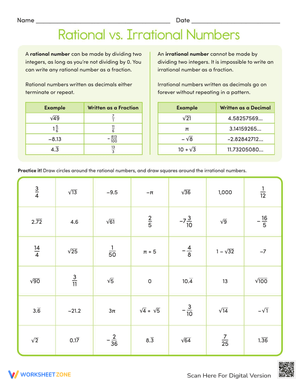
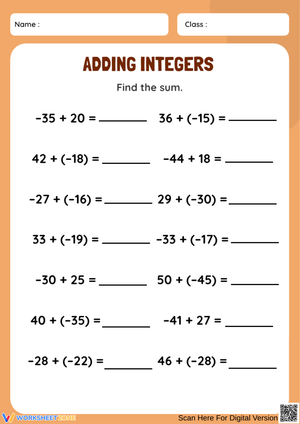
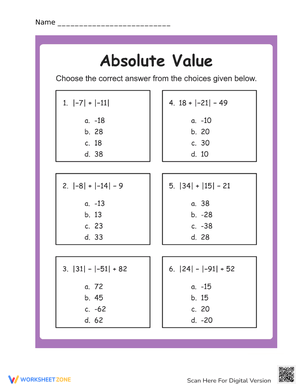
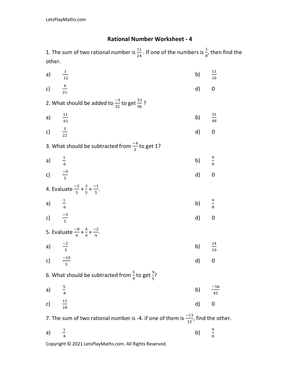
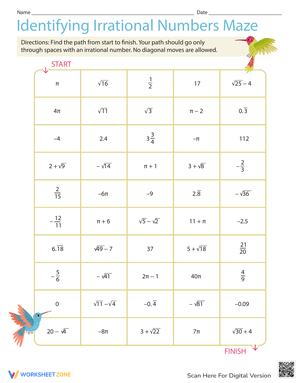
These 8th grade integers and rational numbers printable worksheets give teachers a set of standalone resources covering the full spread of number system skills eighth graders need — comparing, ordering, computing, and representing values across integers, fractions, and decimals without treating those forms as separate, unrelated topics. The sets that hold up in real classroom use are the ones that push students to move between number representations, because that transition is exactly where the understanding fractures.
What's Inside the Set
Each worksheet targets a specific skill, and the set as a whole moves from focused practice toward mixed application:
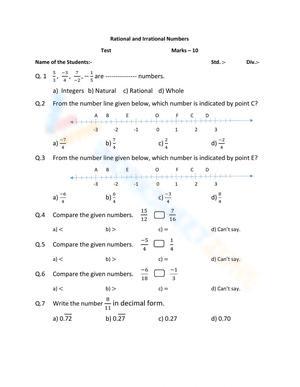
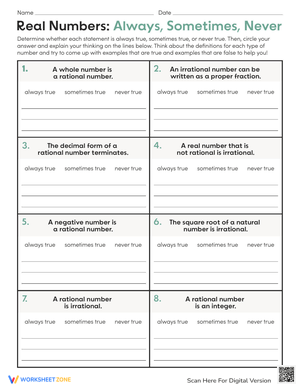
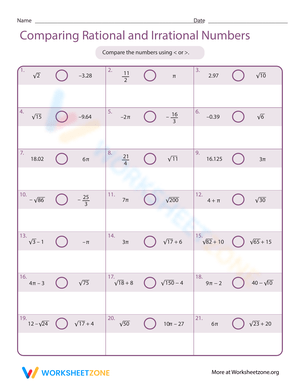
- Comparing and ordering rational numbers: Students work through mixed lists of positive and negative integers, fractions, and decimals — not organized by type, which is the only arrangement that reveals whether students can actually move between forms.
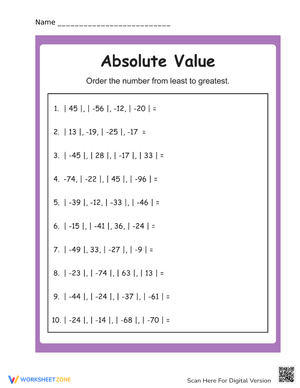
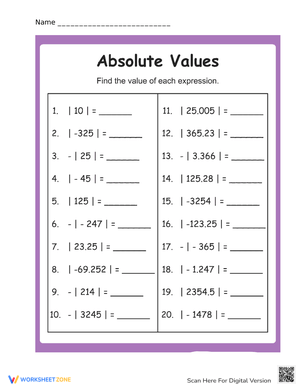
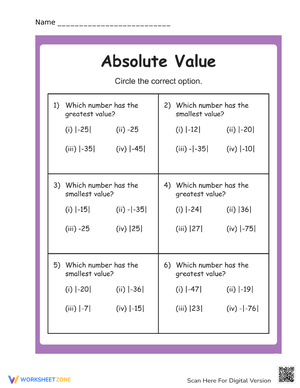
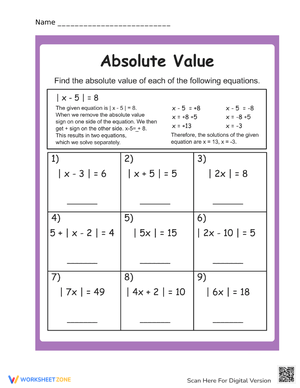
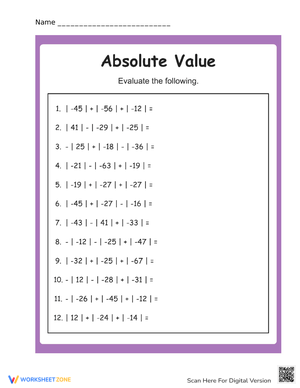
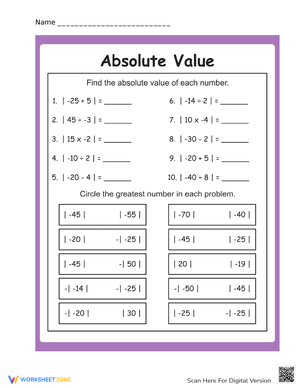
- Absolute value and opposites: Students identify distance from zero, write opposites, and distinguish absolute value from sign removal — three skills that students frequently collapse into a single vague procedure.
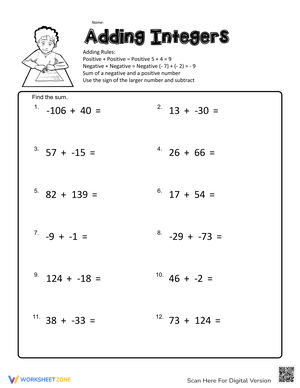
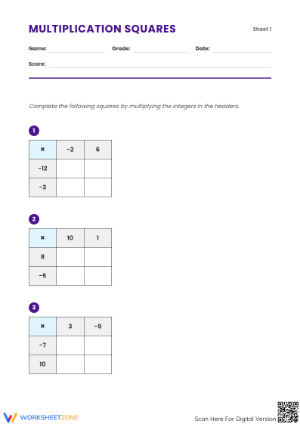
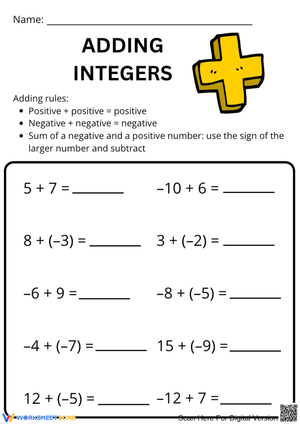
- Integer operations: Addition, subtraction, multiplication, and division appear in both symbolic and word-problem form, with enough variation to prevent students from pattern-matching to the most recent example they saw.
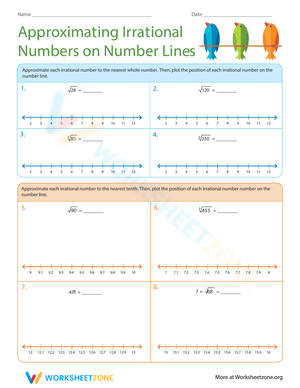
- Number line tasks: Students plot values, compare positions, and justify placements in writing rather than just marking points.
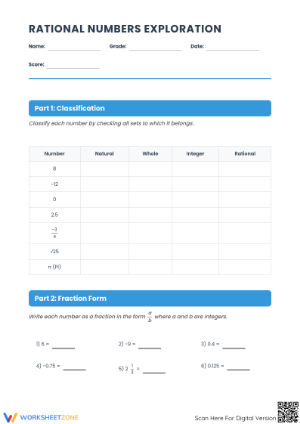
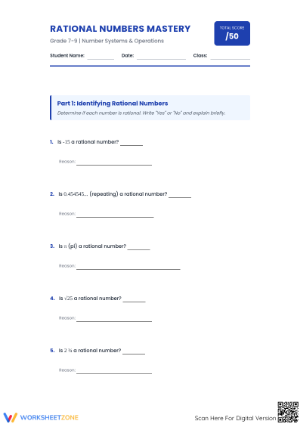
- Mixed rational number review: Later worksheets combine integers, fractions, and decimals in the same problem set, requiring students to select a strategy rather than repeat the one most recently practiced.
The sequence matters as much as the content. A set that opens with focused integer work, introduces fractions and decimals separately, and then asks students to work across all three forms mirrors how eighth graders consolidate new number concepts — narrow focus first, then deliberate combination. That order also gives teachers useful diagnostic information at each stage: if a student handles the integer worksheets but struggles when the forms mix, the instructional target becomes clear.
Errors That Surface Early and What They Tell You
When students sit down with 8th grade integers and rational numbers printable worksheets, the errors that appear most often are not computational failures — they are comparison reversals rooted in earlier number intuitions. Students who correctly rank 1/4 as less than 1/2 will frequently flip that logic with negatives, placing −1/4 below −1/2 on a mental number line because it "feels smaller." That mistake does not look like confusion; it looks like a confident wrong answer. Number line tasks surface this quickly, before the reversal becomes automatic.
Absolute value produces a specific second error: students learn to "drop the negative sign" as a procedure, then apply it mechanically to expressions like |−3 + 5|, stripping the negative from −3 before adding. The result is |3 + 5| = 8 instead of the correct |2| = 2. True-or-false items — "Is |−8| greater than |3|? Is |−3| equal to |3|?" — require students to evaluate each claim rather than execute a memorized step. Error analysis items, where a worked example contains a deliberate sign mistake, reveal whether a student can identify what went wrong or would have committed the same error without noticing.
Fitting These Worksheets Into the Week Without Reworking Your Plans
A four- or five-item focused worksheet works well as a Monday warm-up after a weekend gap, when students need low-stakes reactivation before new instruction begins. The ten minutes before a transition can hold one worksheet targeting a single skill — integer ordering, or absolute value identification — without any setup. Mixed-review worksheets belong mid-unit or near assessment time, when the instructional goal shifts from introducing a skill to selecting between skills.
Stations are a practical fit. One station focuses on number line plotting, one on integer operations, one on real-world contexts (temperature drop, elevation change, debt comparison), and one on error analysis. Because every resource in the set is a standalone printable worksheet, preparing station materials takes minutes rather than a lesson redesign. For homework, the focused worksheets are a better match than the mixed ones — after a lesson on absolute value, a short worksheet covering only absolute value keeps the assignment coherent and makes feedback faster. A practical routine that reduces sign errors on mixed-review work: add a small three-step reminder at the top of each worksheet — convert, compare, justify — so students slow down and rewrite numbers into a useful form before comparing rather than rushing through sign decisions.
Problem Formats That Build Reasoning Beyond Computation
Real-world contexts work best when the situation and the mathematics are genuinely aligned. Temperature change supports integer addition and subtraction because the numbers map cleanly onto a vertical number line — students who understand that a drop from −3°C to −11°C represents an 8-degree decrease have an intuition they can verify computationally. Bank balances and debts give positive and negative quantities a consequence that motivates careful sign management. These are not decorative contexts; they are cases where the real-world structure and the mathematical structure reinforce each other.
Task format variety matters as much as context. True-or-false items expose misconceptions about absolute value and order faster than standard computation problems. Error analysis shows whether students can reason about the structure of a problem or only execute an algorithm. Ordering tasks that combine fractions, integers, and decimals in a single list — ranking −3/4, −0.8, −1, and 0.5 from least to greatest — require conversion and comparison in one step. These formats appear throughout the worksheets rather than being isolated into a single section marked "reasoning."
Standard Alignment
The 8th grade integers and rational numbers printable worksheets in this set address standards across two grade levels, which accurately reflects where eighth graders actually stand. The rational number operations — adding, subtracting, multiplying, and dividing integers and fractions — align with 7.NS.A.1 and 7.NS.A.2, foundational standards that many students enter 8th grade still consolidating. Using focused worksheets early in the year as both diagnostic and consolidation tools is a practical move: they show quickly which students have genuine fluency and which ones are relying on workarounds they picked up in 7th grade.
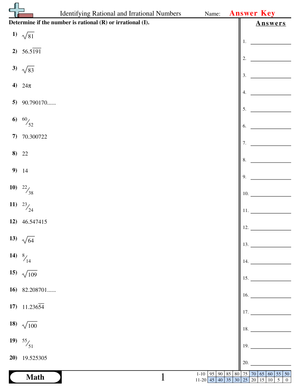
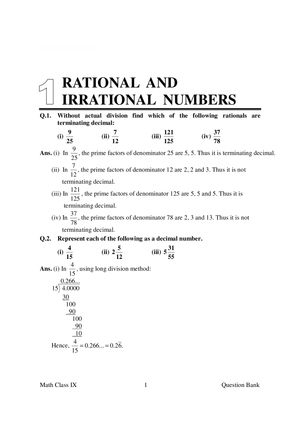
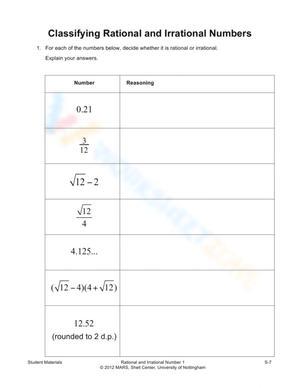
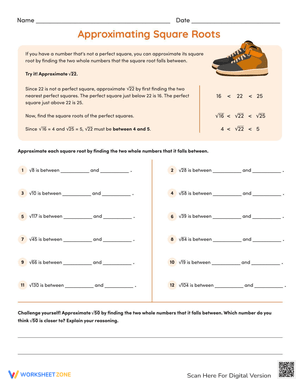
The connection between rational numbers and their decimal forms aligns with 8.NS.A.1, which asks students to recognize that every rational number has a decimal expansion that either terminates or repeats. In classroom terms, a worksheet asking students to convert −3/4 to a decimal and explain what kind of decimal it produces is doing standards-level work, not just review. These worksheets serve both functions: building the number fluency that seventh-grade standards establish and preparing students for the formal rational-versus-irrational distinction that 8.NS.A introduces.
Adjusting the Set for Students at Different Readiness Levels
Most Grade 8 math classes span a wider readiness range than the grade-level standard implies. Students who are still consolidating fluency with negative integers should start with integer-only worksheets, ideally with a number line printed directly on the page to reduce the working memory demand during sign decisions. Once those students can reliably compare and compute with integers, introduce fractions and decimals one form at a time before moving to the mixed sets. That progression is not remediation in the pejorative sense — it is an honest starting point for students who did not fully nail 7th-grade number system work.
For students working at or above grade level, the 8th grade integers and rational numbers printable worksheets that include error analysis and written justification produce the most growth. Asking a student to write a full explanation of why −3/4 is greater than −1 tells you more than a correct answer does. Extension tasks combine three or more number forms in a single ordering prompt, or present non-routine comparisons like determining whether −0.6 is greater than, less than, or equal to −3/5 — a problem that requires converting and then reasoning carefully about which negative value sits farther from zero.
Frequently Asked Questions
Do these worksheets cover both integers and rational numbers, or just one?
Each worksheet in the set targets a specific skill, so some focus on integers only while others work across integers, fractions, and decimals. The mixed-review worksheets combine all three forms in the same problem set — that is where students practice choosing a strategy rather than applying the most recently demonstrated one.
When in the school year do these fit best?
The focused integer worksheets work well in the first weeks of 8th grade as a consolidation and diagnostic tool. They show quickly which students have genuine fluency and which ones have gaps from 7th-grade number system work. The mixed rational number worksheets are more effective mid-year, once students are expected to move fluently between integers, fractions, and decimals inside expressions and equations.
Are answer keys included?
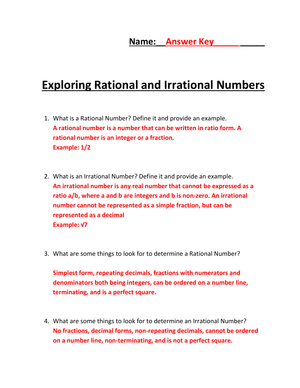
Yes. Answer keys matter most for rational number work, where a single sign error can run through a multi-step problem and leave a student confident in a wrong answer. Having a key available during small-group time lets teachers give immediate, specific correction rather than waiting to return papers the following day.
Can these replace a full textbook unit on rational numbers?
No — and they are not meant to. These worksheets provide focused practice and formative information, not initial instruction. They belong alongside direct teaching, worked examples, and classroom discussion. Used that way, they sharpen the fluency that instruction introduces and give teachers a clearer read on where each student actually stands.













 Interactive Worksheet Maker
 Quiz Maker
 Word Search Maker
 Crossword Puzzle Maker
 Word Scramble Generator
 Sentence Scramble Generator
 Handwriting Worksheet Generator
 Name Tracing Generator
 Fill In The Blank Generator