


























Views
Downloads
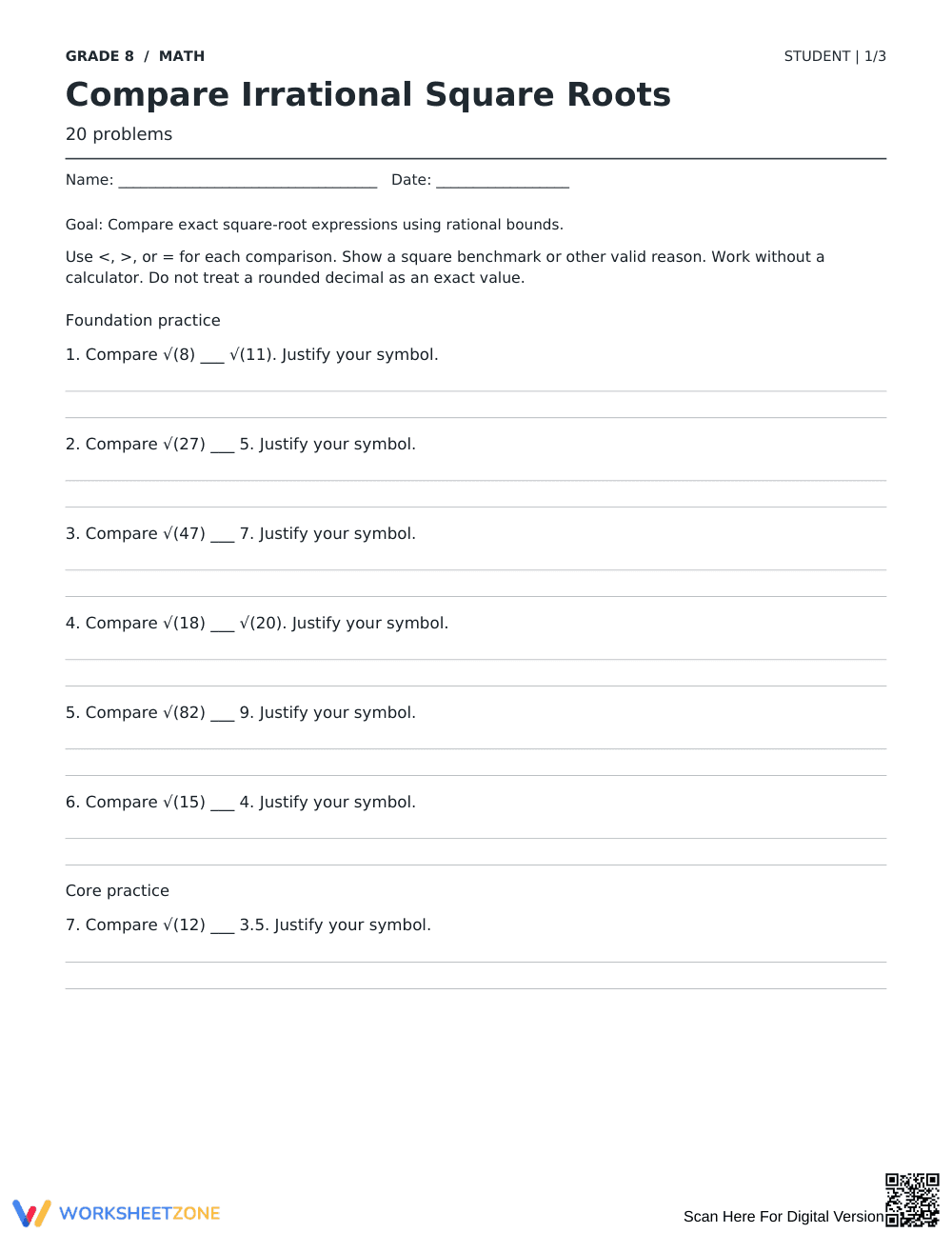
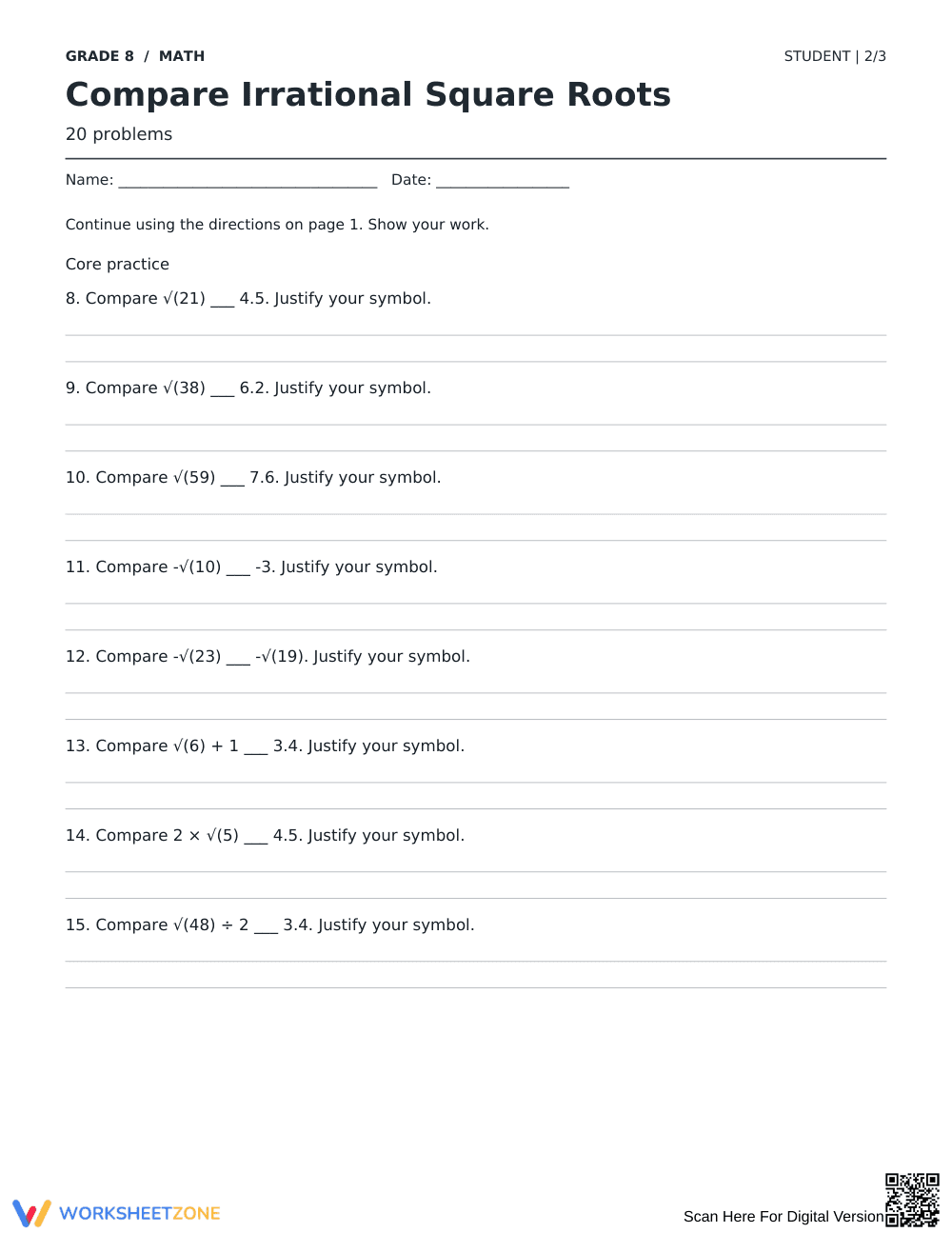
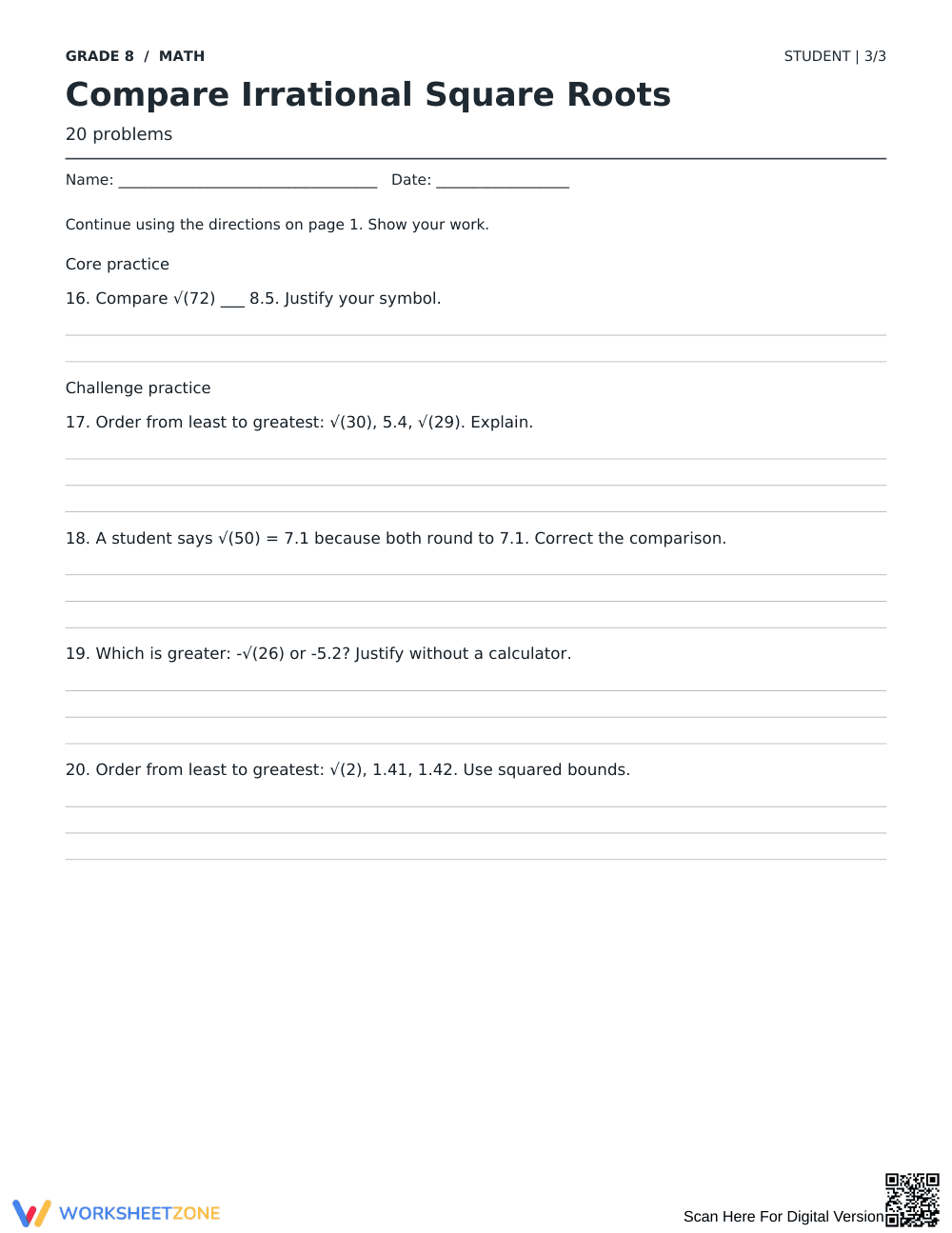

Compare Irrational Square Roots | Grade 8 Printable
Paste this activity's link or code into your existing LMS (Google Classroom, Canvas, Teams, Schoology, Moodle, etc.).
Students can open and work on the activity right away, with no student login required.
You'll still be able to track student progress and results from your teacher account.
This Grade 8 math worksheet builds students' ability to compare and order irrational square roots by locating approximate decimal values on a number line, giving students a concrete strategy for reasoning about numbers that cannot be expressed as exact fractions.
At a Glance
- Grade: 8 · Subject: Math
- Standard:
CCSS.MATH.CONTENT.8.NS.A.2— Approximate irrational numbers and place them on a number line- Skill Focus: Comparing and ordering irrational square roots using rational approximations
- Format: 2 pages · 24 problems · Answer key included · PDF
- Best For: Guided practice after direct instruction on irrationals
- Time: 25–35 minutes
The worksheet spans two student pages and presents 24 structured problems. Students estimate the decimal value of square roots such as √5, √13, and √50, then use inequality symbols to compare pairs and arrange sets in ascending or descending order. A number line model is embedded throughout to anchor abstract values to a visual reference. The full answer key covers both pages with worked solutions.
- Guided practice (Problems 1–8): Students identify which two consecutive integers a given square root falls between, with a partially completed number line scaffold reducing cognitive load as they build the approximation habit.
- Supported practice (Problems 9–16): Students compare two irrational values using <, >, or = without the integer-bracket scaffold, applying the estimation strategy independently while sentence frames remain available for written justification.
- Independent practice (Problems 17–24): Students order sets of three to four irrational and rational numbers from least to greatest, integrating all prior skills with no structural support beyond the blank number line.
This gradual-release sequence mirrors the I Do, We Do, You Do framework, allowing teachers to model Problems 1–8 whole-class before releasing students to work in pairs and then independently.
The primary standard is CCSS.MATH.CONTENT.8.NS.A.2: Use rational approximations of irrational numbers to compare the size of irrational numbers, locate them approximately on a number line diagram, and estimate the value of expressions. A supporting connection to CCSS.MATH.CONTENT.8.NS.A.1 is present, as students must distinguish rational from irrational values when ordering mixed sets.
Use this worksheet after direct instruction on perfect squares and rational approximation to consolidate new learning, or assign it before a unit assessment as a focused review. For a formative-assessment checkpoint, observe whether students in Problems 9–16 efficiently recall the integer benchmarks established in Problems 1–8 — students who revert to guessing benefit from a brief re-teach on the benchmark-square strategy. Most students complete the full worksheet in 25–35 minutes.
This worksheet is designed for Grade 8 students working toward proficiency with the Number System domain, including those who need repeated exposure to approximation before the concept solidifies. It pairs naturally with a perfect-squares anchor chart posted during work time and complements any lesson on irrational numbers that uses a classroom number line as a visual anchor.
Rational approximation of irrational numbers is a foundational Grade 8 skill assessed on the NAEP. Aligned to CCSS.MATH.CONTENT.8.NS.A.2, this worksheet targets the specific student action of placing square roots on a number line by estimating their decimal value to the nearest tenth. The 24-problem sequence operationalizes a gradual-release model: integer-bracket scaffolds in early problems fade systematically so that by the final eight problems students order mixed rational and irrational sets without support, producing observable evidence of transfer suitable for formative records or progress monitoring.


