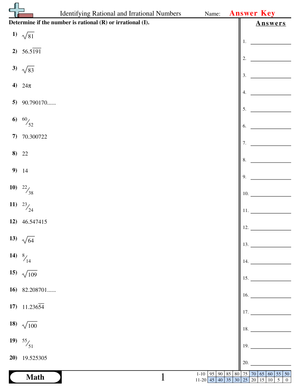
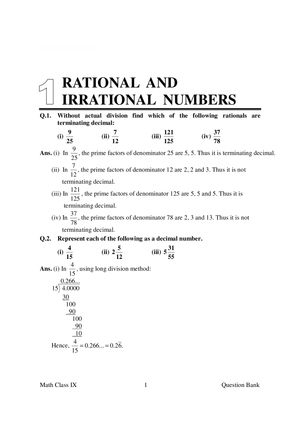
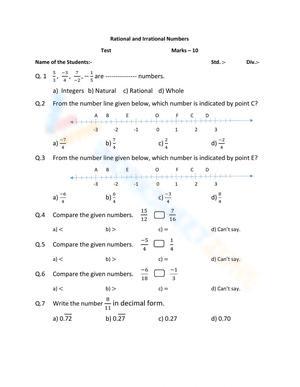
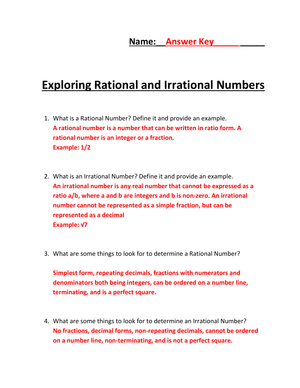
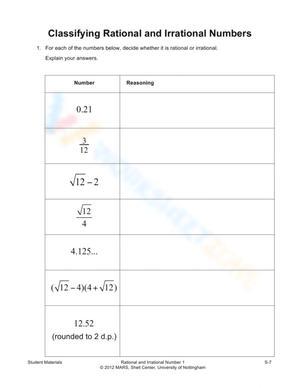
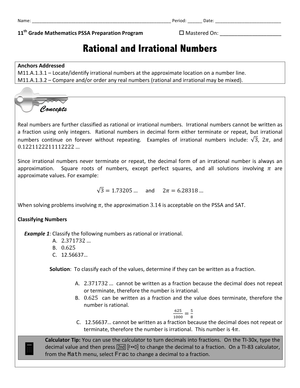
These 8th grade rational and irrational numbers worksheets give teachers a focused set of classification and reasoning tasks that move students past definition recall into the decimal analysis and radical work CCSS 8.NS actually demands. The challenge in this unit isn't labeling two categories — it's recognizing the same number when it shows up as a fraction, a terminating decimal, a repeating decimal, or a square root expression. Students who correctly identify 3/4 as rational often freeze when the same value appears as 0.75, and that gap is exactly what repeated worksheet practice closes.
What the Set Covers
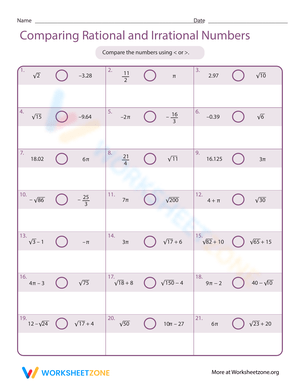
The worksheets target several connected skills across classification, decimal reasoning, and estimation. Students classify integers, fractions, terminating decimals, and repeating decimals as rational — then contrast those with nonterminating, nonrepeating decimals and radical expressions. A separate but equally important focus is distinguishing perfect-square roots like √9 and √16, which equal whole numbers and are therefore rational, from non-perfect-square roots like √2 and √7. Estimation worksheets ask students to place irrational values between consecutive whole numbers and then narrow to consecutive tenths. Comparison tasks require ordering a mix of rational and irrational numbers, and several worksheets include short written prompts where students explain in one or two sentences why a decimal form confirms a number's category.
8th grade rational and irrational numbers worksheets that include all of these item types — not just identification problems — give teachers real diagnostic information. A student who handles fractions confidently but marks √4 as irrational reveals a specific gap around perfect squares, not a general misunderstanding of the rational/irrational distinction.
Mistakes Students Make That These Worksheets Surface
The most persistent error is sorting by visual appearance rather than by decimal behavior. Students learn early that π and √2 are irrational, then apply that "unfamiliar symbol = irrational" logic to √4 and √25 — both of which simplify to rational whole numbers. This shows up clearly in actual student work: a student will correctly mark 5 as rational, then mark √25 as irrational because the radical sign signals something different to them.
Repeating decimals are the second major stumbling block. Students who have been told "decimals that go on forever are irrational" will classify 0.666... and 2.121212... as irrational, because those decimals don't end. The correction requires them to see that a repeating block — regardless of how long it runs — always corresponds to a fraction. Writing 0.333... as 1/3 on the board and asking students to verify with long division is often the moment the rule actually sticks. Worksheets that pair a repeating decimal with its fraction equivalent in the same problem reinforce that connection without the teacher having to rebuild it from scratch in every period.
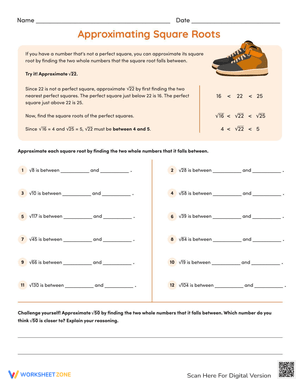
A third error appears in number line estimation. When asked to place √10, students frequently mark it near 5 — splitting the distance between 1 and 10, rather than reasoning from the fact that √9 equals 3. Including a "identify your benchmark perfect squares first" prompt on estimation worksheets makes this reasoning visible before students commit to a placement, so the error is caught in the work rather than only in the final answer.
Where These Worksheets Fit in the Week
The most effective sequence uses the worksheets across three to four days rather than crowding them into a single lesson. On day one, work through an introductory classification worksheet as a whole-class activity — ask students to read answers aloud and explain one choice per problem. On days two and three, assign decimal and radical worksheets as independent practice after a brief warm-up review of the previous day's error patterns. Reserve a comparison or number line worksheet for day four as a consolidation task before the unit assessment.
Warm-ups are one of the strongest fits for this resource. Three to five classification problems take six or seven minutes at the start of a period, give every student something to do while attendance is taken, and immediately surface the misconceptions worth addressing before the main lesson. The item types are short enough to use in the last eight minutes of class as a quick formative check before dismissal — teachers can review answers on the spot and note which students missed the decimal or radical items.
8th grade rational and irrational numbers worksheets work well in station rotation, too. One station runs a cut-and-sort classification task; a second focuses on number line estimation; a third asks students to choose three or four numbers from a list and write out why each belongs in its category. Because the worksheets don't depend on each other in a fixed order, they can be distributed across stations without worrying about sequencing.
Tailoring the Worksheets to Different Readiness Levels
Students enter this unit with genuinely different starting points. Some arrive comfortable with fractions and terminating decimals but have never encountered radical notation. Others have seen square roots but carry weak fraction sense. A few need to establish the vocabulary — rational, irrational, integer, repeating — before the classification tasks carry any meaning.
- Students who need more support: Start with integers and simple fractions before introducing decimal or radical problems. A reference card listing the definitions and two worked examples per category reduces working memory load during the classification task itself. Allow calculator access so students can convert fractions to decimals and focus on reading decimal behavior rather than computing it.
- On-grade students: Follow the standard sequence — fractions and integers, then terminating and repeating decimals, then radicals, then mixed comparisons. Require written justification for at least two or three answers on each worksheet.
- Students ready for extension: Ask them to construct their own examples: "Write three numbers that look irrational but are actually rational." Have them order a set of five mixed values from least to greatest and explain each step. Introduce the idea that the sum of a rational and an irrational number is always irrational, and ask them to test several cases to see why.
Exit tickets work well here because two classification questions and one short explanation — pulled directly from the final section of a worksheet — are usually enough to show who is ready to move on and who needs targeted follow-up. A student who misses both the repeating decimal item and the perfect-square root item needs different small-group attention than one who misses only the number line estimation problem.
Standard Alignment
CCSS 8.NS.A.1 requires students to understand informally that every number has a decimal expansion and to distinguish rational numbers — those whose decimal expansions terminate or repeat — from irrational numbers. CCSS 8.NS.A.2 extends that work to approximating irrational values and placing them on a number line. In most Grade 8 pacing guides, 8.NS.A.1 appears two to three weeks into the school year because it draws directly on the fraction and decimal fluency students built in 6th and 7th grade. The estimation work of 8.NS.A.2 typically follows in the same unit and sets up the real-number reasoning students return to in the functions and geometry units later in the year.
Frequently Asked Questions
Do students need prior square root instruction before starting these worksheets?
Some familiarity with perfect squares helps but isn't required from day one. Students who know that 4, 9, 16, 25, and 36 are perfect squares handle the radical classification problems faster. For classes with limited square root exposure, spend five to ten minutes reviewing perfect squares before introducing the radical items — or introduce the classification-only worksheets first and bring in the radical worksheets a day or two later once that foundation is in place.
How is number line placement handled in the set?
The number line worksheets ask students to identify the two consecutive whole numbers an irrational value falls between, then narrow to consecutive tenths. A student estimating √10 would first confirm it falls between 3 and 4 (since √9 equals 3 and √16 equals 4), then estimate whether it sits closer to 3.1 or 3.2. A "show your benchmark" prompt accompanies each number line problem so teachers can check the reasoning process, not just the placement answer.
How should teachers handle the common confusion between 22/7 and pi?
This is one of the more instructive conversations this unit generates. The fraction 22/7 is a rational approximation of π — convenient for estimation, but not equal to π. Pi's true decimal expansion neither terminates nor repeats, which makes it irrational. 8th grade rational and irrational numbers worksheets that include a problem specifically contrasting 22/7 with π help students see that an approximation and the actual value are different numbers with different classifications. Two or three minutes of direct discussion on this point tends to pay off on unit assessments, where similar items appear with some regularity.













 Interactive Worksheet Maker
 Quiz Maker
 Word Search Maker
 Crossword Puzzle Maker
 Word Scramble Generator
 Sentence Scramble Generator
 Handwriting Worksheet Generator
 Name Tracing Generator
 Fill In The Blank Generator