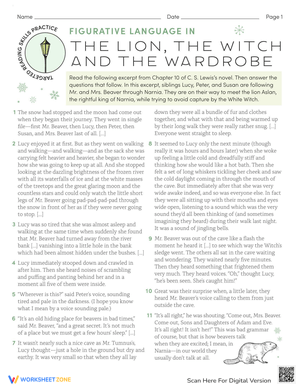
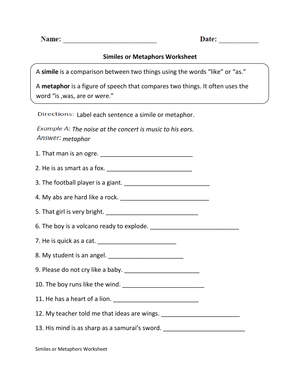
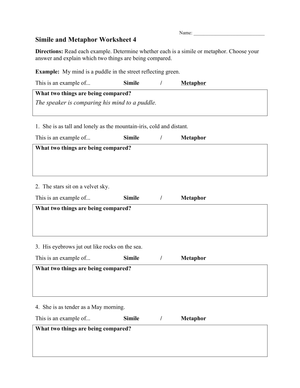
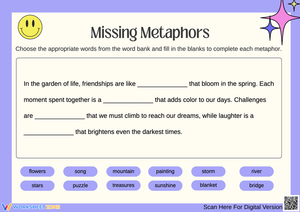
These metaphors pdf worksheets for 8th grade target the exact instructional gap most middle school ELA teachers hit around week three of a figurative language unit: students who can circle the metaphor but cannot explain what it does to the reader. Each worksheet moves students from locating comparisons to interpreting them, with tasks that require real inferencing rather than labeling.
What Each Worksheet Asks Students to Do
The worksheets cover five distinct tasks, each demanding a different kind of thinking:
- Identification: Students locate the metaphor within a sentence or short passage — this establishes the baseline before analysis begins.
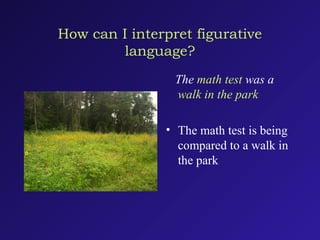
- Meaning in context: Students explain what two things are being compared and what the comparison implies. A student who writes only "life is compared to a road" has identified the comparison without interpreting it; a stronger response explains what a road implies about direction, choice, and obstacles.
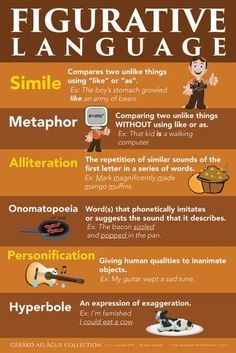
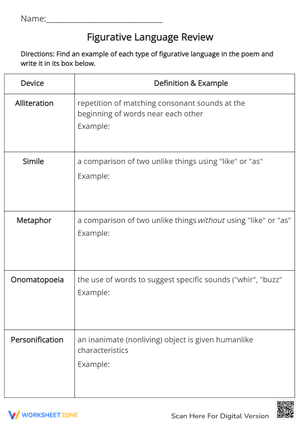
- Simile vs. metaphor distinction: Students determine whether a comparison uses like or as. This sounds mechanical but consistently trips up eighth graders who learned the rule without encountering enough varied examples.
- Effect on tone or imagery: Students describe what the metaphor creates — a mood, a visual impression, or a shift in how the reader understands the subject.
- Writing original examples: Students rewrite a literal statement as a metaphor or generate one connected to a class text or theme.
The writing task matters even when class time is tight. Students who struggle to write a metaphor often reveal shallow understanding they were hiding on the identification items.
Where Students Get Stuck: Errors Worth Anticipating Before the Lesson
The most consistent error in eighth grade metaphor work is surface restatement. A student reads "the mind is an ocean" and writes: "The author compares the mind to an ocean. The ocean is a large body of water." That response names the comparison without interpreting it. It says nothing about what the ocean-comparison implies about the mind — its depth, the calm surface hiding turbulence underneath, its capacity for sudden change. The gap between identification and interpretation is where most reteaching happens, and it shows up reliably by the third or fourth item in any practice set.
A second predictable mistake involves direction of explanation. When students analyze "her voice was velvet," some describe velvet — its texture, its appearance — without connecting back to what that tells the reader about the voice. The comparison vehicle is where their explanation stops, when the actual question asks what the vehicle reveals about the subject. Catching this error early prevents it from calcifying before students reach passage-level analysis on a state assessment.
There is also the student who treats dramatic comparisons as automatically negative. If the metaphor is "the city is a graveyard after midnight," some students write that the author is being sad without specifying what quality the graveyard transfers — stillness, abandonment, an eerie quiet that feels wrong for a place usually full of people. That level of imprecision is too loose for grade 8 expectations, and it tends to show up most in students who rush the explanation step.
Getting the Most Out of These Worksheets Week to Week
For teachers running a figurative language unit, these worksheets fit in three natural places. As a bell ringer, one or two identification-and-meaning items take roughly six to eight minutes and work especially well on Mondays when students need a low-stakes entry into close reading. As a follow-up to direct instruction, a worksheet assigned immediately after modeling keeps the gradual release intact — students move from the teacher's example to independent application while the lesson is still fresh. As a Friday review, a mixed worksheet that includes both simile and metaphor items asks students to use the distinction actively, which is harder than working with one device in isolation.
Passage-based worksheets take longer and surface more disagreement, which is exactly the point. When two students interpret the same metaphor differently, the conversation that follows teaches more than the worksheet alone. Building in five minutes for partner comparison before a whole-class debrief makes a real difference in how students learn to articulate their reasoning.
Sub plans are a different situation. Sentence-level worksheets are genuinely self-contained in a way passage analysis is not — a class without their teacher rarely has the discussion support needed for open-ended interpretation questions. Sorting metaphors pdf worksheets for 8th grade by task type before adding them to sub folders is a small planning decision that prevents frustrating half-finished lessons.
Adjusting the Set for a Range of Learners
One useful sorting insight: task difficulty does not track with text length. A sentence built around an abstract metaphor can demand more inferencing than a full paragraph where context makes the comparison obvious. Keeping this in mind changes which students get which worksheets and how teachers sequence the set across a unit.
Students still working on the literal-versus-figurative distinction need a structured entry point before analysis begins. A sentence frame such as "The author compares ___ to ___ in order to suggest ___" reduces the cognitive load enough that those students can focus on the metaphor itself rather than the mechanics of writing an explanation. Providing two or three possible interpretations to evaluate — rather than an open-ended prompt — keeps the thinking honest without removing it entirely.
On-level students generally do well with the standard identification-and-interpretation sequence. The productive push for this group is the "why" question: not just what is being compared, but why this comparison is more precise or affecting than a literal statement. Asking for one piece of textual evidence that supports their interpretation builds a habit that transfers across all of their eighth-grade ELA work.
Advanced students move quickly past identification and need analysis tasks to stay engaged. Asking them to compare two metaphors within the same passage and explain which creates stronger imagery, or to revise a weak metaphor into a more precise one, raises the ceiling without requiring different materials. These metaphors pdf worksheets for 8th grade work across that full range because the core skill stays constant while the response expectation adjusts.
Standard Alignment
These worksheets align to CCSS.ELA-LITERACY.RL.8.4, which asks students to determine figurative and connotative meanings of words and phrases as used in a text and to analyze the impact of specific word choices on meaning and tone. The standard explicitly targets interpretation — not identification — which is why analysis and effect questions appear throughout the set rather than recognition tasks alone. Teachers in states using modified or parallel frameworks will find the skill progression matches the grade 8 placement of figurative language in most ELA standards documents.
Frequently Asked Questions
Do these worksheets come with answer keys?
Yes. Each worksheet includes answer support with brief explanations of the figurative meaning, not just the labeled answer. That distinction matters for interpretation questions, where a short note on why a particular reading fits the text lets teachers run small-group reteaching without reconstructing the reasoning during a forty-minute block.
How is this set different from a general figurative language packet?
General figurative language sets spread practice across simile, personification, hyperbole, alliteration, and other devices. This set stays inside metaphor, which allows for a tighter instructional sequence. Students get enough repeated practice with one device to move from recognition to analysis within a unit, rather than touching each device briefly and moving on before the skill consolidates.
Are these appropriate for students reading below grade level?
The sentence-level worksheets work well for below-grade-level readers when combined with the sentence frames and structured response options described in the differentiation section above. Passage-based worksheets require closer consideration — some students need the passage read aloud before they can focus on the metaphor analysis. These metaphors pdf worksheets for 8th grade are not built to be effortless for struggling readers, but the structured response formats give those students a real entry point rather than an open-ended task they cannot start.












 Interactive Worksheet Maker
 Quiz Maker
 Word Search Maker
 Crossword Puzzle Maker
 Word Scramble Generator
 Sentence Scramble Generator
 Handwriting Worksheet Generator
 Name Tracing Generator
 Fill In The Blank Generator