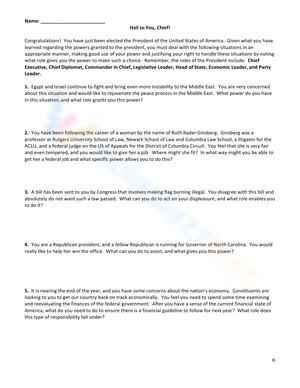
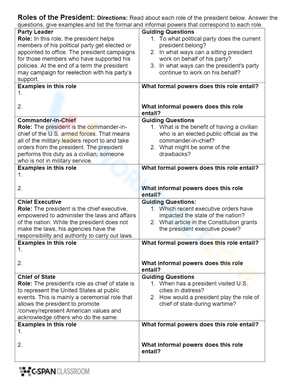
These roles of the president worksheets for 7th grade give middle school civics teachers a direct path from "the president runs the country" — the answer most 7th graders start with — to a working understanding of how the executive branch is divided, limited, and woven into the rest of the constitutional system. The set targets seven presidential roles, pairs each with realistic scenarios, and consistently asks students to account for checks on executive power alongside what the president can do.
The Seven Roles and What Students Practice With Each One
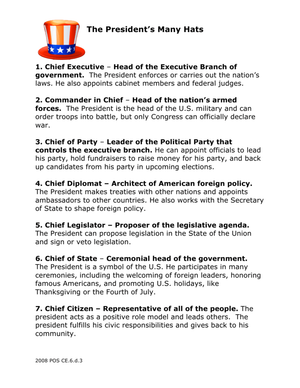
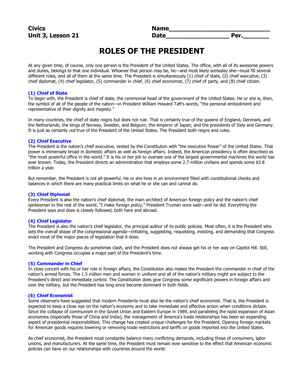
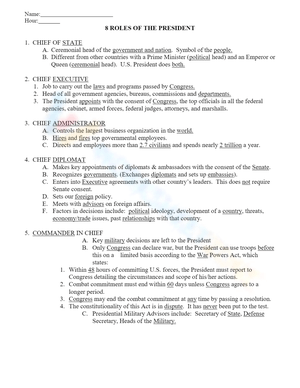
Most grade 7 curricula organize the executive branch around seven functions: chief executive, chief diplomat, commander in chief, legislative leader, head of state, chief of party, and chief citizen. Students work through definitions first, but the more demanding task is recognizing each role in context — reading a scenario and naming which function is being performed, then backing that identification with a reason.
- Chief executive: carries out laws and manages the federal executive branch.
- Chief diplomat: meets with foreign leaders, negotiates treaties, and directs foreign policy.
- Commander in chief: leads the armed forces and makes military decisions.
- Legislative leader: proposes legislation, addresses Congress, and exercises veto power.
- Head of state: represents the country at official ceremonies and national events.
- Chief of party: serves as the public face of a political party and supports party candidates.
- Chief citizen: speaks to national values, models civic responsibility, and addresses the concerns of the general public.
Each worksheet in the set works through these roles in a different format — matching, vocabulary practice, scenario identification, and constructed response — so students encounter the same content more than once without repeating the same activity.
Formats That Move Students From Recognition to Explanation
The activities build in sequence. An early worksheet asks students to match each role to a plain-language definition. A later worksheet presents brief scenarios — the president signs an executive order directing a federal agency, meets with a foreign head of government, or addresses the nation after a disaster — and students mark which role applies, then write one sentence of reasoning.
That written-response step carries a lot of the instructional weight. Completing the sentence "The president is acting as commander in chief because..." forces students to connect label to action, which is where the civics understanding actually develops. Vocabulary work runs through the set as well, covering terms like executive branch, veto, treaty, cabinet, and diplomacy in context rather than as bare definitions.
Mistakes Students Make That These Worksheets Help You Catch
The most persistent confusion is between chief executive and commander in chief. Students frequently treat them as interchangeable because both involve "being in charge." A reliable way to surface this is a scenario where the president appoints a new secretary of education — students often mark commander in chief because the president is "leading." Seeing the correction and the reasoning behind it does more for retention than re-reading definitions. These roles of the president worksheets for 7th grade put that kind of close comparison directly into the scenario tasks so teachers can address the confusion in real time rather than after a quiz.
A second pattern worth watching: students will correctly mark head of state for a speech delivered at a foreign capital but also mark chief diplomat because the location involves another country. The issue is that 7th graders tend to attach roles to settings rather than functions. Scenario practice that places the same setting in multiple functional contexts corrects that habit before it hardens into a fixed misconception.
Fitting These Worksheets Into Your Unit Without Rebuilding Your Plans
A 40- to 50-minute class works well structured like this: open with 8 to 10 minutes of direct instruction on Article II and the seven roles, then move students into the matching and vocabulary worksheet for independent or partner practice while you circulate. The scenario worksheet fits well as a second activity in the same period or as the entry point for the next class.
The worksheets also run cleanly as stations. One station handles vocabulary, a second works through role scenarios, and a third asks students to sort presidential actions into direct powers and shared powers that involve Congress or court review. An exit ticket asking for one role and one limit on that role gives a quick formative read on where students stand before moving into deeper constitutional content.
Standard Alignment
These worksheets align to the C3 Framework for Social Studies, specifically D2.Civ.1.6-8 (explaining the roles of institutions in civic life) and D2.Civ.4.6-8 (explaining the powers and limits of governmental institutions). In practice, that means students do not just name the seven roles — they explain how those roles interact with checks and balances, which is the analytical move the C3 framework calls for at the middle school level. Most state standards that follow NCSS middle school government guidelines map to the same skills.
Adjusting the Set for Mixed-Readiness Classrooms
For students who need more support with the written-response tasks, sentence frames do real work here: The president is acting as _____ because _____. That structure removes the blank-page stall while still requiring students to produce reasoning rather than just circle an answer. It also gives you something more concrete to read during review — a completed frame with a vague rationale tells you something specific about what that student still needs.
Stronger students handle a harder version of the scenario task: instead of identifying one role, they identify multiple overlapping roles in a single situation. A presidential address to a joint session of Congress, for example, touches legislative leader, head of state, and chief citizen simultaneously. Asking students to argue which role is primary — and why — produces the kind of analytical writing that pushes civics thinking past surface recognition. The roles of the president worksheets for 7th grade include extension prompts built into the scenario tasks, so this differentiation does not require you to build separate materials.
Frequently Asked Questions
How long does it take to teach all seven presidential roles?
Most teachers cover definitions in one 40- to 50-minute class, then use a second class for scenario practice and checks and balances. The worksheets in this set are built for that two-day sequence but also work as standalone review or homework in a longer unit.
Are these worksheets appropriate for 8th grade review?
The reading level and task design fit 7th grade, but the content holds at the 8th grade level too. The roles of the president worksheets for 7th grade work as a refresher for 8th graders who need to solidify foundational executive branch knowledge before moving into deeper constitutional analysis.
Do the worksheets address the president's relationship with Congress and the courts?
Yes. Every constructed-response prompt asks students to name not just the role being performed but also what limit or shared power applies. A worksheet focused on the legislative leader role, for example, asks students to explain what happens to a presidential veto when Congress votes to override it — keeping checks and balances integrated throughout the set rather than saved for a separate lesson.












 Interactive Worksheet Maker
 Quiz Maker
 Word Search Maker
 Crossword Puzzle Maker
 Word Scramble Generator
 Sentence Scramble Generator
 Handwriting Worksheet Generator
 Name Tracing Generator
 Fill In The Blank Generator